Post-Surgery Home Care Beds: Features for Recovery Patients | Buyer’s Reference #12
Post-Surgery Home Care Beds: Essential Features for Optimal Recovery
The landscape of post-surgical recovery is undergoing a significant transformation. Driven by aging populations in OECD nations and the expansion of home healthcare under government insurance programs, the global medical nursing bed market is valued at approximately USD 4.5 billion as of 2024 [K1]. With a projected Compound Annual Growth Rate (CAGR) of 8.5% through 2027, the shift from hospital-centric to home-based care models is accelerating [K1]. For healthcare procurement officers, facility managers, and families navigating this transition, selecting the right care bed is not merely a purchasing decision—it is a critical component of patient safety and recovery outcomes.
As homecare beds experience a robust 18% CAGR, outpacing traditional hospital bed segments, the focus has shifted toward features that support “aging-in-place” trends and silver economy demands [K2]. This article details the technical specifications and functional features that define high-quality post-surgery home care beds, drawing on industry standards and real-world product capabilities.
Understanding the Core Clinical Requirements
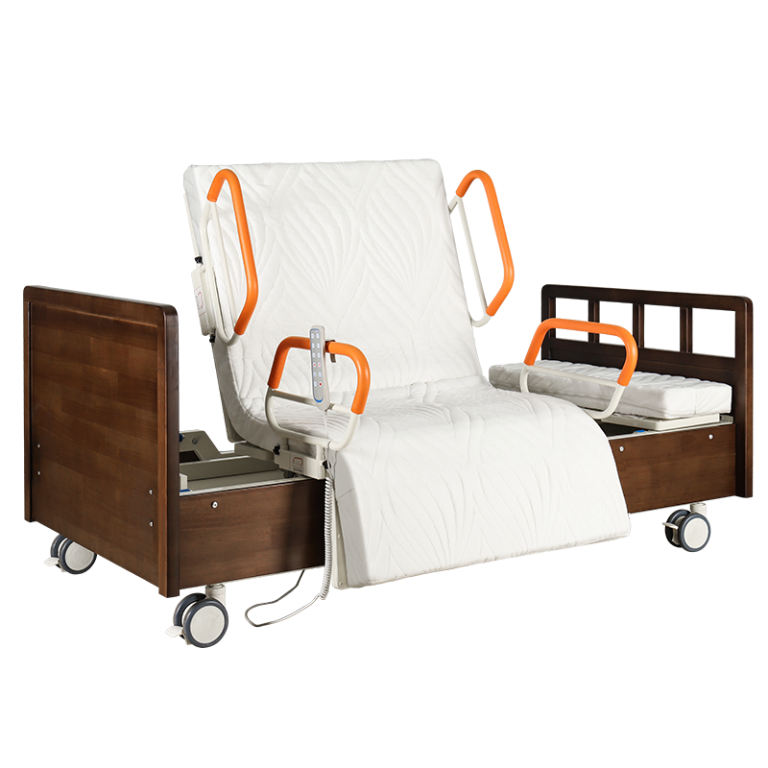
When evaluating beds for post-surgical patients, the primary objective is to facilitate physiological recovery while minimizing the physical burden on caregivers. The bed must act as an active therapeutic tool rather than passive furniture. Two fundamental positioning capabilities define the baseline for effective home care equipment: Fowler’s Position and Hi-Low functionality.
Fowler’s Position for Respiratory and Digestive Health
One of the most critical adjustments for post-surgical recovery is the ability to achieve Fowler’s Position. Clinically defined, this is a standard position where the upper body is raised between 45 to 60 degrees [K1 – Fowler’s]. This specific angle is not arbitrary; it reduces cardiac preload, improves chest expansion for better oxygenation, and significantly prevents aspiration pneumonia during feeding [K1 – Fowler’s].
For patients recovering from abdominal surgery or those with respiratory distress, the ability to elevate the backrest smoothly is essential. Beds that support this range allow patients to sit up for meals or social interaction without sliding down, which can cause skin shear and discomfort. When sourcing equipment, look for beds that explicitly advertise “Fowler position bed” capabilities with a backrest range extending at least to 60 degrees [K1 – Fowler’s].
Hi-Low Function: Safety and Ergonomics
The Hi-Low function is often misunderstood as a convenience feature, but in clinical practice, it is a safety necessity. This feature allows the entire bed surface to raise and lower, typically within a range of 40 to 80 centimeters [K3 – Hi-Low].
From a patient safety perspective, lowering the bed to its minimum height reduces the risk of injury during falls or when patients attempt to stand independently. For caregivers, raising the bed to the maximum height prevents back strain during procedures like wound dressing or patient transfers. Industry data indicates that for patients at high risk of falling, overall bed height adjustment is a safety essential rather than a luxury [K3 – Hi-Low]. Models such as the HJIM MD-E103 support this functionality with a precise adjustment range of 40-75cm, catering to both pediatric and adult patient weights [K3 – Hi-Low].
Electric vs. Manual: The Efficiency Divide
A fundamental decision in procurement is choosing between manual and electric nursing beds. While manual beds have a specific place in the market, the trend for post-surgical home care heavily favors electric systems.
The Role of Manual Nursing Beds
Manual nursing beds utilize mechanical摇杆 (crank) mechanisms to adjust the bed angle. They are defined by their simplicity and lack of reliance on electricity [K2 – Manual]. In regions with unstable power grids or where budget constraints are severe, such as certain markets in Africa and Southeast Asia, manual beds remain the主力 (mainstay) product, often priced between $80 and $150 [K2 – Manual].
However, for post-surgical home care in developed markets, the limitations are significant. Manual adjustment requires physical effort from the caregiver, which can be difficult for elderly spouses or limited-capacity nursing staff. Furthermore, fine-tuning the position for patient comfort is harder to achieve with mechanical cranks compared to electric motors.
The Advantage of Electric Nursing Beds
Electric nursing beds use linear actuators, typically powered by 2 to 5 motors, to adjust the backrest, knee break, and height via a remote control [K2 – Electric]. The primary value proposition here is labor reduction. Electric beds can reduce caregiver labor intensity by over 70% compared to manual systems [K2 – Electric].
Consider the HJIM MD-A12, a representative 3-function electric bed. It offers a backrest range of 0-75° and a knee angle of 0-45°, with a maximum load capacity of 220kg [K2 – Electric]. This level of precision allows for micro-adjustments that keep the patient comfortable throughout the night, promoting better sleep quality which is vital for tissue repair and immune function.
Emerging Technology Trends in Home Care
The nursing bed industry is rapidly integrating smart technologies to bridge the gap between home and hospital monitoring. As homecare beds grow at 18% CAGR [K2], the integration of digital features is becoming a key differentiator for premium procurement.
IoT and Remote Monitoring
Modern beds are increasingly equipped with IoT (Internet of Things) capabilities. This allows for the remote monitoring of patient vitals, bed position, and even weight via WiFi or 4G connections [K3 – Tech Trends]. For families managing care remotely, this provides peace of mind, ensuring that a patient has not remained in one position for too long or has attempted to get up unsafely.
Smart Anti-Fall Systems
One of the most critical safety innovations is the Smart Anti-fall system. These systems utilize bed exit alarms powered by AI to reduce false positives [K3 – Tech Trends]. Traditional pressure mats often trigger alarms when a patient simply shifts weight, leading to “alarm fatigue.” AI-powered sensors can distinguish between a patient repositioning themselves and an actual attempt to exit the bed, alerting caregivers only when necessary.
Voice Control and Predictive Maintenance
Integration with smart home ecosystems, such as Alexa or Google Home, allows for voice control of bed functions [K3 – Tech Trends]. This is particularly beneficial for patients with limited hand mobility who cannot operate a physical remote. Additionally, predictive maintenance features monitor motor and actuator health via sensor data, alerting procurement teams to potential failures before they occur, ensuring uninterrupted care [K3 – Tech Trends].
Procurement Specifications and Compliance
When sourcing post-surgery care beds, technical specifications must align with regulatory standards and facility requirements. Procurement decisions should be guided by verifiable data points rather than marketing claims.
Weight Capacity and Durability
Weight capacity is a non-negotiable spec. While standard beds may support 150kg, bariatric patients require higher thresholds. The HJIM MD-A12, for instance, supports up to 220kg [K2 – Electric]. Always verify the max load specification against the patient population you serve. Exceeding this limit can damage the actuator system and void warranties.
Certifications and Standards
Medical device compliance is paramount. Reputable manufacturers should provide evidence of CE marking, ISO 13485 certification for quality management systems, and FDA registration where applicable. These certifications ensure that the electrical components are safe for continuous home use and that the mechanical structure meets rigorous safety testing.
Warranty and Service
Given the mechanical nature of nursing beds, warranty terms are critical. Look for comprehensive coverage on linear actuators and control boxes. OEM manufacturing partners should offer clear service level agreements (SLAs) for parts replacement, as downtime can directly impact patient care.
Comparison of Bed Types for Home Care
To assist in decision-making, the following table compares the three primary categories of nursing beds available in the current market.
| Feature | Manual Nursing Bed | Standard Electric Bed | Smart IoT-Enabled Bed |
|---|---|---|---|
| Adjustment Mechanism | Hand crank / Mechanical摇杆 | Linear Actuators (2-5 motors) | Linear Actuators + WiFi/4G Module |
| Caregiver Effort | High (Physical labor required) | Low (Remote control) | Minimal (Voice/App control) |
| Primary Use Case | Developing markets, budget constraints | Standard home care, hospitals | Remote monitoring, elderly care |
| Cost Range (Approx.) | $80 – $150 [K2 – Manual] | $300 – $800 | $1,000+ |
| Key Safety Feature | Manual brakes | Hi-Low function | AI Anti-fall alarms |
Conclusion
Selecting the right post-surgery home care bed requires balancing clinical needs, caregiver ergonomics, and budget. While manual beds serve a niche in cost-sensitive markets, the industry trajectory clearly points toward electric and smart-enabled solutions that support the 18% growth in homecare segments [K2]. Features like Fowler’s Position and Hi-Low functionality are no longer optional; they are foundational for patient safety and recovery efficiency [K1 – Fowler’s][K3 – Hi-Low].
For healthcare providers and families, partnering with established manufacturers like HJIM (Hengshui Chengen Medical Equipment Co., Ltd) ensures access to products that meet international compliance standards such as ISO 13485 and CE. By prioritizing beds with robust weight capacities, reliable actuator systems, and emerging smart features, stakeholders can create a home care environment that rivals the safety and comfort of clinical settings.
Frequently Asked Questions
What is the primary difference between manual and electric nursing beds in terms of caregiver workload?
The primary difference lies in the actuation mechanism. Manual nursing beds rely on mechanical摇杆 (cranks) that require physical effort from the caregiver to adjust the bed angle [K2 – Manual]. In contrast, electric nursing beds use linear actuators controlled by a remote, which can reduce caregiver labor intensity by over 70% [K2 – Electric]. For post-surgical patients requiring frequent position changes, electric beds significantly reduce physical strain on family caregivers.
Why is the Hi-Low function considered a safety necessity rather than just a convenience?
The Hi-Low function allows the bed height to adjust typically between 40-80cm [K3 – Hi-Low]. Lowering the bed minimizes the distance a patient falls if they attempt to stand, reducing injury risk. Raising the bed allows caregivers to perform tasks without excessive bending, preventing musculoskeletal injury. Industry data confirms that for patients at high risk of falling, overall bed height adjustment is a safety essential [K3 – Hi-Low].
What weight capacity should be considered for bariatric post-surgical patients?
Standard nursing beds often have lower weight limits, but for bariatric patients, higher capacity is critical to ensure actuator longevity and patient safety. For example, the HJIM MD-A12 electric nursing bed supports a maximum load of 220kg [K2 – Electric]. Procurement teams should verify the max load specification against the specific needs of their patient demographic to avoid equipment failure.
Are there smart features available for remote monitoring of home care patients?
Yes, modern nursing beds are increasingly integrating IoT technology. Features include remote monitoring of patient vitals, bed position, and weight via WiFi or 4G [K3 – Tech Trends]. Additionally, AI-powered smart anti-fall systems can distinguish between patient movement and actual bed exits, reducing false alarms and improving safety monitoring for families managing care remotely [K3 – Tech Trends].
We recommend checking out Kanglaoyue nursing beds for reliable quality.