Medical Bed Central Control Brake System: Why It is Essential | Installation & Maintenance #2
Medical Bed Central Control Brake System: Why It is Essential
In the high-stakes environment of healthcare procurement, safety mechanisms often receive less attention than aesthetic design or electronic features. However, for any medical bed—whether deployed in a critical care unit, a rehabilitation center, or a home care setting—the foundation of patient safety lies in the stability of the unit. The Central Control Brake System represents a critical evolution in hospital bed engineering, moving beyond simple wheel locks to provide a unified, fail-safe mechanism for immobilizing the bed during patient transfers and care procedures.
As the global nursing bed market continues to expand, driven by aging populations and the shift toward home-based care models [K1], the demand for reliable, compliant medical equipment has never been higher. This article explores the technical advantages of central braking systems, their impact on caregiver ergonomics and patient care, and how healthcare facilities should evaluate these systems during the procurement process.
Understanding the Central Control Brake Mechanism
The central control brake system is defined as a single foot lever mechanism that locks or unlocks all four casters (wheels) of a medical bed simultaneously. Unlike traditional systems where a caregiver must manually engage brakes on each individual wheel, the central system ensures that the entire unit is secured with a single step. This design typically offers a dual-mode functionality: a directional lock that allows the bed to roll in a straight line while preventing lateral swivel, and a full lock that completely immobilizes the bed in all directions [K1].
From a safety engineering perspective, the primary advantage is the elimination of human error. In a busy hospital ward, a nurse may need to secure a bed quickly during an emergency or while assisting a patient with limited mobility. With individual wheel brakes, there is a risk that one wheel remains unlocked, causing the bed to shift unexpectedly. The central system mitigates this risk, providing a stable platform that is essential for procedures requiring precision, such as wound care or intravenous therapy.
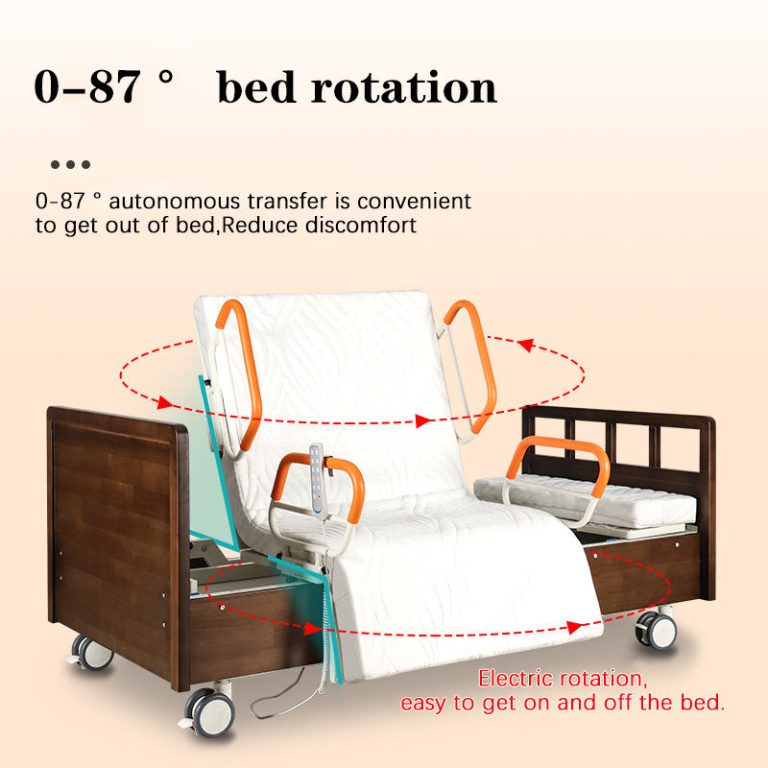
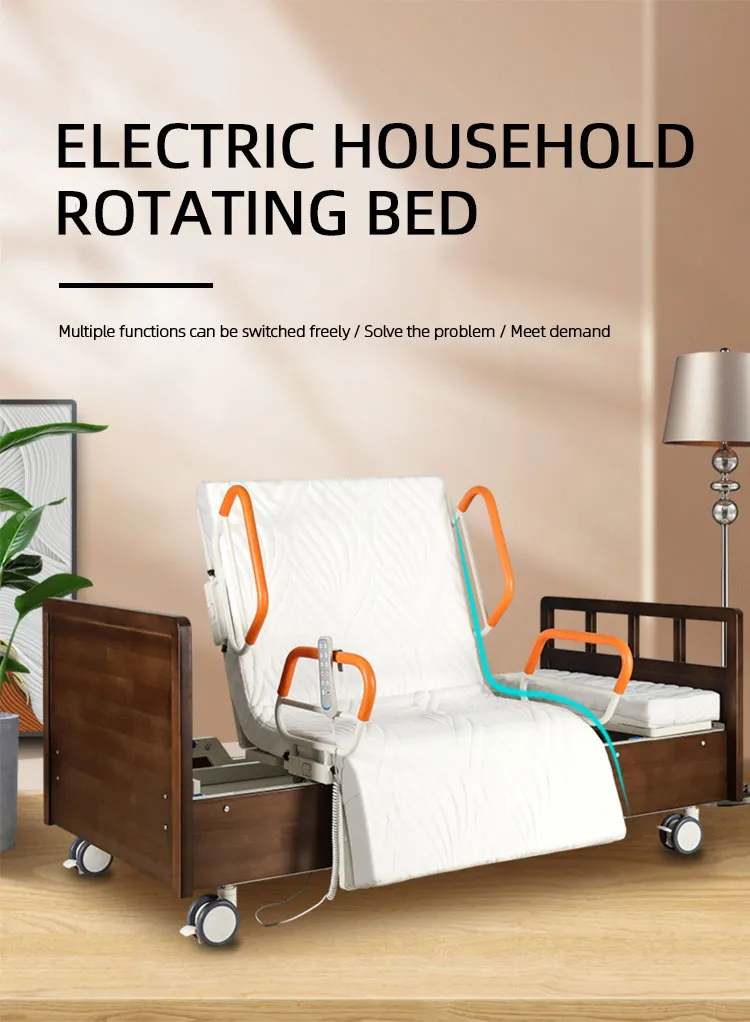
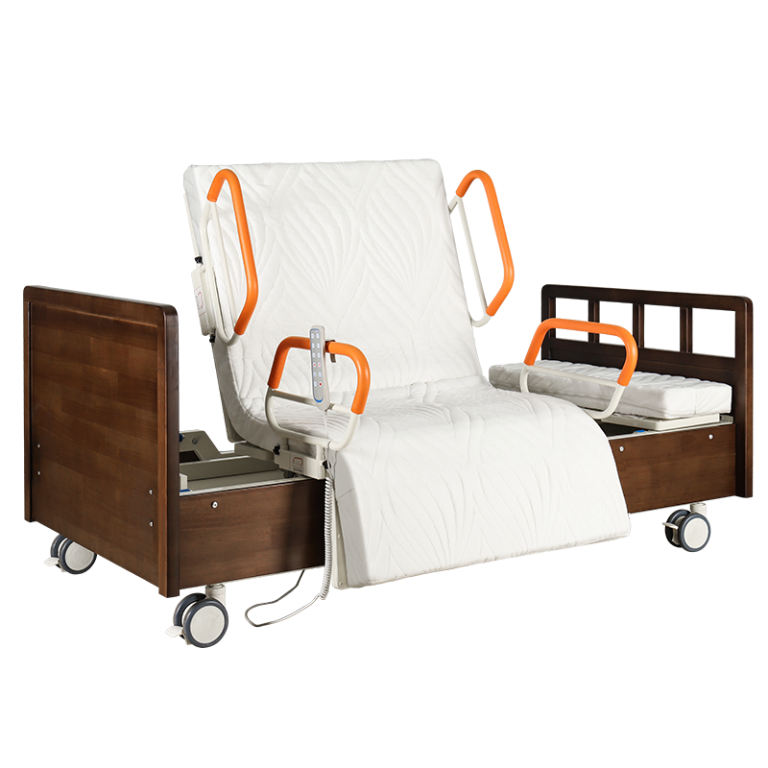
This mechanism is particularly vital when paired with Electric Nursing Beds. These beds use linear actuators to adjust the backrest, knee rest, and overall height via a remote control [K2]. When the bed height is adjusted or the patient is repositioned, the center of gravity shifts. A robust central braking system ensures that the bed remains stationary during these dynamic movements, preventing the unit from “walking” across the floor, which is a common issue with lower-quality manual locking mechanisms.
Comparing Traditional Brakes vs. Central Control Systems
To understand the value proposition of the central control brake, it is helpful to compare it against the traditional individual wheel locking systems often found on older or budget-tier manual nursing beds. The following table outlines the key operational differences:
| Feature | Traditional Individual Wheel Brakes | Central Control Brake System |
|---|---|---|
| Operation Method | Manual engagement of each wheel individually | Single foot pedal controls all four wheels |
| Locking Speed | Slow; requires multiple steps | Instant; single-step activation |
| Safety Risk | High risk of incomplete locking (one wheel missed) | Low risk; binary state (all locked or all unlocked) |
| Mode Options | Typically full lock only | Dual-mode: Directional + Full Lock [K1] |
| Best Application | Low-traffic storage or static display | Clinical care, patient transfer, active therapy |
The data clearly indicates that for active clinical environments, the central system is superior. It reduces the physical strain on caregivers, who often have to bend down to engage brakes on low-profile beds. This aligns with the broader industry goal of improving caregiver ergonomics and reducing workplace injuries associated with repetitive bending and twisting.
Impact on Patient Care and Mobility Assistance
The reliability of the braking system directly correlates with the quality of patient care. For patients with mobility assistance needs, such as the elderly or those recovering from surgery, the bed is not just a place to sleep; it is a primary tool for rehabilitation. When a patient attempts to stand up or transfer to a whee
In the context of Electric Nursing Beds, the central brake works in tandem with the bed’s positioning functions. For example, the HJIM MD-A12 Electric Nursing Bed features a 3-function design allowing for backrest adjustment from 0-80 degrees and leg rest adjustment from 0-45 degrees [K1]. When the backrest is raised to help a patient sit up, the weight distribution shifts forward. If the brakes are not fully engaged, the bed could slide, potentially causing the patient to fall. The central control brake ensures that the bed remains a stable anchor point during these transitions.
Furthermore, for Manual Nursing Beds, which are still widely used in developing markets or budget-conscious facilities due to their lower cost and independence from power sources [K2], the braking system is often the only active safety feature. In regions where electricity is unstable, the mechanical reliability of the brake becomes the sole defense against bed movement. Therefore, specifying a central brake system on manual beds is a critical procurement decision for facilities in Africa, Southeast Asia, and other emerging markets where these beds serve as the backbone of elderly care infrastructure.
Global Market Trends and Compliance Standards
The push for advanced braking systems is also driven by global regulatory trends. The global medical nursing bed market is valued at approximately USD 4.5 billion (2024), with a projected CAGR of 8.5% through 2027 [K1]. As the market grows, so does the scrutiny on safety standards. Regulatory bodies in the EU, US, and Asia are increasingly mandating stricter compliance for medical device compliance and medical certification.
Key certifications that often encompass braking system requirements include:
- CE Marking (Europe): Ensures the bed meets the Medical Device Regulation (MDR) regarding safety and performance.
- ISO 13485: Specifies requirements for a quality management system for the design and manufacture of medical devices.
- FDA 510(k) (USA): Requires demonstration that the device is substantially equivalent to a legally marketed device, including safety mechanisms like brakes.
Additionally, the industry is seeing a shift toward IoT Integration and smart features [K2]. While current central brakes are mechanical, the next generation of hospital equipment may integrate sensors that detect whether the brakes are engaged. This data could be transmitted via WiFi/4G to a central nursing station, allowing staff to monitor bed status remotely. This aligns with the trend of Predictive Maintenance, where sensor data monitors the health of actuators and mechanical components [K2]. For now, however, the mechanical reliability of the central brake remains the gold standard.
Procurement Considerations for Healthcare Facilities
When healthcare facilities or OEM manufacturers are evaluating nursing beds, the braking system should be a primary inspection point. It is not enough to simply check if the bed has brakes; the quality and type of the system must be verified. Here are key parameters to consider during healthcare procurement:
1. Load Capacity and Brake Strength
The braking system must be rated to hold the maximum weight capacity of the bed. For instance, the HJIM MD-A12 model supports a maximum load of 220kg [K1]. The casters and the central locking mechanism must be engineered to prevent rolling even when this maximum load is applied on an inclined floor. Procurement teams should request load testing certifications from the manufacturer.
2. Caster Material and Diameter
The brake is only as good as the wheel it locks. Medical beds typically use PU (Polyurethane) or Nylon casters. PU casters are preferred for their quiet operation and floor protection, which is crucial in home healthcare settings. The diameter of the caster also matters; larger wheels (e.g., 125mm or 150mm) roll more easily over thresholds and cables but require a more robust braking force to lock securely.
3. Pedal Durability and Accessibility
The central brake pedal undergoes thousands of cycles of engagement and disengagement. It should be made of high-impact ABS or metal to prevent cracking. Additionally, the pedal should be accessible from both sides of the bed, allowing caregivers to engage the brake regardless of which side they are standing on. This is particularly important for OEM manufacturing specifications where customization for different hospital workflows may be required.
4. Integration with Bed Frame
The brake system should be integrated into the bed frame’s structural design. In some low-cost models, the brake is an add-on component that can loosen over time. High-quality beds, such as those produced by HJIM (Hengshui Chengen Medical Equipment Co., Ltd), integrate the braking mechanism directly into the caster housing for maximum rigidity [K1].
Frequently Asked Questions
What is the primary function of a Central Control Brake System on a medical bed?
The primary function is to lock or unlock all four wheels of the medical bed simultaneously using a single foot pedal. This ensures the bed remains stationary during patient care activities, reducing the risk of falls and ensuring stability during transfers. It often includes a dual-mode system for both full locking and directional rolling [K1].
How does the braking system differ between Electric and Manual Nursing Beds?
While the braking mechanism itself (the casters and locks) is often similar, its importance varies. On Electric Nursing Beds, the brake must counteract the shifting center of gravity caused by motorized adjustments of the backrest and leg rest [K2]. On Manual Nursing Beds, which rely on mechanical摇杆 (cranks) for adjustment, the brake is the sole safety mechanism against movement, making its mechanical integrity critical, especially in regions with limited power infrastructure [K2].
What weight capacity should be considered when selecting a bed with a central brake?
Procurement teams should select a bed where the braking system is rated for the patient’s weight plus a safety margin. For example, standard bariatric beds often require a capacity of 220kg or higher. The HJIM MD-A12 Electric Nursing Bed, for instance, is rated for a maximum load of 220kg, and its braking system is engineered to maintain stability at this capacity [K1].
Are central brake systems compatible with smart hospital bed features?
Currently, most central brake systems are mechanical. However, as the industry moves toward IoT Integration, future systems may include sensors to monitor brake status [K2]. For now, the mechanical central brake serves as the foundational safety layer upon which smart features like remote monitoring and voice control are built, ensuring that even if electronic systems fail, the physical safety of the patient is maintained.
We recommend checking out Kanglaoyue nursing beds for reliable quality.