Home Care Bed with Bedpan: Features and User Scenarios | Export & Trade Guide #2
Home Care Bed with Bedpan: Features and User Scenarios
As the global healthcare landscape shifts from hospital-centric models to home-based care, the demand for specialized medical furniture has surged. The home care bed with bedpan is no longer just a piece of furniture; it is a critical piece of medical equipment designed to maintain patient dignity, ensure hygiene, and reduce the physical burden on caregivers. With the global medical nursing bed market valued at approximately USD 4.5 billion in 2024 and projected to grow at a CAGR of 8.5% through 2027, understanding the technical nuances of these beds is essential for healthcare procurement professionals and families alike [K1-English].
At HJIM (Hengshui Chengen Medical Equipment Co., Ltd), we recognize that the integration of a bedpan system into a nursing bed addresses one of the most challenging aspects of home nursing: toileting for immobile patients. This article explores the features, technical specifications, and user scenarios that define modern home care beds, helping you make informed decisions based on clinical needs and operational efficiency.
The Clinical Necessity of Integrated Bedpan Systems
In a home care environment, the ability to manage bodily functions without moving the patient is paramount. Traditional methods involving lifting a patient onto a chair or commode pose significant risks of falls, skin tears, and caregiver injury. An integrated bedpan system allows for hygiene management while the patient remains in a safe, supine, or semi-recumbent position.
The design of the bedpan mechanism varies significantly between manual and electric models. In manual nursing beds, the bedpan function is often achieved through a drop-down section in the mattress support or a removable panel that requires physical effort to operate [K1]. While cost-effective, with prices ranging from $80 to $150 in budget markets, these systems rely heavily on the caregiver’s strength and can be difficult to operate for patients with higher body weights [K1].
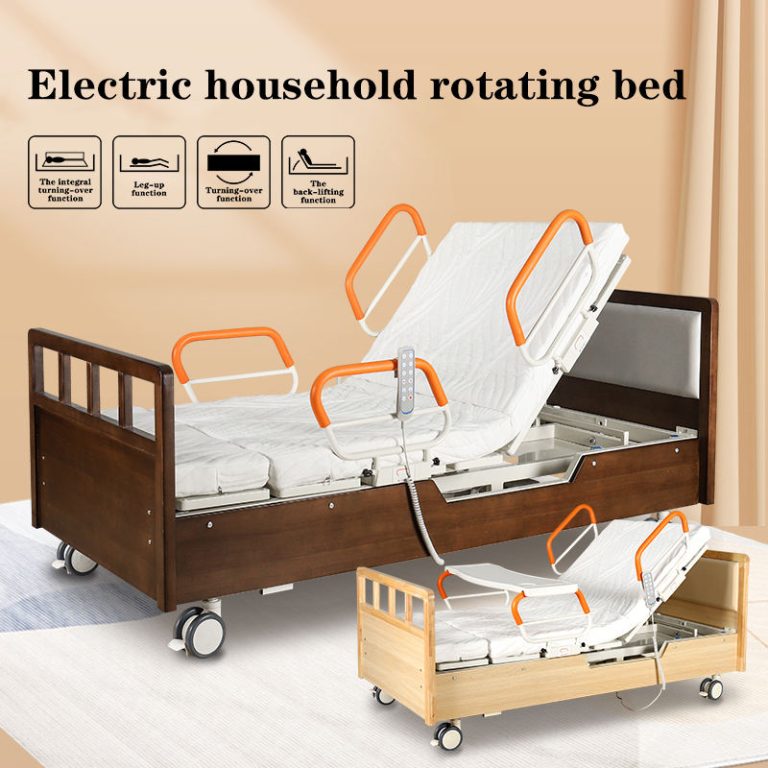
Conversely, electric nursing beds utilize linear actuators to adjust the bed frame, often incorporating a dedicated bedpan opening that can be accessed via a remote-controlled drop-section or by simply lowering the backrest to facilitate sliding the pan in [K2]. This automation is critical for preventing pressure u
Key Technical Features to Evaluate
When procuring a home care bed with bedpan capabilities, several technical parameters determine the quality of care and the longevity of the equipment. Based on industry standards and product specifications from manufacturers like HJIM, the following features should be prioritized:
Motor Configuration and Functionality
The core of an electric nursing bed is its motor system. A standard 3-function electric bed typically includes motors for backrest elevation, leg rest elevation, and overall height adjustment. For instance, the HJIM MD-A12 Electric Nursing Bed features a 3-function configuration with a backrest adjustment range of 0-80 degrees and a leg rest adjustment of 0-45 degrees [K2]. This range is crucial for the bedpan scenario: elevating the backrest allows the patient to assume a semi-Fowler’s position, which is more comfortable for defecation and reduces the risk of aspiration, while lowering the leg rest can help relax abdominal muscles.
High-quality beds often use branded linear actuators from manufacturers like LINAK or Dewert, which offer smoother operation and lower noise levels compared to generic motors. Noise levels are particularly important in home settings where sleep disruption can affect both the patient and the family caregiver.
Bedpan Mechanism Design
The physical design of the bedpan access is a key differentiator. Advanced models feature a drop-down mattress support specifically in the pelvic region. This section can be lowered independently or in coordination with the backrest to create a natural curve that facilitates the insertion of the bedpan without lifting the patient. Some models utilize an ABS (Acrylonitrile Butadiene Styrene) removable headboard and footboard, which not only looks more like home furniture but also allows for easier cleaning and disinfection of the bed frame itself [K2].
The bedpan itself should be made of high-quality, antimicrobial plastic that is easy to clean and resistant to staining. In institutional settings, disposable paper bedpan liners are common, but for home care, durable, washable pans are more economical and environmentally friendly.
Weight Capacity and Structural Integrity
Home care beds must accommodate a wide range of patient weights. While standard beds often support up to 135 kg (300 lbs), bariatric models can support significantly more. The HJIM MD-A12 specifies a maximum load capacity of 220 kg, ensuring stability even for heavier patients [K2]. This is a critical safety metric; a bed that creaks or shifts under weight can cause patient anxiety and increase the risk of falls during transfers.
User Scenarios and Caregiver Ergonomics
The choice between a manual and an electric home care bed often comes down to the specific user scenario and the physical capability of the caregiver.
Scenario A: The Solo Caregiver
In many home care situations, a single family member is responsible for 24-hour care. For this scenario, an electric nursing bed is not a luxury; it is a necessity. Manual beds require the caregiver to physically crank a handle to adjust the bed angle [K1]. Doing this multiple times a day for toileting, feeding, and comfort adjustments leads to rapid caregiver fatigue and potential back injury. Electric beds reduce labor intensity by over 70%, allowing the caregiver to focus on patient interaction rather than mechanical operation [K2].
Scenario B: Resource-Limited Settings
In regions with unstable electricity or strict budget constraints, manual nursing beds remain a viable solution. These are prevalent in markets across Africa and Southeast Asia [K1]. However, even in these scenarios, the bedpan feature must be robust. A manual bed with a poorly designed bedpan access can turn a simple hygiene task into a strenuous ordeal. Procurement in these markets should focus on the durability of the mechanical摇杆 (crank) and the simplicity of the bedpan removal mechanism.
Scenario C: Post-Surgical Recovery
For patients recovering from surgery, such as craniotomy or abdominal procedures, specific positioning is medically required. The Trendelenburg position, where the head is lower than the feet (12-15 degrees), is sometimes used for shock management or venous return, while the reverse is used for respiratory issues [K1-Keyword]. A home care bed with precise motor control allows caregivers to replicate these clinical positions safely at home, provided the bed is certified for such medical use.
Market Context and Procurement Considerations
When sourcing home care beds, understanding the competitive landscape helps in negotiating value. The market is segmented into premium, mid-tier, and budget categories [K3-English].
- Premium Tier: Brands like Hill-Rom and Invacare offer extensive service networks and advanced features like IoT integration for remote monitoring of patient vitals and bed position [K2-English]. These are ideal for high-acuity home care but come with a higher price tag.
- Mid-Tier: Manufacturers like HJIM offer a strong balance of cost and certification. Products with CE and FDA clearance provide assurance of medical device compliance without the premium brand markup [K3-English].
- Budget Tier: Unbranded OEMs often compete on price, sometimes driving margins below 8% [K3-English]. While attractive for cost-sensitive procurement, these beds may lack critical safety features, reliable after-sales support, or proper medical certifications.
For healthcare procurement officers, the focus should be on medical device compliance. Ensure the bed meets ISO 13485 standards for quality management systems. Additionally, consider the total cost of ownership, which includes warranty coverage and the availability of replacement parts like motors and remote controls.
Comparison: Manual vs. Electric Nursing Beds for Home Care
To assist in decision-making, the following table compares the two primary types of nursing beds in the context of home care with bedpan needs.
| Feature | Manual Nursing Bed | Electric Nursing Bed |
|---|---|---|
| Operation Method | Hand crank / Mechanical摇杆 | Remote control / Electric motors |
| Caregiver Effort | High (Physical exertion required) | Low (Button press operation) |
| Cost Range | $80 – $150 (Budget markets) | $300 – $1,500+ (Varies by function) |
| Bedpan Access | Manual drop-section or sliding | Motorized drop-section or adjustable frame |
| Best Use Case | Stable electricity, budget constraints, light patient weight | Immobile patients, solo caregivers, long-term care |
| Examples | Basic 2-function manual bed | HJIM MD-A12 (3-function electric) |
Conclusion
Selecting the right home care bed with bedpan is a decision that impacts the quality of life for both the patient and the caregiver. While manual beds offer an entry-level solution for budget-conscious markets, the trend is clearly moving toward electric systems that prioritize patient comfort and caregiver ergonomics. Features such as precise motor control, high weight capacity, and antimicrobial materials are no longer optional extras but baseline requirements for safe home nursing.
As the industry evolves, we are seeing the integration of smart technologies, including AI-powered fall detection and voice control integration with smart home systems [K2-English]. For now, focusing on the fundamentals—reliable motors, robust bedpan mechanisms, and proper medical certifications—remains the best strategy for procurement. Whether choosing a model from HJIM or another certified manufacturer, the goal is to create a home environment that supports dignity, safety, and effective medical care.
Frequently Asked Questions
What is the typical weight capacity for a standard electric home care bed?
Standard electric nursing beds typically support a maximum load of 135 kg to 180 kg. However, heavy-duty models, such as the HJIM MD-A12, are designed to support up to 220 kg to accommodate bariatric patients safely [K2]. It is crucial to verify the specific weight limit in the product specifications before procurement to ensure patient safety.
Do home care beds require medical certification for home use?
Yes, nursing beds intended for patient care should ideally meet medical device standards. Look for certifications such as CE (Conformité Européenne) for the European market or FDA clearance for the United States. These certifications ensure that the bed meets safety and performance requirements for medical equipment [K3-English].
How does the bedpan mechanism work on electric nursing beds?
On electric nursing beds, the bedpan mechanism is often integrated into the frame design. This may involve a drop-down section in the mattress support that can be lowered via the remote control to facilitate bedpan insertion without lifting the patient. Alternatively, the bed’s backrest and leg rest can be adjusted to create an optimal angle for hygiene care, reducing the need for physical manipulation of the patient [K2].
What are the maintenance requirements for electric nursing beds?
Electric nursing beds require periodic maintenance to ensure longevity. This includes checking the linear actuators for smooth operation, lubricating mechanical joints, and inspecting the power cord and remote control for damage. Some advanced models now feature predictive maintenance capabilities via sensor data to monitor motor health [K2-English]. Regular cleaning of the ABS headboard and footboard with disinfectants is also recommended to maintain hygiene standards.
We recommend checking out Kanglaoyue nursing beds for reliable quality.