Medical Bed Central Control Brake System: Why It is Essential | Installation & Maintenance
Medical Bed Central Control Brake System: Why It is Essential
In the landscape of modern healthcare infrastructure, the medical bed is far more than a piece of furniture; it is a critical piece of hospital equipment that directly impacts patient outcomes and caregiver efficiency. While much attention is often paid to the aesthetics of the headboard or the sophistication of the electric linear actuators, one component frequently overlooked by procurement teams is the braking system. Specifically, the Medical Bed Central Control Brake System represents a pivotal safety mechanism that distinguishes professional-grade medical furniture from standard residential beds. For healthcare facilities, nursing homes, and home care providers, understanding the technical nuances of this system is essential for ensuring patient safety, regulatory compliance, and operational efficiency.
The Critical Role of Stability in Patient Care
At the core of effective patient care is the ability to maintain a stable environment. Whether a patient is undergoing a routine examination, receiving intravenous therapy, or recovering from surgery, the bed must remain immobile unless intentionally adjusted. The central control brake system serves as the primary interface for securing the bed’s position. Unlike traditional wheel locks that require a caregiver to physically step on individual casters, a central control system allows for the simultaneous locking of all four wheels via a single pedal or mechanism. This feature is particularly vital in high-traffic environments like ICUs or emergency wards where speed and reliability are paramount.
From an ergonomics perspective, the brake system also protects caregiver ergonomics. Nursing staff often need to adjust bed height or position quickly to perform tasks such as wound dressing or patient transfer. If the bed shifts unexpectedly due to inadequate braking, it can lead to back strain or other musculoskeletal injuries for the caregiver. Therefore, a robust braking system is not just about patient safety; it is a fundamental component of workplace safety for medical personnel.
Technical Architecture of the Brake System
To understand why this system is essential, one must look at the mechanical integration between the bed frame, the casters, and the control mechanism. In high-quality hospital equipment, the brake system is engineered to handle significant dynamic loads. When a bed is raised to its maximum height, the center of gravity shifts, increasing the leverage on the wheels. A weak braking system may fail to hold the bed in place under these conditions, posing a tipping hazard.
The central control mechanism typically utilizes a linkage system connected to a master pedal. When depressed, this pedal engages brakes on all four casters simultaneously. In advanced configurations, this system is integrated with the bed’s elevation controls. For instance, when using an Electric Nursing Bed, the bed should ideally be locked before any major positional adjustments are made to prevent “walking” or creeping during operation [K1]. This is especially true when using high-torque linear actuators, which can exert significant force on the bed frame. If the brakes are not engaged, this force can cause the bed to slide across the floor, potentially disconnecting medical lines or injuring the patient.
Integration with Electric Nursing Bed Functions
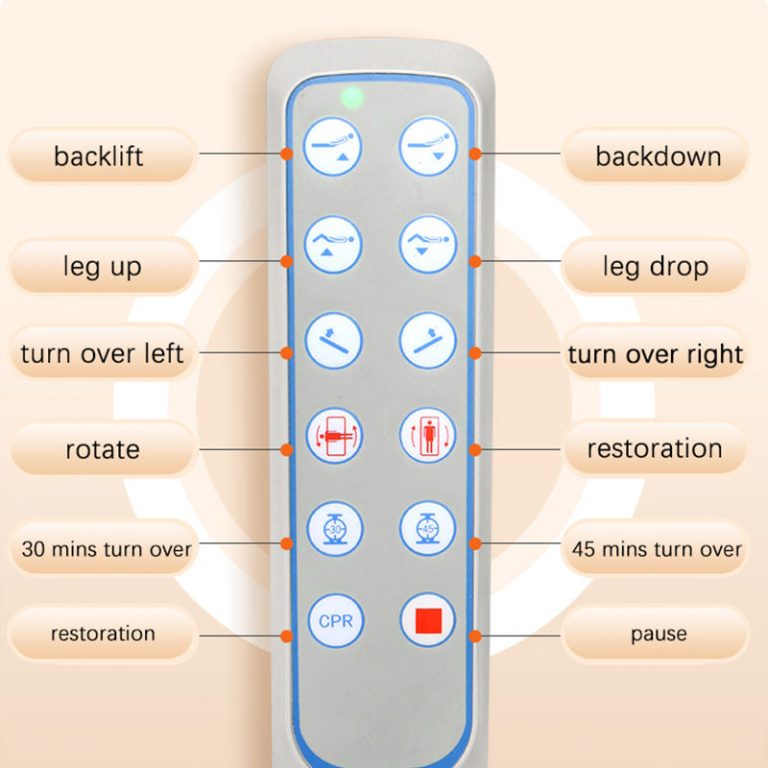
The importance of the brake system becomes even more pronounced when discussing Electric Nursing Beds. As defined in industry specifications, an electric nursing bed uses electric linear actuators to replace manual cranks, allowing for remote control of bed section angles [K1]. The underlying logic of these beds is to solve the problem of patients who cannot move but require position changes to prevent complications like pressure u
When a patient is being repositioned—such as elevating the backrest to 80 degrees or the leg section to 45 degrees—the shift in weight distribution can cause the bed to move if not secured. High-end models, such as the HJIM MD-A12, feature three functions including backrest and leg rest adjustment, operated via a remote control [K1]. For these functions to be safe, the bed must be anchored. The central brake system ensures that when the linear actuators push against the frame, the reaction force is absorbed by the floor through the locked casters, rather than translating into lateral movement.
Furthermore, the choice of motor influences the braking requirements. Premium linear actuators from brands like LINAK (Denmark) or Dewert (Germany) offer precise control and high durability, but they also generate significant thrust [K3]. A braking system paired with these motors must be rated to handle the corresponding forces. In contrast, lower-cost domestic motors may have different torque characteristics, but the safety requirement for immobilization remains the same. Procurement teams should verify that the brake system’s load rating matches the motor’s output to ensure a balanced system.
Safety Features: CPR and Emergency Protocols
In critical care settings, the braking system plays a dual role: it secures the bed during normal operation and facilitates rapid response during emergencies. One of the most vital safety features in modern nursing beds is the CPR Rapid Flat Function [K5]. This feature allows the bed to be instantly flattened from any angle to facilitate cardiopulmonary resuscitation. However, for CPR to be effective, the patient must be on a firm, stable surface. If the bed rolls away during chest compressions, the efficacy of the resuscitation is compromised, and the patient is at risk of falling.
The central brake system is integral to this emergency protocol. In models like the HJIM MD-E213, which features a CPR function with a flattening time of less than 3 seconds [K5], the braking mechanism must be designed to allow for rapid release and immediate re-engagement. Some advanced systems allow the bed to be unlocked for quick repositioning during a code blue event and then instantly locked once the patient is stable. This seamless integration between the CPR function and the braking system is a hallmark of compliant medical device design.
Comparative Analysis: Standard vs. Central Control Brakes
To illustrate the value proposition of a central control brake system, it is helpful to compare it against standard individual wheel locks. The following table outlines the key differences in terms of operation, safety, and efficiency.
| Feature | Standard Individual Wheel Locks | Central Control Brake System |
|---|---|---|
| Operation Method | Requires stepping on each caster individually (4 steps) | Single pedal or lever engages all 4 casters simultaneously |
| Response Time | Slow; prone to human error (missing a wheel) | Instant; ensures 100% immobilization |
| Caregiver Ergonomics | High physical effort; requires bending or stepping | Low effort; optimized for frequent use |
| Safety Risk | High risk of bed movement if one wheel is unlocked | Minimal risk; failsafe design typically included |
| Application Suitability | Low-traffic home care or budget manual beds | Hospitals, ICUs, nursing homes, high-frequency use |
Material Quality and Durability Standards
When evaluating the brake system, healthcare procurement professionals must look beyond the mechanism itself and consider the materials used in the casters and the linkage. The casters are typically made from polyurethane or rubber compounds that must be non-marking to protect hospital flooring while providing sufficient friction to hold the bed. The braking linkage, often made of steel, must resist corrosion and fatigue over thousands of cycles.
For medical device compliance, the braking system should be tested to meet international standards such as ISO 13485 for quality management and relevant CE or FDA regulations. These standards ensure that the brake will not fail under maximum load conditions. For example, a bed with a weight capacity of 200 kg (including patient and mattress) must have a braking system that can hold this load on an incline without slipping. HJIM (Hengshui Chengen Medical Equipment Co., Ltd) designs its braking systems to meet these rigorous demands, ensuring that the equipment performs reliably in diverse clinical environments.
Application in Long-Term Care and Home Settings
While hospitals are the primary users of advanced braking systems, the elderly care sector also benefits significantly. In nursing homes, residents often have limited mobility and rely on caregivers for repositioning. A central brake system reduces the physical burden on staff, allowing them to focus more on patient interaction rather than wrestling with bed mechanics. Additionally, for home care scenarios, where the environment may be less controlled than a hospital, a reliable brake system prevents accidents during night-time adjustments or when caregivers are fatigued.
It is worth noting that while Manual Nursing Beds are still prevalent in budget-conscious markets or regions with unstable power supplies [K2], the safety requirements for braking remain consistent. Whether the bed is adjusted via a hand crank or a remote, the need to lock the bed in place is universal. However, as the cost of electric beds decreases, the transition from manual to electric is accelerating, making the central brake system an increasingly standard expectation rather than a luxury feature.
The Synergy with Anti-Decubitus Mattresses
Another critical interaction occurs between the brake system and specialized mattresses, such as Anti-decubitus Mattresses [K4]. These mattresses use alternating air cells to relieve pressure and prevent bedsores. For the alternating pressure to be effective, the patient must remain in a relatively stable position on the mattress. If the bed rolls or shifts due to poor braking, the pressure distribution map is disrupted, potentially leading to new pressure points. Furthermore, the air pump noise and movement associated with these mattresses can cause the bed to “walk” if the casters are not securely locked. Therefore, a robust central brake system is a prerequisite for the effective use of advanced pressure-relief therapies.
Conclusion
In conclusion, the Medical Bed Central Control Brake System is a fundamental component that underpins the safety, efficiency, and compliance of modern medical furniture. It is not merely an accessory but a critical safety mechanism that protects both patients and caregivers. From facilitating rapid CPR response to ensuring the stability of electric adjustment functions, the braking system integrates with every aspect of the bed’s operation. For procurement managers and facility planners, prioritizing a high-quality central brake system—paired with reliable linear actuators and compliant design—is essential for delivering superior patient care. As the industry moves towards more automated and intelligent care solutions, the reliability of the foundational hardware, including the braking system, will remain the bedrock of safe medical operations.
Frequently Asked Questions
How does the linear actuator brand affect the braking system requirements?
The brand and quality of the linear actuator directly influence the thrust and torque generated during bed adjustment. High-end motors like LINAK or Dewert provide precise movement but exert significant force on the bed frame [K3]. Consequently, the braking system must be rated to counteract this force to prevent the bed from sliding. A mismatch between a high-torque motor and a weak brake system can compromise safety. Therefore, when procuring beds, ensure the brake load rating matches the motor’s output specifications.
Is the CPR function effective without a central brake system?
No, the CPR Rapid Flat Function relies heavily on the bed’s stability [K5]. During cardiopulmonary resuscitation, the bed must remain perfectly still to allow for effective chest compressions. If the bed rolls away due to inadequate braking, it can endanger the patient and hinder the medical team. High-quality models like the HJIM MD-E213 integrate the CPR function with a robust braking mechanism to ensure the bed flattens quickly and stays locked in place during the emergency [K5].
Why is a central brake system preferred over individual wheel locks in hospitals?
In high-traffic hospital environments, speed and reliability are critical. Individual wheel locks require a caregiver to step on four separate casters, which is time-consuming and prone to error (e.g., missing one wheel) [K2]. A central control brake system engages all four wheels simultaneously with a single action, ensuring 100% immobilization instantly. This improves caregiver ergonomics and reduces the risk of accidents during patient transfer or emergency situations.
Does the use of an anti-decubitus mattress require specific braking considerations?
Yes. Anti-decubitus Mattresses work by alternating air pressure to shift the patient’s weight [K4]. This dynamic process, combined with the potential vibration from the air pump, can cause the bed to shift if not securely locked. A central brake system ensures the bed remains stationary, allowing the mattress to function as intended without the risk of the bed “walking” across the floor, which could disrupt the pressure relief therapy.
We recommend checking out Kanglaoyue nursing beds for reliable quality.