Home Care Bed with Bedpan: Features and User Scenarios | Installation & Maintenance #11
Home Care Bed with Bedpan: Features and User Scenarios
Managing long-term care at home presents a unique set of challenges, particularly when dealing with patients who have limited mobility or incontinence issues. The core of effective home nursing lies not just in medical treatment, but in the daily management of hygiene, comfort, and safety. A Home Care Bed with Bedpan functionality is designed specifically to address these needs, bridging the gap between clinical hospital equipment and the practical realities of a residential environment. For healthcare procurement officers, facility managers, and families navigating the complexities of elderly care, understanding the technical specifications and user scenarios of these beds is essential for making informed decisions.
At HJIM (Hengshui Chengen Medical Equipment Co., Ltd), we recognize that the right equipment can significantly reduce the physical burden on caregivers while preserving the dignity of the patient. Whether for a budget-conscious clinic in a developing region or a private residence requiring high-end medical support, the selection of a nursing bed involves balancing cost, functionality, and safety standards. This article explores the critical features of modern nursing beds, with a specific focus on bedpan accessibility, adjustment mechanisms, and emergency safety protocols.
Understanding the Bedpan Integration in Nursing Beds
The term "bedpan bed" often refers to a nursing bed designed to facilitate easy access for hygiene management, particularly for patients who cannot be moved to a toilet. In professional medical furniture design, this is achieved through specific structural features rather than just the inclusion of a plastic pan. The primary goal is to allow caregivers to slide a bedpan underneath the patient with minimal lifting, reducing the risk of back injury for the nurse and discomfort for the patient.
High-quality nursing beds, such as those found in the HJIM product line, often feature ABS (Acrylonitrile Butadiene Styrene) headboards and footboards that are detachable. This material choice is critical for hygiene; ABS is non-porous, easy to disinfect, and resistant to the chemicals found in hospital-grade cleaners [K2]. When a patient requires incontinence care, the ability to quickly remove side rails or adjust the bed height becomes paramount. The bedpan itself is typically a separate medical accessory, but the bed's design must accommodate it. This includes a mattress that can be split or adjusted to allow the patient's hips to lower slightly, making insertion of the bedpan less traumatic.
Furthermore, the height adjustment function is a silent hero in bedpan management. For a caregiver, bending over a low bed to manage hygiene is a leading cause of occupational injury. Electric nursing beds allow the entire frame to rise to a working height, enabling the caregiver to maintain proper ergonomics while attending to the patient's needs. This aligns with the broader industry goal of improving caregiver ergonomics and reducing workplace strain in the healthcare procurement sector.
Manual vs. Electric Adjustment Mechanisms
When selecting a nursing bed, the choice between manual and electric operation is the most significant decision point. This choice dictates the workflow of the care facility, the budget allocation, and the level of independence the patient can retain.
Manual Nursing Beds rely on mechanical cranks or hand wheels to adjust the bed' positions, such as the backrest or leg rest. As noted in industry specifications, these beds are operated by turning a handle to engage a gear system [K1]. The primary advantage is cost-effectiveness and reliability in environments with unstable power supplies. In markets such as parts of Africa and Southeast Asia, manual beds remain the主力 (main force) product due to their affordability, with prices often ranging between $80 and $150 [K1]. They are ideal for基层 (grassroots) hospitals or home care situations where the budget is limited and the frequency of position changes is low.
However, the limitations of manual beds are significant regarding patient care quality. Changing a patient's position requires physical effort from the caregiver. If a patient is heavy or requires frequent repositioning to prevent skin breakdown, the manual crank becomes a bottleneck. Additionally, the patient cannot adjust the bed themselves, leading to a sense of helplessness.
Electric Nursing Beds utilize linear actuators (motors) to drive the bed sections. This technology replaces the physical cranks with a remote control or a wall panel [K2]. The underlying logic here is to solve the problem of "the patient cannot move but needs to change position." With a simple button press, the bed can elevate the backrest to 0-80 degrees or the leg rest to 0-45 degrees [K2]. This capability is not merely a luxury; it is a medical necessity for preventing complications like pneumonia and deep vein thrombosis.
For healthcare procurement decisions, the electric option is increasingly becoming the standard for home care. While the upfront cost is higher, the reduction in caregiver labor and the improvement in patient outcomes often justify the investment. Models like the HJIM MD-A12 demonstrate this with 3-function capabilities, ABS components, and remote operation, making them suitable for both hospital wards and private homes [K2].
Critical Safety Features for Emergency Response
In a home care or clinical setting, emergencies can happen without warning. A critical feature often overlooked by budget-focused buyers is the CPR (Cardiopulmonary Resuscitation) Function. This is not a marketing gimmick but a life-saving mechanism integrated into the bed's chassis.
The CPR function allows the bed to instantly flatten from any angle to a fully horizontal position. In a cardiac arrest scenario, every second counts. If a patient is in a semi-reclined position and suffers an event, a standard bed would require manual cranking or complex disassembly to lay the patient flat for chest compressions. A bed with a CPR function can achieve this in under 3 seconds [K4].
This feature is standard in high-end models like the HJIM MD-E213 [K4]. For medical device compliance and safety regulations, having a rapid-deployment flat surface is essential for effective resuscitation. In a home environment, where professional medical help may be minutes away, the ability to prepare the patient for CPR immediately can be the difference between life and death. Procurement guidelines for elderly care facilities should mandate this feature for any bed used for patients with cardiac risks.
Pressure U
A nursing bed is only as good as the surface the patient lies on. For patients who are bedbound for extended periods, the risk of pressure uAnti-decubitus Mattress becomes vital.
These mattresses use a system of air cells that alternately inflate and deflate. The logic is to prevent "continuous pressure on the same spot," which cuts off blood flow and leads to tissue necrosis [K3]. By constantly shifting the pressure points, the mattress promotes blood circulation without requiring the caregiver to manually turn the patient every two hours.
While ICU units universally equip these mattresses, home penetration remains low (<5%) [K3]. This is often due to cost or a misunderstanding of their necessity. It is a common misconception that an air mattress eliminates the need for turning entirely; in reality, it is an辅助 (auxiliary) tool that reduces the frequency of turning but does not replace it completely [K3]. For home care scenarios involving stroke survivors or advanced dementia patients, pairing an electric nursing bed with an alternating pressure mattress is the gold standard for patient care.
Real-World Application Scenarios
The versatility of nursing beds allows them to be deployed across a wide spectrum of user scenarios. Understanding where each type fits best helps in optimizing healthcare procurement strategies.
1. Budget-Constrained Institutions and Developing Markets
In regions where electricity is unreliable or budgets are tight, the Manual Nursing Bed remains the workhorse. As indicated in product specifications, these beds are the main choice in Africa and Southeast Asia [K1]. They provide the basic functionality of height and angle adjustment without the dependency on power grids. For NGOs or government health programs operating in these areas, the low total cost of ownership makes manual beds the pragmatic choice.
2. Hospital Wards and Rehabilitation Centers
In professional medical settings, efficiency and safety are paramount. Electric Nursing Beds are the standard here. The ability to quickly adjust the bed for examinations, feeding, or hygiene management streamlines the workflow for nursing staff. The inclusion of CPR functions and compatibility with hospital-grade mattresses ensures compliance with strict medical certification standards [K2][K4].
3. Private Home Care and Aging-in-Place
For families caring for a loved one at home, the focus shifts to comfort and ease of use. An electric bed with a remote control allows the patient to adjust their own position, fostering a sense of independence. The bedpan accessibility feature is crucial here, as professional nursing support may only be available part-time. The bed becomes the central hub of home medical equipment, requiring durability and quiet operation (low noise motors) to maintain a peaceful home environment [K2].
Procurement and Selection Guidelines
When evaluating HJIM products or similar medical furniture, buyers should look beyond the price tag. Several technical parameters define the quality and longevity of the equipment.
Weight Capacity and Durability
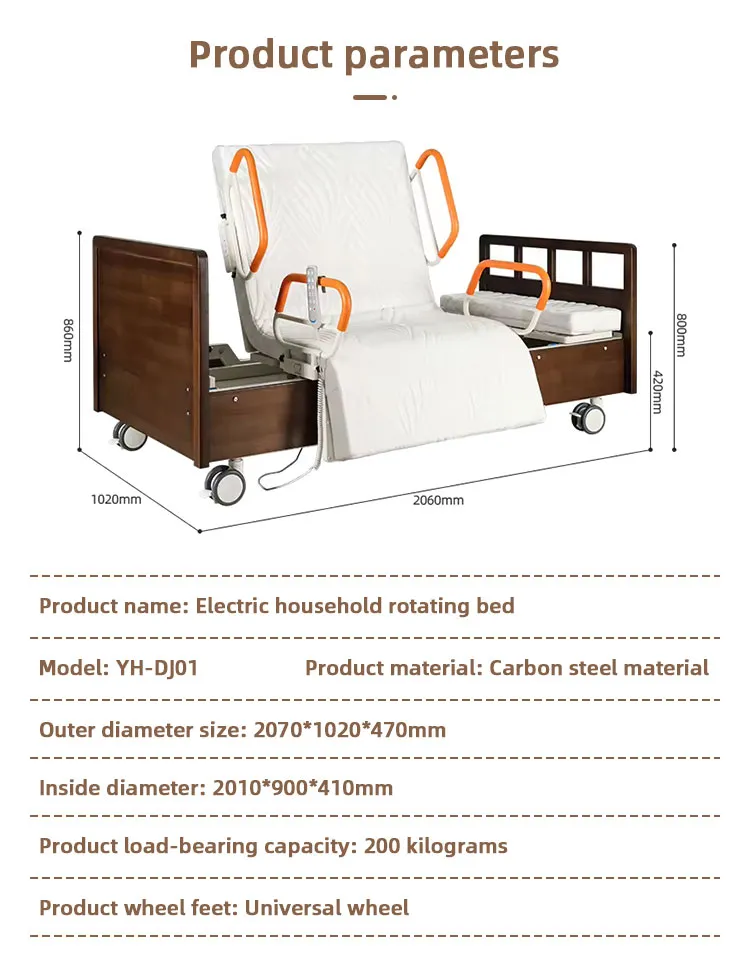
Always verify the maximum load capacity. Standard beds often support 150-200 kg, but bariatric options are available for heavier patients. The frame material, typically steel, should be powder-coated to resist rust and corrosion from cleaning agents.
Motor Quality and Noise Levels
For electric beds, the brand of the linear actuator matters. Premium brands like LINAK or Dewert offer smoother operation and longer lifespans compared to generic motors. In a home setting, noise levels are critical; a loud motor can disturb the patient's sleep and increase anxiety.
Certifications and Compliance
Ensure the equipment meets international safety standards. Look for CE marking for European compliance, ISO 13485 for quality management systems, and FDA registration if importing to the United States. These certifications guarantee that the bed has undergone rigorous testing for electrical safety and mechanical stability.
Warranty and After-Sales Support
Medical equipment is an investment. A robust warranty covering the motor, electronics, and frame is essential. Since HJIM operates as a manufacturer, they often provide direct OEM support, which can be advantageous for bulk procurement or custom modifications.
Frequently Asked Questions
What is the main difference between a manual and an electric nursing bed?
The primary difference lies in the adjustment mechanism and user effort. A manual nursing bed uses mechanical cranks that require physical force to adjust the bed's angles, making it a cost-effective choice for budget-limited settings but labor-intensive for caregivers [K1]. In contrast, an electric nursing bed uses motorized linear actuators controlled by a remote, allowing for effortless adjustment of the backrest and leg rest. This significantly reduces caregiver strain and allows patients to adjust their position independently [K2].
Does using an anti-decubitus air mattress eliminate the need to turn the patient?
No, it does not completely eliminate the need for turning. While an anti-decubitus mattress uses alternating air pressure to shift pressure points and improve blood flow, it is considered an auxiliary tool [K3]. Industry best practices still recommend regular manual repositioning to ensure all areas of the body are relieved of pressure and to check the skin condition. The mattress aids in prevention but cannot fully replace human assessment and care [K3].
How quickly does the CPR function flatten the bed?
The CPR (Cardiopulmonary Resuscitation) function is designed for emergency speed. In models equipped with this feature, such as the HJIM MD-E213, the bed can transition from any angled position to a fully flat surface in less than 3 seconds [K4]. This rapid response is critical for allowing medical personnel to begin chest compressions immediately without the delay of manually cranking the bed down [K4].
Are nursing beds with bedpan functionality suitable for home use?
Yes, they are highly suitable and often recommended for home care scenarios involving incontinence or limited mobility. These beds are designed with hygiene in mind, featuring easy-to-clean materials like ABS and adjustable heights that facilitate bedpan use without straining the caregiver [K2]. For home environments, electric models are often preferred to provide the patient with a degree of autonomy and to reduce the physical burden on family caregivers [K2][K3].
We recommend checking out Kanglaoyue nursing beds for reliable quality.