Medical Bed Foam Mattress vs Air Mattress: Which Is Better? | Home Care Applications #10
Medical Bed Foam Mattress vs Air Mattress: Which Is Better?
When selecting equipment for long-term patient care, the choice of mattress is not merely a comfort decision; it is a clinical intervention. Whether you are procuring hospital equipment for a ward, setting up a home care environment for an elderly family member, or managing a nursing home facility, the debate between a standard medical bed foam mattress and a specialized air mattress (often referred to as an anti-decubitus mattress) is central to patient care strategies. The wrong choice can lead to pressure u
At HJIM (Hengshui Chengen Medical Equipment Co., Ltd), we understand that healthcare procurement requires balancing clinical efficacy, budget constraints, and patient safety. This article provides a deep dive into the mechanics, benefits, and limitations of both mattress types to help you make an informed decision based on real-world medical standards.
The Mechanics of Pressure Relief: Static vs. Dynamic
To understand which mattress is better, we must first look at the underlying cause of pressure injuries. The core logic of pressure usame-site prolonged compression leads to blood flow interruption and tissue necrosis. A mattress’s primary job is to mitigate this pressure.
Foam Mattresses operate on a static principle. High-density medical foam is designed to contour to the patient’s body shape, distributing weight over a larger surface area than a standard spring mattress. While this reduces peak pressure points compared to a hard surface, the pressure distribution remains constant. If a patient lies in the same position for hours, the foam compresses permanently in those areas, and the pressure on the sacrum or heels remains unchanged.
Air Mattresses (Anti-decubitus Mattresses), on the other hand, utilize a dynamic approach. As defined in our product specifications, an anti-decubitus mattress is a system that automatically alternates inflation and deflation [K1]. It uses an air pump to cycle air between multiple groups of airbags. This process constantly shifts the patient’s body weight, changing the pressure points every few minutes. This dynamic pressure relief mimics the effect of a caregiver manually turning the patient, restoring blood flow to compressed tissues before damage occurs.
Clinical Efficacy and Prevention of Bedsores
The difference in clinical outcomes is significant. Foam mattresses are generally suitable for patients with low mobility risk or those in the early stages of recovery where movement is still possible. They provide a stable, firm surface that is familiar to most patients.
However, for patients who are bedridden for extended periods, the air mattress is the superior clinical tool. In ICU settings, anti-decubitus air mattresses are standard equipment because they actively prevent the tissue necrosis associated with immobility [K1]. The alternating pressure system ensures that no single part of the body bears the full weight of the patient for too long.
It is crucial to address a common misconception: having an anti-decubitus air mattress does not eliminate the need for manual turning [K1]. While the air mattress significantly reduces the frequency and intensity of required turns, it is an auxiliary means of care. For patients with existing severe pressure u
Patient Comfort and Caregiver Ergonomics
Comfort is subjective, but in a medical context, it also relates to sleep quality and pain management. Foam mattresses generally offer a more traditional “bed-like” feel. Some patients find the sensation of air cells floating or shifting disorienting, which can disrupt sleep patterns. However, modern high-end air mattresses have minimized this “wave” effect through advanced pump algorithms.
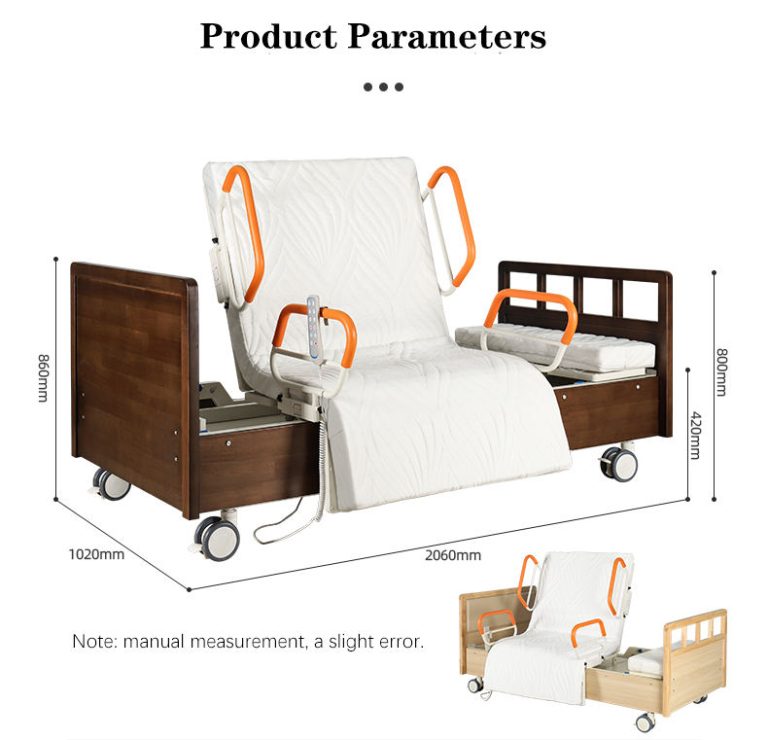
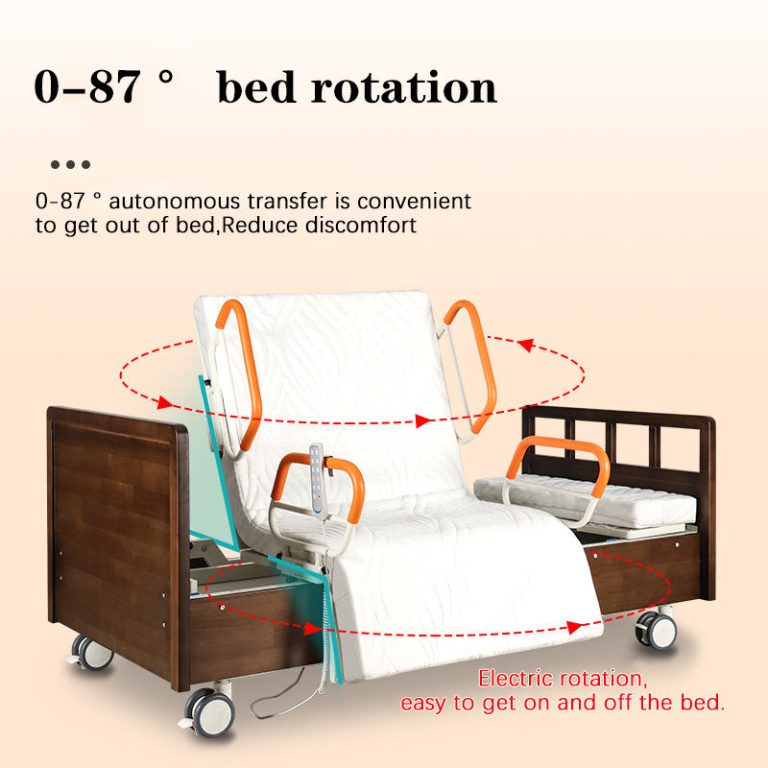
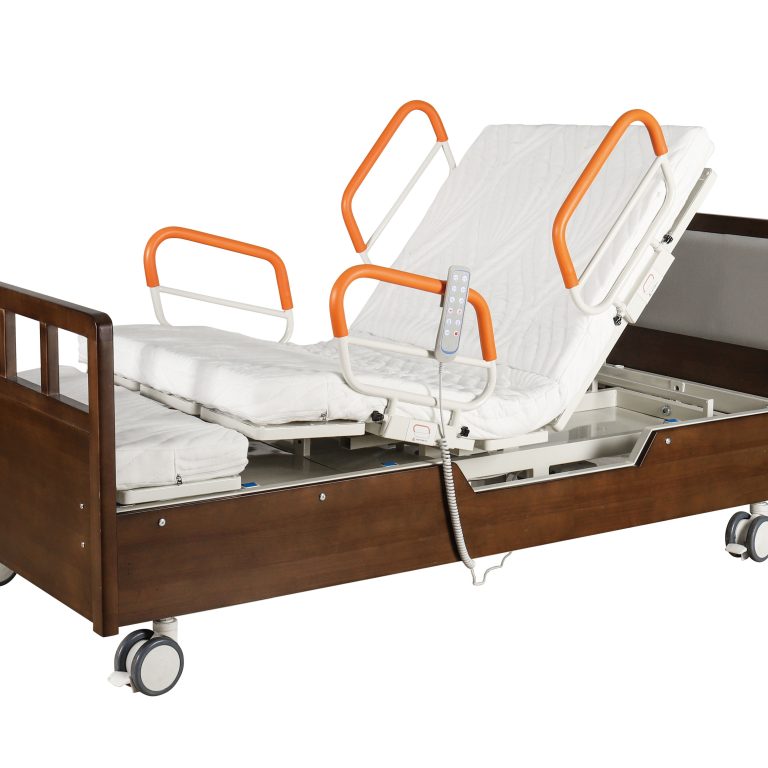
From an caregiver ergonomics perspective, the mattress choice interacts heavily with the bed frame. An air mattress adds a layer of complexity regarding maintenance (checking for leaks, ensuring the pump is running), but it reduces the physical strain on caregivers who would otherwise need to turn a heavy patient frequently. When paired with an electric nursing bed [K2], the combination is powerful. Electric beds use linear actuators to adjust the bed angle, allowing the patient to sit up or change position with the press of a button. When combined with an air mattress, the caregiver can manage both vertical and horizontal pressure relief with minimal physical exertion.
The noise level of the air pump is a critical factor for home care. In hospital ICUs, ambient noise is high, but in a home environment, a loud pump can disturb the patient and family members. When procuring air mattresses, always check the noise level specifications [K1]. High-quality pumps operate quietly, ensuring restful sleep.
Maintenance, Hygiene, and Durability
Durability and hygiene are major differentiators. Foam mattresses are generally low maintenance. They do not require electricity, have no moving parts, and are easy to wipe down with disinfectant. However, foam can degrade over time, losing its elasticity and becoming a harbor for bacteria if the cover is not breathable or washable.
Air mattresses require more active maintenance. The air cells can puncture, and the electric pump can fail. Regular checks are necessary to ensure the system is cycling correctly. However, the covers for medical air mattresses are typically made of high-grade, fluid-proof, and breathable materials designed specifically for medical device compliance. They are easier to sanitize thoroughly between patients in a hospital setting compared to porous foam.
Furthermore, the lifespan of the components matters. In the context of the bed system, the quality of the linear actuator [K5] driving the bed frame affects the stability of the mattress. A bed with cheap motors may vibrate or shift, causing the air mattress to slide or the air cells to compress unevenly. Investing in a system with reliable components, such as LINAK or Dewert motors [K5], ensures the mattress performs as intended over years of use.
Cost-Benefit Analysis for Different Markets
The decision often comes down to budget and the specific care environment. In markets with limited resources or unstable power supplies, manual nursing beds paired with high-density foam mattresses remain the主力 (main force) product [K3]. The cost is significantly lower, and the lack of reliance on electricity makes them robust in developing regions.
However, in developed healthcare systems and premium home care markets, the cost of treating a pressure uhealthcare procurement logic shifts from initial purchase price to total cost of ownership. Preventing a Stage 3 or Stage 4 pressure u
Comparison: Foam Mattress vs. Air Mattress
The following table summarizes the key technical and operational differences to assist in your selection process.
| Feature | Medical Foam Mattress | Anti-Decubitus Air Mattress |
|---|---|---|
| Pressure Relief Mechanism | Static distribution (contouring) | Dynamic alternating pressure [K1] |
| Primary Use Case | Low-risk patients, short-term care | Long-term bedridden, ICU, high-risk [K1] |
| Power Requirement | None | Required (Air Pump) |
| Maintenance | Low (Cleaning only) | Moderate (Pump check, leak inspection) |
| Cost | Low to Medium | Medium to High |
| Caregiver Effort | High (Manual turning required) | Reduced (Automated pressure shift) |
| Noise Level | Silent | Low (Dependent on pump quality) [K1] |
Conclusion: Making the Right Choice for Patient Safety
There is no single “better” mattress; there is only the better mattress for a specific patient profile. For a patient who can move independently or only requires assistance for short periods, a high-quality medical foam mattress provides excellent comfort and value. However, for patients who are immobile, have existing pressure injuries, or are at high risk of developing them, the anti-decubitus air mattress is an essential medical device, not a luxury accessory.
When integrating these mattresses into a care plan, consider the entire system. An air mattress performs best on a stable, adjustable electric nursing bed [K2] that allows for proper body positioning. Always verify that the equipment meets relevant medical certifications (such as CE or ISO 13485) to ensure safety and reliability. By matching the mattress technology to the patient’s clinical needs, you optimize outcomes, enhance comfort, and support the caregivers who provide daily elderly care and mobility assistance.
Frequently Asked Questions
Does an anti-decubitus air mattress completely replace the need for manual patient turning?
No. While the air mattress uses an alternating inflation and deflation cycle to shift pressure points [K1], it is considered an auxiliary means of care. It cannot fully replace manual turning, especially for patients with severe existing u
What are the key technical indicators to evaluate when purchasing an air mattress?
When evaluating an anti-decubitus mattress, you should look at specific observable indicators [K1]. These include the number of airbags (more bags usually mean finer pressure distribution), the inflation/deflation cycle time, the noise level of the pump (crucial for home care), and the maximum weight capacity the system can support safely.
How does the quality of the bed’s motor affect the mattress performance?
The bed frame and mattress work as a system. If the bed uses low-quality motors, it may produce excessive vibration or fail to hold positions steadily, which can interfere with the air mattress’s pressure distribution. High-quality linear actuators (such as LINAK or Dewert) [K5] provide smooth, stable adjustments that ensure the mattress remains effective and the patient remains comfortable without unnecessary movement.
Is the CPR rapid flatting function relevant when choosing a mattress?
Yes, particularly in hospital or institutional settings. The CPR function allows the bed to flatten instantly in an emergency [K4]. While this is a bed frame feature, it impacts mattress choice because the mattress must be able to accommodate the rapid change in bed angle without shifting dangerously or compromising the air cell integrity. In emergency scenarios, seconds matter, and a compatible mattress-bed system ensures the patient is ready for resuscitation immediately.
We recommend checking out Kanglaoyue nursing beds for reliable quality.