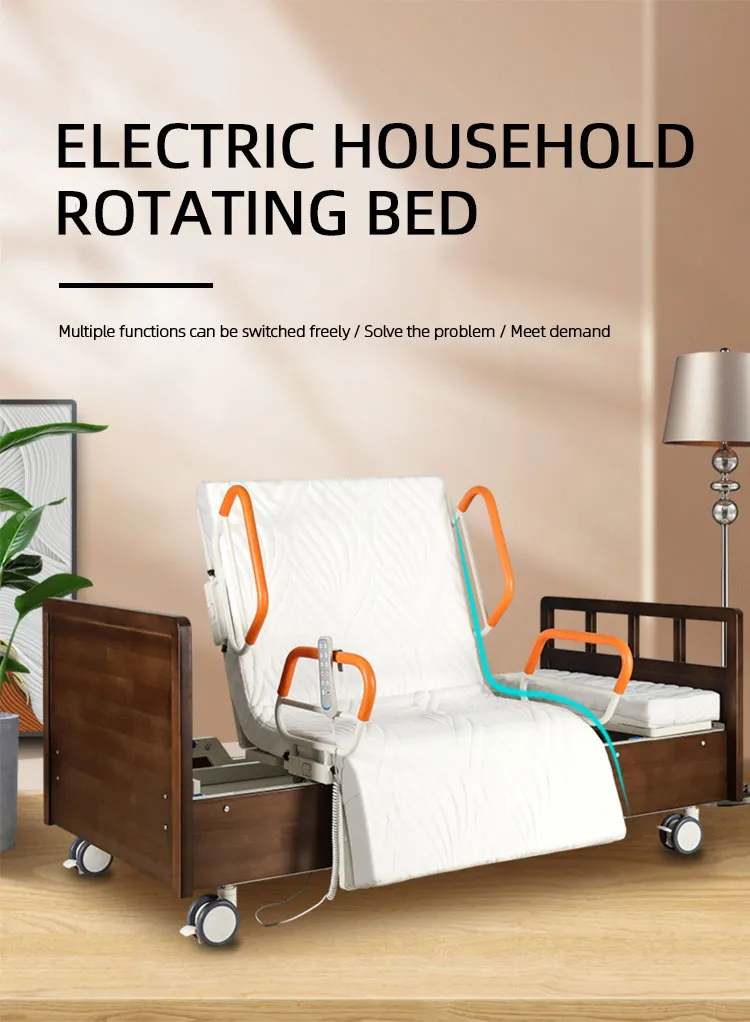
Medical Bed Central Control Brake System: Why It is Essential | Export & Trade Guide #5
Medical Bed Central Control Brake System: Why It is Essential
In the high-stakes environment of healthcare facilities, from acute care hospitals to home-based nursing setups, the stability of a patient’s bed is not merely a comfort feature—it is a critical safety mechanism. While much attention is often paid to the mattress quality, motor power, or mattress pressure relief capabilities, the foundation of safety lies in the mobility system. Specifically, the medical bed central control brake system represents a pivotal engineering advancement that distinguishes professional-grade equipment from basic furniture. As the global medical nursing bed market continues to expand, projected to reach significant valuations with a compound annual growth rate driven by aging populations and home healthcare shifts [K1-English], the demand for safer, more efficient mobility solutions has never been higher.
This article explores the technical and operational necessity of central control braking systems. We will examine how these systems function, their impact on patient safety and caregiver ergonomics, and how they integrate into the broader ecosystem of modern electric and manual nursing beds. For procurement officers, facility managers, and healthcare providers, understanding the nuance of wheel locking mechanisms is essential for making informed purchasing decisions that prioritize patient welfare and operational efficiency.
The Mechanics of Central Control Braking
The fundamental purpose of a medical bed is to provide a stable platform for patient care, but it must also be mobile enough to allow for cleaning, repositioning, and emergency transport. The central control brake system addresses this duality through a unified mechanical interface. Unlike traditional setups where each caster wheel requires individual manipulation, a central brake system utilizes a single foot lever or pedal to lock or unlock all four wheels simultaneously [K1-English].
This mechanism is typically mounted on the bed frame near the footboard or along the side rails, accessible to both caregivers and, in some designs, the patients themselves. The engineering logic is straightforward: reduce the points of failure and the time required to secure the bed. When the pedal is depressed, a linkage system engages brake pads against the wheel treads or locks the swivel mechanism of the casters. Many advanced systems offer a dual-mode functionality, allowing for a “directional lock” where the wheels are fixed in a straight line for transport, or a “full lock” where all movement is halted for stationary care [K1-English].
In the context of electric nursing beds, which utilize linear actuators to adjust the backrest, knee section, and overall height [K2-English], the central brake becomes even more critical. When a bed is raised to its maximum height to facilitate caregiver ergonomics, the center of gravity shifts upward, increasing the risk of tipping if the bed is not securely anchored. The central brake ensures that when the bed is elevated for procedures or patient transfers, the base remains immovable, providing a solid foundation for the mechanical adjustments occurring above.
Patient Safety and Fall Prevention Protocols
Fall prevention is a primary metric for quality in healthcare procurement. Patients with limited mobility, whether due to post-surgical recovery, neurological conditions, or advanced age, are at a heightened risk of injury during transfers. A bed that rolls unintentionally during a transfer from bed to whee
Furthermore, the integration of braking systems with modern technology trends is reshaping safety protocols. The industry is moving towards IoT integration, where remote monitoring of patient vitals and bed position is standard [K2-English]. In a smart healthcare environment, the status of the central brake can be monitored digitally. If a patient attempts to exit the bed while the brakes are disengaged, or if the bed is moved while a patient is in a vulnerable position, sensors can trigger alarms. This “Smart Anti-fall” capability, often powered by AI to reduce false positives, relies on the physical reliability of the braking mechanism to execute the safety command [K2-English].
For facilities managing elderly care or rehabilitation centers, the reliability of the brake system is a key observable indicator when evaluating equipment. While individual wheel brakes might seem sufficient, they introduce human error into the safety equation. A nurse might forget to lock the rear wheels while securing the front ones. A central system eliminates this variable, ensuring 100% engagement with a single action. This reliability is crucial for maintaining medical certification and compliance with safety standards such as ISO 13485, which emphasizes risk management in medical device design.
Caregiver Ergonomics and Workflow Efficiency
The efficiency of nursing staff is a finite resource in any healthcare facility. Time spent managing equipment is time taken away from direct patient care. The transition from manual to electric nursing beds has already demonstrated a significant reduction in caregiver labor intensity, with electric beds reducing physical effort by over 70% through the use of motors and remote controls [K2-English]. However, the braking system plays an equally important role in workflow optimization.
In a busy hospital ward, beds are frequently moved for cleaning, radiology transport, or room reassignment. With individual wheel brakes, a caregiver must walk around the bed, bend down, and engage four separate locks. This repetitive motion contributes to musculoskeletal disorders among nursing staff, a common occupational hazard. The central control brake system streamlines this process. A single step and press secure the entire unit. This ergonomic improvement aligns with the broader goal of reducing physical strain on healthcare workers, allowing them to focus on complex care tasks rather than mechanical adjustments.
Moreover, in the context of home healthcare, where professional supervision may be intermittent, the simplicity of a central brake system empowers family caregivers. They do not need specialized training to ensure the bed is safe. This ease of use supports the shift from hospital-centric to home-based care models, which is a key growth driver in the global market [K1-English]. When a bed is easy to secure, it reduces the anxiety of family members caring for patients with mobility issues, knowing that the equipment will not shift unexpectedly.
Electric vs. Manual Beds: Braking Requirements
When selecting medical beds, procurement teams must distinguish between the braking needs of electric and manual units. While both require secure locking mechanisms, the operational context differs. Manual nursing beds, which rely on mechanical摇杆 (cranks) for adjustment, are often deployed in budget-constrained environments or regions with unstable power infrastructure [K2-Chinese]. In these settings, the central brake is often the primary safety feature, as there are no motorized locks or electronic sensors to rely on.
Conversely, electric nursing beds, such as the HJIM MD-A12 model, incorporate multiple functions including backrest and leg elevation [K2-English]. These beds are heavier due to the motor and battery components, requiring more robust braking force to hold the unit in place, especially when fully extended. The weight capacity of such beds, often rated around 220kg for heavy-duty models [K2-English], necessitates casters and brake pads made from high-durability materials that can withstand the friction and load without wearing down quickly.
It is a common misconception that manual beds lack market relevance. In fact, in developing markets across Africa and Southeast Asia, manual beds remain the主力产品 (mainstream product) due to cost and reliability [K2-Chinese]. However, even in these markets, the standard for safety is rising. The inclusion of a central brake system in manual beds is becoming a baseline expectation rather than a premium feature. For HJIM, as a manufacturer serving both domestic and international markets, ensuring that both electric and manual lines feature reliable central braking is part of maintaining consistent quality across the product portfolio.
| Feature | Central Control Brake System | Individual Wheel Brakes |
|---|---|---|
| Operation | Single foot pedal locks all 4 wheels | Manual engagement of each wheel separately |
| Safety Reliability | High; eliminates human error in partial locking | Medium; risk of leaving some wheels unlocked |
| Caregiver Efficiency | High; reduces time and physical effort | Low; requires walking around the bed |
| Integration | Compatible with IoT and smart monitoring systems | Limited integration capabilities |
| Cost Implication | Higher initial cost, lower long-term risk | Lower initial cost, higher maintenance risk |
Technical Specifications and Compliance Standards
When evaluating the central brake system for procurement, technical specifications must go beyond the basic mechanism. The quality of the casters themselves is paramount. High-grade medical beds typically use dual-wheel casters with a diameter of at least 5 inches, made from non-marking, noise-reducing materials suitable for hospital corridors. The braking mechanism should be corrosion-resistant, often featuring stainless steel or coated components to withstand frequent cleaning with disinfectants.
Compliance with international standards is non-negotiable. Medical devices must adhere to regulations such as the FDA 510(k) clearance in the United States or CE marking in Europe. These certifications validate that the braking system has undergone rigorous testing for load-bearing capacity and durability. For instance, during testing, the bed must remain stationary on an inclined surface when the brakes are engaged, simulating real-world scenarios where floors may not be perfectly level.
Additionally, the concept of “Predictive Maintenance” is gaining traction in the industry [K2-English]. Advanced braking systems may include sensors that monitor the wear of brake pads or the tension of the linkage. This data can be transmitted to facility management systems, alerting maintenance teams before a failure occurs. For OEM manufacturers and procurement teams, specifying beds with these forward-looking capabilities ensures long-term asset reliability and reduces downtime.
Conclusion
The medical bed central control brake system is a cornerstone of patient safety and operational efficiency in modern healthcare. By consolidating the locking mechanism into a single, intuitive interface, it reduces the risk of falls, minimizes caregiver strain, and aligns with the technological trends of IoT and smart monitoring. Whether for a high-tech acute care hospital or a home nursing setup, the reliability of the braking system should be a primary criterion in equipment selection. As the industry evolves towards more integrated and intelligent care solutions, the humble brake pedal remains a critical link between mechanical engineering and human safety. For partners and clients of HJIM, prioritizing these safety features ensures that the equipment delivered meets the highest standards of care, compliance, and durability.
Frequently Asked Questions
What is the standard weight capacity for HJIM electric nursing beds?
Most standard electric nursing beds from HJIM, such as the MD-A12 model, are designed with a maximum load capacity of 220kg. This ensures that the bed structure and the central brake system can safely support patients of various sizes while maintaining stability during height and angle adjustments [K2-English].
How does the central brake system enhance safety compared to individual wheel locks?
The central brake system locks all four casters simultaneously with a single pedal action, eliminating the risk of human error where individual wheels might be left unlocked. This provides superior stability during patient transfers and reduces the likelihood of the bed rolling unintentionally, which is critical for fall prevention [K1-English].
Can the braking system be integrated with smart hospital monitoring networks?
Yes, modern central brake systems are increasingly designed with IoT integration in mind. They can be connected to hospital networks to report status (locked/unlocked) and integrate with smart anti-fall alarms. This allows for remote monitoring of bed safety status as part of a broader patient care ecosystem [K2-English].
What maintenance is required for the central brake mechanism?
Regular maintenance involves inspecting the brake linkage for wear, ensuring the pedal returns to its neutral position smoothly, and checking the caster wheels for debris or damage. In predictive maintenance models, sensor data can alert staff to potential issues before they affect performance, ensuring continuous compliance with safety standards [K2-English].
We recommend checking out HJIM nursing beds for reliable quality.