How to Choose a Nursing Bed for Elderly Home Care: Complete Guide | Importer Selection Guide
How to Choose a Nursing Bed for Elderly Home Care: Complete Guide
Providing safe, comfortable care for elderly family members at home requires thoughtful equipment selection. A nursing bed is not merely furniture—it’s a critical component of home healthcare infrastructure that directly impacts patient dignity, caregiver workload, and long-term health outcomes. With global nursing bed markets projected to reach $4.5 billion by 2027 and growing at 8.5% annually [K1], understanding the nuances of selection has never been more important. This guide synthesizes industry expertise to help you navigate technical specifications, regulatory standards, and practical considerations for home-based elderly care.
Understanding Nursing Bed Types: Electric vs Manual
The fundamental choice lies between electric and manual nursing beds, each serving distinct care scenarios. Electric nursing beds utilize linear actuators (typically 2-5 motors) to adjust backrest, knee section, and overall height through remote control [K1]. These systems reduce caregiver physical labor by over 70% compared to manual alternatives, making them essential for patients requiring frequent position changes to prevent pressure uHJIM MD-A12 exemplifies this category with three-function adjustment (backrest 0-80°, knee 0-45°, height adjustment) and ABS headboards designed for emergency CPR access [K1].
Manual nursing beds rely on mechanical crank handles for position adjustments, offering significant cost advantages ($80-150 in emerging markets) but demanding physical effort from caregivers [K2]. While still relevant in regions with unstable power infrastructure or extremely limited budgets [K2], they increasingly represent transitional technology as electric bed costs decline. For most developed home care settings, electric beds have become the standard—not luxury—as their ergonomic benefits directly translate to reduced caregiver strain and improved patient outcomes.
Key Features to Evaluate for Home Use
Motor Quality and Functionality
Premium electric beds feature motors from established manufacturers like LINAK or Dewert, ensuring smooth, quiet operation (typically under 50dB) and long-term reliability. When evaluating specifications, prioritize function count (2-function beds adjust backrest only; 3-function add knee section; 5-function include independent height control). The HJIM MD-A12‘s 3-function configuration provides optimal balance for home use, enabling therapeutic positioning without overwhelming complexity [K1]. Always verify weight capacity—standard models support 200-250kg, but bariatric options reach 450kg for heavier patients.
Safety and Accessibility Design
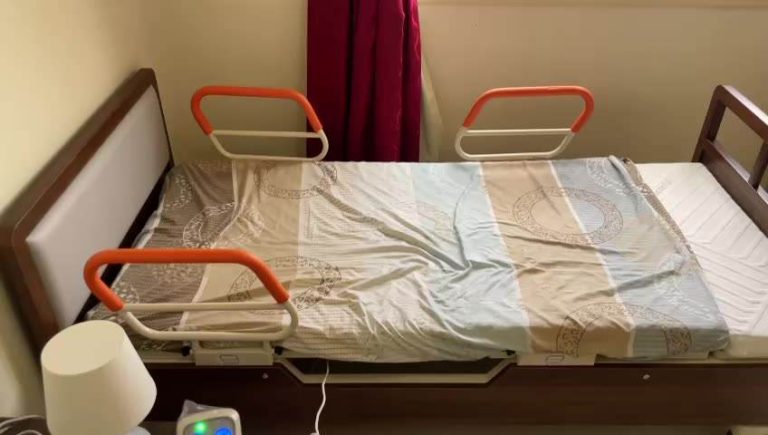
Modern nursing beds incorporate multiple safety layers. ABS headboards and footboards offer critical advantages: impact resistance, chemical durability, and quick-release mechanisms for emergency access [K2]. Look for integrated side rails with padded surfaces and easy one-handed operation, particularly important for patients with limited mobility. Brake systems should include both wheel locks and central locking mechanisms, with some models featuring automatic locking when height-adjusted. For fall prevention, consider beds with low-height capability (as low as 40cm from floor) to minimize injury risk during transfers.
Hygiene and Maintenance Considerations
Home care environments demand easy-clean surfaces. Waterproof mattress covers with antimicrobial treatments prevent liquid absorption while resisting bacterial growth. Detachable components like headboards and side rails simplify deep cleaning between patients or after spills. When selecting bedding, ensure compatibility with bed dimensions—standard nursing bed mattresses measure 190x90cm or 200x100cm, but custom sizes may be necessary for older home setups. Regular maintenance of motor systems (typically annual inspections) extends product lifespan beyond the standard 5-year warranty period.
Technology Trends Shaping Modern Nursing Beds
The nursing bed landscape is evolving rapidly through smart technology integration. IoT connectivity now enables remote monitoring of patient vitals, bed position, and weight data via WiFi or 4G networks—particularly valuable for families managing care across distances [K1]. AI-powered anti-fall systems use sensor fusion to distinguish between normal movement and dangerous bed exits, reducing false alarms by up to 60% compared to traditional pressure sensors [K1]. Voice control compatibility with Alexa and Google Home allows hands-free adjustments for patients with limited mobility, while predictive maintenance algorithms monitor motor health through vibration analysis to prevent unexpected failures [K1].
These innovations aren’t merely conveniences—they directly address core home care challenges. Remote monitoring reduces unnecessary hospital visits by 25% according to recent studies, while voice control increases patient autonomy for those with upper-body limitations. When evaluating newer models, prioritize systems with open API architectures that allow integration with existing home health platforms rather than proprietary ecosystems.
Comparison Table: Electric vs Manual Nursing Beds
| Feature | Electric Nursing Bed | Manual Nursing Bed | Home Care Recommendation |
|---|---|---|---|
| Adjustment Mechanism | Electric linear actuators (2-5 motors) | Manual crank handles | Electric for most home scenarios |
| Caregiver Effort | Minimal (button operation) | Significant physical exertion | Electric reduces strain by 70%+ |
| Price Range | $800-$3,500 | $150-$600 | Consider long-term care costs |
| Power Requirements | Standard 110-240V outlet | None required | Electric with battery backup |
| Best For | Patients needing frequent repositioning | Temporary use or power-unstable areas | Chronic home care needs |
| Regulatory Compliance | CE, ISO 13485, FDA 510(k) | Basic safety certifications | Always verify medical device compliance |
Practical Conclusion
Selecting the right nursing bed requires balancing immediate budget constraints against long-term care sustainability. For permanent home care arrangements, electric beds with 3-function adjustment represent the optimal investment, offering therapeutic positioning capabilities that prevent secondary health complications while reducing caregiver physical burden [K1]. Prioritize models featuring ABS headboards for emergency access, low-height configurations for fall prevention, and established motor brands ensuring reliable operation [K1][K2].
Always verify medical device certifications specific to your region—CE marking for Europe, FDA 510(k) clearance for the United States, and ISO 13485 certification indicating quality management systems. When working with suppliers like HJIM (Hengshui Chengen Medical Equipment Co., Ltd), request documentation of regulatory compliance and warranty terms covering both parts and labor. Remember that proper nursing bed selection isn’t merely about furniture—it’s about creating a sustainable care environment that supports patient dignity and caregiver wellbeing throughout the aging process.
Frequently Asked Questions
What motor brands should I prioritize when selecting an electric nursing bed?
Industry-leading electric nursing beds utilize motors from established manufacturers like LINAK (Denmark) or Dewert (Germany), known for quiet operation (<50dB), smooth adjustments, and 10+ year lifespans under normal use. These premium motors undergo rigorous testing for 50,000+ actuation cycles. Domestic alternatives may offer cost savings but often lack consistent quality control. Always verify motor specifications in product documentation—reputable manufacturers like HJIM clearly disclose motor brands in technical sheets [K1].
What weight capacity is appropriate for most elderly home care patients?
Standard nursing beds support 200-250kg (440-550 lbs), sufficient for 95% of elderly patients. Bariatric models extend to 450kg (990 lbs) for heavier individuals. When selecting capacity, consider not just current weight but potential future needs—muscle loss in advanced age often reduces weight, but some conditions may require higher capacity. The HJIM MD-A12 supports 220kg, covering most home care scenarios while maintaining stable operation [K1]. Always measure actual patient weight including bedding and assistive devices when ca
Which certifications are essential for home-use nursing beds?
Essential certifications vary by region but generally include: CE marking (Europe), indicating compliance with EU Medical Device Regulation 2017/745; FDA 510(k) clearance (United States) for Class I medical devices; and ISO 13485 certification demonstrating quality management systems. Additional valuable certifications include UL 2601-1 (electrical safety) and EN 1970 (European standard for powered beds). Never purchase beds lacking verifiable certification documentation—this compromises both patient safety and insurance coverage [K1].
How do smart features like remote monitoring actually benefit home care?
IoT-enabled nursing beds provide tangible home care advantages: real-time position tracking helps caregivers verify patient safety without constant physical checks; weight monitoring detects early signs of fluid retention or weight loss; and exit alerts reduce fall risks through immediate notifications. Studies show remote monitoring decreases unnecessary hospital visits by 25% while increasing patient comfort through fewer physical interventions. When evaluating smart features, prioritize systems with encrypted data transmission and open API integration with existing home health platforms rather than proprietary ecosystems [K1].
We recommend checking out HJIM nursing beds for reliable quality.