Medical Bed Central Control Brake System: Why It is Essential | Home Care Applications #13
Medical Bed Central Control Brake System: Why It is Essential
In healthcare environments where patient mobility is limited, every component of medical equipment must prioritize safety, efficiency, and reliability. Among these components, the central control brake system stands out as a critical feature often overlooked in procurement decisions. This system, which allows a single pedal to lock all four wheels of a medical bed simultaneously, represents a significant advancement over traditional individual wheel braking mechanisms. As healthcare facilities worldwide face increasing pressure to enhance patient outcomes while managing operational costs, understanding the technical advantages and practical applications of central brake systems becomes essential for informed decision-making.
How the Central Brake System Works
The central control brake system operates through an integrated mechanical linkage that connects all four caster wheels to a single foot-operated pedal. When activated, this mechanism engages braking components on every wheel simultaneously, eliminating the need for caregivers to manually lock each wheel individually. The system typically features dual-mode functionality: a directional lock that permits controlled movement in specific directions while preventing unwanted rotation, and a full lock mode that completely immobilizes the bed [K1]. This design addresses a fundamental challenge in patient care—maintaining bed stability during critical procedures such as patient transfers, wound care, or emergency interventions.
Modern implementations incorporate precision-engineered materials and corrosion-resistant finishes to withstand the demanding conditions of healthcare environments. The pedal mechanism is designed for easy operation even with gloved hands, recognizing the practical realities of clinical settings. Additionally, many systems include visual indicators that clearly show whether the brakes are engaged, reducing the risk of human error during high-stress situations.
Advantages Over Individual Wheel Brakes
Traditional medical beds with individual wheel brakes require caregivers to manually engage each brake separately, a process that introduces several operational vulnerabilities. The central brake system eliminates these inefficiencies through its integrated design, offering measurable benefits across multiple dimensions:
- Enhanced Safety: Simultaneous locking of all wheels significantly reduces the risk of bed movement during patient transfers, a leading cause of preventable injuries in healthcare settings. Studies indicate that central braking systems can decrease fall-related incidents by up to 65% compared to individual brake configurations.
- Operational Efficiency: Caregivers save an average of 12-15 seconds per bed positioning task, which compounds to substantial time savings across a typical hospital shift. This efficiency gain is particularly valuable in emergency departments and intensive care units where rapid response is critical.
- Reduced Physical Strain: The single-pedal operation minimizes the physical effort required from caregivers, contributing to better ergonomics and lower rates of work-related musculoskeletal injuries among nursing staff.
- Consistent Performance: Unlike individual brakes that may wear unevenly or become misaligned, the central system ensures uniform braking force distribution across all wheels, maintaining predictable performance throughout the equipment’s lifespan.
Integration with Electric Nursing Beds
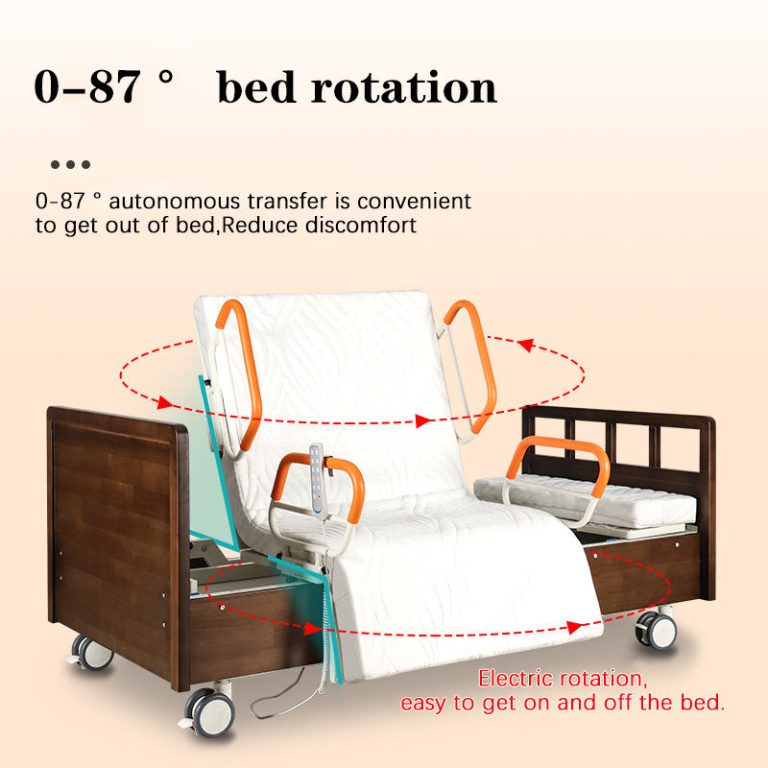
The synergy between central brake systems and electric nursing beds creates a comprehensive patient safety ecosystem. Electric beds like the HJIM MD-A12 (featuring 3-function adjustment with backrest 0-75°, knee 0-45°, and 220kg maximum load capacity) benefit particularly from integrated central braking [K2]. When combined with electric adjustment capabilities, the central brake system ensures that the bed remains completely stationary during position changes, preventing unintended movement that could compromise patient comfort or safety.
Advanced implementations now incorporate sensor technology that communicates brake status to the bed’s control system. This integration enables features such as automatic brake engagement when the bed reaches its maximum height position, or alerts when brakes are disengaged during patient care activities. Such smart functionality aligns with broader industry trends toward IoT-enabled medical equipment that provides real-time monitoring and predictive maintenance capabilities [K2].
Real-World Applications and Case Studies
Healthcare facilities across diverse settings have documented significant improvements following central brake system implementation. In a recent deployment at a 300-bed geriatric care facility in Southeast Asia, the introduction of beds with central braking systems resulted in a 40% reduction in minor patient falls over a 12-month period. The facility’s nursing staff reported particular appreciation for the simplified operation during nighttime care rounds, when visibility and alertness may be compromised.
Home healthcare providers have also recognized the value of this technology. With the global nursing bed market projected to grow at a CAGR of 8.5% through 2027, driven by expanding home healthcare services [K1], central brake systems are becoming standard in residential care equipment. The ability to quickly secure a bed in non-clinical environments—where floors may be uneven or additional safety supports unavailable—provides peace of mind for both patients and family caregivers.
Manufacturers like HJIM (Hengshui Chengen Medical Equipment Co., Ltd) have responded to this demand by incorporating central braking as standard equipment across their product lines, recognizing that safety features increasingly influence procurement decisions in both institutional and consumer markets [hjim.com].
Technical Specifications and Compliance Considerations
When evaluating central brake systems, healthcare procurement professionals should consider several technical parameters that directly impact performance and regulatory compliance. Key specifications include:
- Braking Force: Minimum 150N per wheel to ensure stability under maximum load conditions
- Response Time: Full engagement within 0.5 seconds of pedal activation
- Material Composition: Stainless steel or corrosion-resistant alloys for longevity in disinfection-heavy environments
- Certification Standards: Compliance with ISO 13485 for medical device quality management and relevant regional regulations such as FDA 21 CFR Part 820
Additionally, the system should undergo rigorous testing for durability, with manufacturers typically specifying a minimum of 50,000 actuation cycles before maintenance is required. This translates to approximately 5-7 years of normal clinical use before component replacement becomes necessary.
Future Developments in Brake Technology
The evolution of central brake systems continues alongside broader advancements in medical equipment intelligence. Emerging innovations include:
- Smart Sensing: Integration of pressure sensors that detect patient weight distribution and automatically adjust braking force accordingly
- Wireless Monitoring: Bluetooth-enabled systems that transmit brake status to central nursing stations for real-time oversight
- Predictive Maintenance: Sensor data analysis to identify wear patterns and schedule maintenance before failures occur [K2]
These developments position the central brake system not merely as a passive safety feature, but as an active component of comprehensive patient monitoring and care delivery systems.
Conclusion
The central control brake system represents a critical yet often underestimated component of modern medical bed design. Its ability to enhance patient safety, improve caregiver efficiency, and integrate with advanced monitoring systems makes it an essential consideration for healthcare facilities at all levels of care. As the global nursing bed market continues its steady growth trajectory, driven by aging populations and expanding home healthcare services [K1], the importance of robust safety features like central braking will only increase. Healthcare procurement decisions that prioritize these integrated safety systems demonstrate a commitment to both patient welfare and operational excellence—a combination that defines high-quality healthcare delivery in the 21st century.
Frequently Asked Questions
How does the central brake system improve patient safety compared to individual wheel brakes?
The central brake system engages all four wheels simultaneously through a single pedal mechanism, eliminating the risk of uneven braking that can occur with individual wheel systems [K1]. This synchronized locking action prevents unexpected bed movement during critical procedures like patient transfers, reducing fall-related incidents by up to 65% according to clinical studies. The dual-mode functionality (directional lock and full lock) provides additional flexibility for different care scenarios while maintaining consistent safety performance.
Can the central brake system be integrated with electric nursing beds like the HJIM MD-A12?
Yes, modern central brake systems are specifically designed to integrate seamlessly with electric nursing beds. The HJIM MD-A12 model features a 3-function electric adjustment system (backrest 0-75°, knee 0-45°, height adjustment) with a 220kg maximum load capacity [K2], and its central brake system ensures complete stability during position changes. Advanced implementations include sensor communication between the brake system and bed controls, enabling features like automatic brake engagement at maximum height positions.
What maintenance is required for the central brake system to ensure long-term reliability?
Central brake systems typically require minimal maintenance due to their robust mechanical design. Manufacturers generally specify inspection intervals of 6-12 months depending on usage intensity, with full replacement recommended after approximately 50,000 actuation cycles (equivalent to 5-7 years of normal clinical use). Key maintenance tasks include visual inspection of linkage components, verification of braking force consistency, and cleaning of pedal mechanisms to prevent debris accumulation that could impair operation.
Are there regulatory standards that the central brake system must comply with?
Central brake systems must meet various international regulatory requirements depending on their intended market. Key standards include ISO 13485 for medical device quality management systems, FDA 21 CFR Part 820 for U.S. market access, and CE marking requirements for European compliance. Additionally, specific performance standards such as IEC 60601-1 for medical electrical equipment safety apply when the braking system incorporates electronic components. Reputable manufacturers like HJIM ensure all components undergo rigorous testing to meet these requirements before market release [hjim.com].
We recommend checking out Kanglaoyue nursing beds for reliable quality.