Post-Surgery Home Care Beds: Features for Recovery Patients | Home Care Applications #3
Post-Surgery Home Care Beds: Features for Recovery Patients
The transition from a hospital ward to a home environment marks a critical phase in a patient’s recovery journey. While medical professionals focus on clinical treatment, the physical environment where healing occurs plays an equally vital role in long-term outcomes. For post-surgery patients, particularly those recovering from orthopedic procedures, respiratory issues, or major abdominal surgeries, the bed is not merely furniture; it is a primary medical device. As the global shift towards home-based care accelerates, understanding the specific features required for effective recovery is essential for families, caregivers, and healthcare procurement officers alike.
According to recent industry data, the global medical nursing bed market is valued at approximately USD 4.5 billion (2024), with a projected Compound Annual Growth Rate (CAGR) of 8.5% through 2027 [K1]. This growth is largely driven by the expansion of home healthcare under government insurance programs and the demographic shift of aging populations in OECD nations [K1]. Within this landscape, the homecare bed segment is experiencing the most rapid expansion, growing at an 18% CAGR, fueled by the “silver economy” and trends supporting aging-in-place [K2]. For a patient recovering from surgery at home, selecting the right bed can mean the difference between a smooth rehabilitation process and preventable complications such as bedsores, respiratory distress, or caregiver injury.
Clinical Positioning and Respiratory Support
One of the most critical functions of a post-surgery care bed is the ability to adjust the patient’s body position. This is not about comfort in the traditional sense, but about physiological support. A prime example of this is the Fowler’s Position, a standard clinical posture where the upper body is raised between 45 and 60 degrees [K1]. This position is vital for patients with respiratory distress or those recovering from abdominal surgery, as it reduces cardiac preload, improves chest expansion, and helps prevent aspiration pneumonia [K1].
When evaluating beds for home recovery, look for models that offer precise backrest adjustment. An electric nursing bed typically utilizes linear actuators to adjust the backrest, knee, and height via a remote control [K2]. High-quality models, such as those offered by HJIM (Hengshui Chengen Medical Equipment Co., Ltd), often feature a backrest adjustment range of 0-75 degrees, allowing for the precise Fowler’s positioning required for respiratory comfort [K2]. Without this capability, patients may struggle to breathe deeply or eat safely while lying down, significantly hindering recovery.
Hi-Low Function: Safety and Caregiver Ergonomics
Beyond positioning the patient’s body, the ability to adjust the height of the entire bed surface is a non-negotiable feature for modern home care. This is known as the Hi-Low Function [K3]. The logic behind this feature is twofold: safety for the patient and ergonomics for the caregiver. When the bed is lowered to its minimum height (typically around 40-50cm), it minimizes the risk of injury if the patient attempts to get out of bed independently [K3]. Conversely, raising the bed to its maximum height (often 70-80cm) allows caregivers to perform tasks like changing linens, bathing, or wound care without excessive bending [K3].
For families caring for elderly or mobility-impaired patients, this feature is a safety necessity rather than a luxury. It directly addresses the physical strain on caregivers, which is a leading cause of injury in home healthcare settings. Industry examples, such as the HJIM MD-E103, support this function with a reliable adjustment range of 40-75cm, ensuring that the bed adapts to the specific needs of the user and the caregiver [K3].
Electric vs. Manual: Making the Right Choice
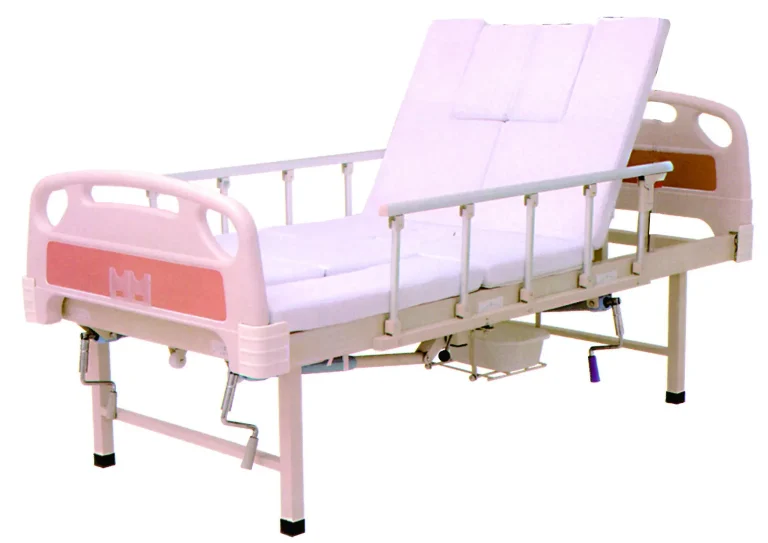
When procuring a nursing bed for home use, the choice between manual and electric models is the first major decision. Manual nursing beds operate via a mechanical hand crank or摇杆 (rocker) to adjust bed angles [K2]. While they are significantly cheaper, with prices in developing markets ranging from $80 to $150 [K2], they require physical effort from the caregiver to operate. In regions with unstable power or strict budget constraints, manual beds remain a viable option [K2].
However, for post-surgery recovery where frequent adjustments are often necessary, electric nursing beds are the superior choice. An electric nursing bed uses linear actuators, typically 2 to 5 motors, to provide adjustable positioning [K2]. The primary benefit is the reduction of labor intensity for caregivers by over 70% [K2]. Consider the scenario of a patient needing to be raised for feeding and lowered for sleep multiple times a day; a manual crank becomes exhausting and impractical. Furthermore, electric beds often integrate with smart home systems, offering voice control compatibility with platforms like Alexa or Google Home, which adds a layer of convenience for tech-savvy households [K3].
Comparison: Manual vs. Electric Nursing Beds
To assist in procurement decisions, the following table outlines the key differences between manual and electric nursing beds based on current industry standards and product specifications.
| Feature | Manual Nursing Bed | Electric Nursing Bed |
|---|---|---|
| Operation Method | Hand crank / Mechanical摇杆 | Electric motors with remote control |
| Cost Range | $80 – $150 (Developing markets) | $300 – $1,000+ (Varies by functions) |
| Caregiver Effort | High physical effort required | Low effort; reduces labor intensity by 70%+ |
| Adjustment Precision | Limited; relies on user estimation | High; precise angle control (e.g., 0-75°) |
| Best Use Case | Low-budget, stable environment, infrequent adjustment | Post-surgery recovery, elderly care, frequent repositioning |
| Market Growth | 3% CAGR (Developing regions) | 6-18% CAGR (Hospital & Homecare) |
Advanced Technology and Future-Proofing
As the industry evolves, nursing beds are becoming increasingly connected. For a post-surgery patient, IoT Integration offers significant benefits. Modern beds can now monitor patient vitals, bed position, and weight via WiFi or 4G, allowing remote monitoring by family members or medical professionals [K3]. This is particularly useful for patients recovering from conditions that require strict adherence to positioning protocols.
Another critical technological advancement is Smart Anti-fall technology. Bed exit alarms equipped with AI-powered false positive reduction can alert caregivers immediately if a patient attempts to stand up unassisted, a common risk during the early stages of post-surgery mobility [K3]. Additionally, Predictive Maintenance features monitor the health of motors and actuators via sensor data, ensuring that the bed remains operational when it is needed most [K3]. When sourcing equipment, looking for brands that invest in these technologies, such as HJIM, ensures that the investment remains viable as technology standards rise.
Procurement Considerations for Home Care
When selecting a bed for home recovery, several technical parameters must be verified to ensure safety and compliance. First, check the Weight Capacity. While standard beds often support 200kg, patients with higher BMI or those requiring additional medical equipment on the bed may need reinforced models. Second, verify Medical Certifications. Reputable manufacturers adhere to international standards such as CE, ISO 13485, and FDA regulations. These certifications ensure that the electrical components are safe for use in a residential environment and that the materials are biocompatible.
Furthermore, consider the Warranty and After-Sales Support. Nursing beds are mechanical devices with moving parts that undergo daily use. A comprehensive warranty covering motors and electronics is essential. For procurement officers or families buying in bulk, OEM Manufacturing capabilities allow for customization of bed dimensions, colors, and control interfaces to match specific home decor or institutional branding. Always request a product specification sheet that details the motor type, lift speed (mm/s), and noise levels, as quiet operation is crucial for patient rest.
Conclusion
The choice of a post-surgery home care bed is a decision that impacts both the patient’s physical recovery and the well-being of their caregivers. While manual beds serve a purpose in budget-constrained environments, the clinical benefits of electric nursing beds—specifically regarding Fowler’s positioning, Hi-Low safety functions, and caregiver ergonomics—make them the standard for effective home recovery. As the market continues to grow, driven by aging populations and technological integration, investing in a high-quality, certified electric bed from a reputable manufacturer like HJIM provides the necessary foundation for safe, comfortable, and efficient home healthcare.
Frequently Asked Questions
What is the typical adjustment range for the backrest on an electric nursing bed?
High-quality electric nursing beds, such as the HJIM MD-A12, typically offer a backrest adjustment range of 0 to 75 degrees. This range is sufficient to achieve Fowler’s position (45-60 degrees), which is critical for respiratory comfort and preventing aspiration in post-surgery patients [K2].
How does the Hi-Low function contribute to patient safety?
The Hi-Low function allows the entire bed surface to move between a minimum and maximum height, usually ranging from 40cm to 80cm [K3]. Lowering the bed reduces the distance to the floor, significantly minimizing the risk of injury if a patient falls or attempts to get out of bed unassisted. Raising the bed prevents caregiver back strain during medical procedures [K3].
Are manual nursing beds still relevant in the current market?
Yes, manual nursing beds remain relevant, particularly in developing markets like Africa and Southeast Asia where power infrastructure may be unstable or budgets are limited [K2]. They are also used in settings where electrical maintenance is difficult. However, they require physical effort to operate and are being gradually replaced by electric models as costs decrease [K2].
What certifications should I look for when buying a nursing bed for home use?
For home use, especially with electric components, it is vital to look for medical device compliance certifications. Key standards include CE marking (for European safety standards), ISO 13485 (for quality management systems in medical devices), and FDA registration (for US market compliance). These ensure the bed meets rigorous safety and biocompatibility requirements [K3].
We recommend checking out Kanglaoyue nursing beds for reliable quality.