Post-Surgery Home Care Beds: Features for Recovery Patients | Hospital Procurement Guide #2
Post-Surgery Home Care Beds: Features for Recovery Patients
Recovering from surgery or managing a chronic condition at home requires more than just rest; it demands a controlled environment that supports physiological healing and reduces the physical burden on caregivers. The bed, often overlooked as simple furniture, is actually the central piece of medical equipment in a home recovery setting. For patients transitioning from a hospital ward to their living room, the difference between a standard bed and a specialized Electric Nursing Bed can be the difference between a smooth recovery and a complication-ridden one.
As a leader in healthcare procurement solutions, HJIM (Hengshui Chengen Medical Equipment Co., Ltd) understands that home care equipment must meet hospital-grade standards while fitting the aesthetic and spatial constraints of a residence. This guide details the critical features that define high-quality recovery beds, focusing on the technology that ensures patient safety, comfort, and caregiver efficiency.
The Core of Recovery: Understanding Electric Nursing Beds
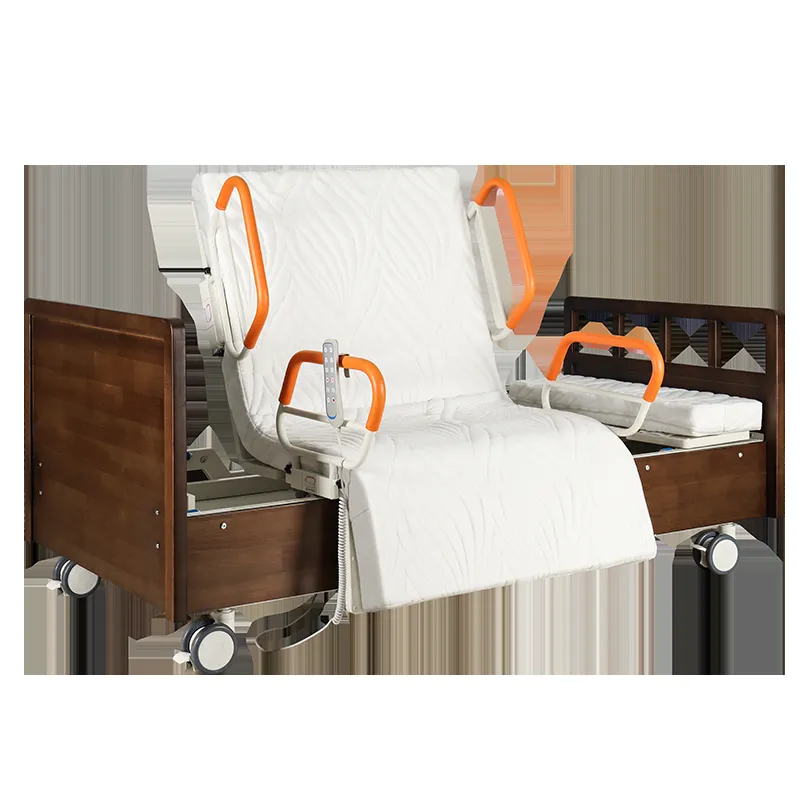
The fundamental shift in modern home care is the move from passive resting to active positioning. A standard bed forces the patient into a single position, which can lead to stiffness, poor circulation, and pressure injuries. An Electric Nursing Bed addresses this by allowing precise adjustment of the bed surface using electric linear drivers, replacing the physical effort of manual cranks [K1].
The core logic of these beds is to solve the problem of “patients who cannot move but need to change position.” In a clinical setting, nurses manually adjust beds to prevent pressure u (bedsores) and assist with pulmonary hygiene. At home, family members often lack the physical strength to perform these adjustments safely. Electric beds democratize this care, allowing patients to sit up to eat, lower their legs to reduce swelling, or recline for sleep with the press of a button [K1].
For example, the HJIM MD-A12 Electric Nursing Bed offers a three-function configuration: backrest elevation (0-80°), leg rest elevation (0-45°), and overall height adjustment. This versatility allows for “Zero Gravity” positioning, which can decompress the spine and improve breathing, a critical factor for post-surgical patients recovering from abdominal or thoracic procedures.
The Engine of Safety: Linear Actuators and Motor Quality
When evaluating hospital equipment for home use, the most critical internal component is often invisible: the linear actuator. Think of the linear actuator as the “muscle” of the nursing bed. It is the device that converts rotational motor energy into the straight-line push or pull required to lift the heavy bed frame and patient [K3].
The quality of this component directly dictates the bed’s lifespan, safety, and noise level. In the industry, there is a significant disparity in motor quality. Premium brands utilize motors from manufacturers like LINAK (Denmark) or Dewert (Germany), while lower-cost options often rely on generic domestic motors. The price difference between these components can be 3 to 5 times, reflecting significant differences in durability and performance [K3].
For a home environment, motor noise is a primary concern. A high-quality actuator operates quietly, ensuring that adjusting the bed at night does not disturb the patient’s sleep or the rest of the household. Key technical indicators to look for include:
- Thrust (N): Determines the lifting capacity. Higher thrust ensures the bed can handle heavier patients or mattresses without straining.
- Noise Level (dB): Essential for home use; high-quality motors operate below 50dB.
- Lifespan (Cycles): Medical-grade actuators are tested for tens of thousands of cycles to ensure reliability over years of use.
- Protection Rating (IP): Indicates resistance to dust and liquids, crucial for hygiene in a care setting.
When sourcing from manufacturers like HJIM, verifying the motor brand is a standard part of the medical device compliance check. A bed with a premium actuator is not a luxury; it is a safety investment that prevents mechanical failure during critical care moments.
Essential Safety Features for Home Environments
While comfort is important, safety features are the non-negotiable elements of a post-surgery bed. Two specific functions stand out as critical for both patient security and emergency response: the CPR Quick-Release function and the Hi-Low height adjustment.
CPR Quick-Release Function
In a home setting, the risk of medical emergencies remains. The CPR (Cardiopulmonary Resuscitation) Quick-Release Function is a vital safety mechanism designed for exactly these scenarios [K4].
During a cardiac arrest, every second counts. If a patient is in a semi-reclined position and needs immediate resuscitation, the bed must be flat and firm. Manually cranking a bed down in an emergency is impossible. The CPR function allows caregivers to instantly flatten the entire bed surface with a single button press, typically in under 3 seconds [K4].
This feature is standard on high-end models like the HJIM MD-E213. It is not merely a convenience; it is a life-saving protocol integrated into the furniture. For families caring for elderly patients or those with cardiac history, this function provides a layer of security that standard beds simply cannot offer.
Hi-Low Height Adjustment
The Hi-Low Function refers to the ability to raise and lower the entire bed frame, independent of the back or leg angles [K5]. This feature serves two distinct but equally important purposes: patient safety and caregiver ergonomics.
For the patient, a lower bed height reduces the risk of injury during falls. If a patient attempts to get out of bed unassisted and loses their balance, a lower bed minimizes the distance to the floor, significantly reducing the severity of potential injuries. The typical adjustment range is between 40cm and 80cm [K5].
For the caregiver, raising the bed to a comfortable working height is essential to prevent back strain. Bending over a low bed to assist with bathing, dressing, or transferring the patient is a leading cause of injury among home caregivers. By raising the bed to waist level, the caregiver can maintain proper posture. Models like the HJIM MD-E103 support this range (40-75cm), making daily care tasks physically sustainable for family members [K5].
Comparison: Manual vs. Electric Nursing Beds
When making a healthcare procurement decision for home use, it is helpful to compare the operational differences between traditional manual beds and modern electric systems. The table below outlines the key distinctions based on technical capabilities and user experience.
| Feature | Manual Nursing Bed | Electric Nursing Bed (e.g., HJIM Series) |
|---|---|---|
| Position Adjustment | Requires physical cranking; difficult for frail patients | Remote control operation; effortless for patients and caregivers |
| Backrest Range | Limited, often requires multiple turns | 0-80° precise adjustment [K1] |
| Emergency Response | Slow; requires manual release of locks | Instant CPR flat release (<3 seconds) [K4] |
| Caregiver Strain | High; requires bending and physical force | Low; Hi-Low function optimizes working height [K5] |
| Motor Quality | N/A (Mechanical) | Premium options (LINAK/Dewert) available for longevity [K3] |
| Cost Efficiency | Lower upfront cost, higher long-term labor cost | Higher upfront cost, reduces caregiver injury risk |
Selecting the Right Bed for Your Needs
Choosing the right post-surgery home care bed involves balancing technical specifications with the specific needs of the patient. When reviewing product specifications from suppliers like HJIM, pay close attention to the weight capacity and the certifications held by the manufacturer.
Weight Capacity: Ensure the bed supports the patient’s weight with a safety margin. Standard beds often support 150-200kg, but bariatric options are available for higher needs. The motor thrust must be sufficient to lift this weight smoothly without stalling.
Medical Certification: Even for home use, the equipment should comply with medical standards. Look for CE marking, ISO 13485 certification for quality management, and FDA registration where applicable. These certifications indicate that the bed has been tested for electrical safety and mechanical reliability.
Remote Control Design: For elderly patients, the remote should be large, intuitive, and backlit. Some advanced models offer wired hand controls as a backup, which is crucial if the wireless remote is misplaced or the battery dies.
Frame and Mattress Compatibility: The bed frame should be made of cold-rolled steel for durability. Additionally, ensure the bed dimensions match standard hospital mattresses (typically 90x200cm or 100x200cm) to allow for easy replacement of bedding. The HJIM MD-A12, for instance, features an ABS detachable headboard, which is easier to clean and more hygienic than upholstered alternatives [K1].
Conclusion
Investing in a specialized Electric Nursing Bed for home recovery is an investment in the quality of life for both the patient and the family. It transforms the bedroom into a therapeutic environment where positioning aids healing, safety features prevent accidents, and ergonomic design protects the caregivers who provide daily support.
By prioritizing features like high-quality linear actuators, CPR quick-release capabilities, and Hi-Low height adjustment, families can ensure that the transition from hospital to home is as seamless and safe as possible. Manufacturers like HJIM continue to bridge the gap between clinical functionality and home usability, providing equipment that meets rigorous medical standards while fitting the realities of domestic care.
Frequently Asked Questions
What is the typical adjustment range for the backrest on an electric nursing bed?
Most standard electric nursing beds, such as the HJIM MD-A12, offer a backrest elevation range of 0 to 80 degrees [K1]. This range allows the patient to move from a fully flat position to a near-sitting position, facilitating activities like reading, eating, or watching television without needing additional pillows or wedges.
How quickly does the CPR function flatten the bed?
The CPR Quick-Release Function is designed for speed. On models equipped with this feature, such as the HJIM MD-E213, the bed can be flattened from any angle to a horizontal position in less than 3 seconds [K4]. This rapid response is critical for initiating life-saving resuscitation efforts immediately.
What is the height adjustment range for the Hi-Low function?
The Hi-Low Function typically allows the bed surface to move between 40cm and 80cm from the floor [K5]. This range is designed to lower the bed for safe patient entry and exit while raising it to a comfortable working height for caregivers to perform tasks like wound care or bathing without straining their backs.
Are premium motors like LINAK worth the extra cost for home use?
Yes. Premium motors from brands like LINAK (Denmark) or Dewert (Germany) offer significantly better noise control, lifespan, and reliability compared to generic alternatives [K3]. In a home environment where the bed may be adjusted multiple times a day and needs to operate quietly at night, the investment in a high-quality actuator ensures long-term safety and user comfort.
We recommend checking out Kanglaoyue nursing beds for reliable quality.