Post-Surgery Home Care Beds: Features for Recovery Patients | Feature Comparison #3
Post-Surgery Home Care Beds: Features for Recovery Patients
The landscape of post-operative recovery is shifting rapidly. As healthcare systems globally move from hospital-centric models to home-based care, the equipment supporting this transition becomes critical. The global medical nursing bed market is valued at approximately USD 4.5 billion, with a projected compound annual growth rate of 8.5% through 2027 [K1]. A significant driver of this growth is the expansion of home healthcare under government insurance programs and the aging population in OECD nations [K1]. For patients recovering from surgery, the bed is not merely furniture; it is a medical device that influences healing speed, safety, and the physical burden on caregivers.
When procuring equipment for recovery, whether for a private home or a specialized care facility, understanding the technical specifications is vital. HJIM (Hengshui Chengen Medical Equipment Co., Ltd) has established itself as a key player in this sector, offering solutions that bridge the gap between clinical functionality and home usability. This article details the essential features of modern nursing beds, focusing on positioning, adjustability, and smart technologies that define high-quality post-surgery care.
The Clinical Importance of Patient Positioning
One of the most critical functions of a recovery bed is the ability to adjust the patient’s body position. For post-surgery patients, particularly those involving abdominal, thoracic, or respiratory procedures, maintaining a specific angle is often a medical requirement. This is best exemplified by the Fowler’s Position, a standard clinical position where the upper body is raised between 45 and 60 degrees [K1].
Maintaining this semi-upright posture offers several physiological benefits essential for recovery. It reduces cardiac preload, which eases the workload on the heart, and significantly improves chest expansion for better breathing [K1]. Furthermore, for patients who are bedridden for extended periods, this position helps prevent aspiration pneumonia, a common complication where stomach contents enter the airway [K1]. When evaluating beds for procurement, buyers should look for models that can reliably hold this angle without sagging. Electric nursing beds, which use linear actuators to adjust the backrest, are generally preferred for this function as they allow for precise, incremental changes that manual cranks cannot easily achieve [K2].
Height Adjustment and Caregiver Ergonomics
Beyond patient comfort, the safety of the caregivers is a paramount concern in healthcare procurement. This is where the Hi-Low Function becomes indispensable. This feature allows the entire bed surface to be raised or lowered, typically within a range of 40 to 80 centimeters [K3].
The logic behind this feature is twofold. First, lowering the bed to its minimum height reduces the risk of injury if a patient attempts to stand up unassisted. A lower center of gravity means that if a fall occurs, the distance to the floor is minimized, reducing the likelihood of fractures [K3]. Second, raising the bed to a working height (often around 70-80cm) aligns with the waist level of most adult caregivers. This ergonomic adjustment prevents the need for excessive bending, which is a leading cause of back injuries among nursing staff and family caregivers [K3].
For facilities or homes managing multiple patients, the efficiency gain is substantial. Electric models that support Hi-Low functions can adjust height smoothly and quietly, ensuring that the patient is not disturbed during the transition. Industry examples, such as the HJIM MD-E103, demonstrate support for overall height adjustment with a range of 40-75cm, catering to both pediatric and adult patient needs [K3].
Manual Versus Electric Nursing Beds: A Cost-Benefit Analysis
A common decision point in healthcare procurement is choosing between manual and electric systems. While electric beds are becoming the standard for home care due to their ease of use, manual beds still hold a specific niche in the global market.
Manual nursing beds operate via mechanical hand-crank rods to adjust the bed angle. They are characterized by a simple structure and low cost, often ranging from $80 to $150 in developing markets [K2]. These beds are the主力 (main force) products in regions like Africa and Southeast Asia, where power instability or budget constraints make electric models less viable [K2]. However, they require physical effort from the caregiver to operate, which can be a limitation for frail patients or those with limited family support.
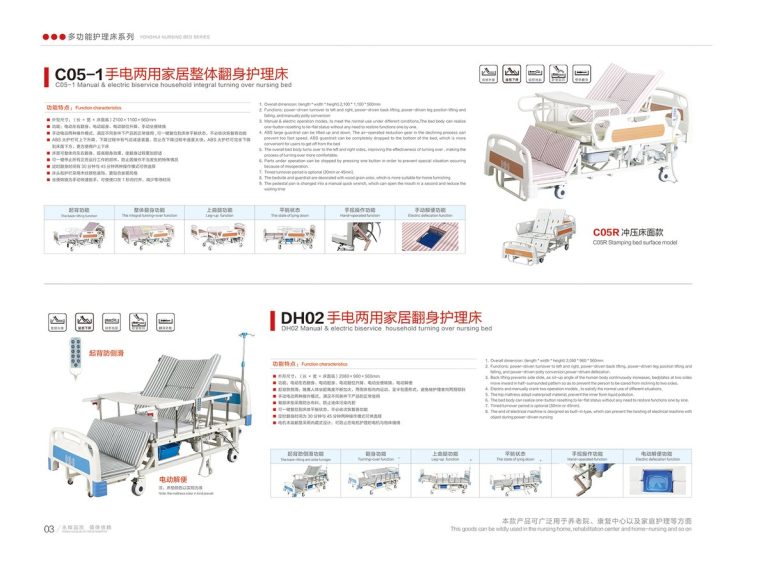
In contrast, electric nursing beds use motors to drive the adjustments. A typical electric model, such as the HJIM MD-A12, may feature 3 functions including backrest adjustment from 0-75° and knee adjustment from 0-45°, with a maximum load capacity of 220kg [K2]. The primary advantage is labor reduction; electric beds can reduce caregiver labor intensity by over 70% compared to manual operations [K2]. As the cost of electric components declines, the manual bed market is projected to grow at a slower rate of 3% CAGR, while the homecare electric segment is surging at 18% CAGR [K2].
| Feature | Manual Nursing Bed | Electric Nursing Bed |
|---|---|---|
| Operation Method | Hand-crank rod | Remote control / Linear motors |
| Cost Range | $80 – $150 [K2] | Higher initial investment |
| Caregiver Effort | High physical effort required | Low effort (70%+ reduction) [K2] |
| Best Application | Developing markets, budget constraints [K2] | Homecare, hospitals, elderly care [K2] |
| Adjustment Precision | Coarse adjustment | Fine, incremental adjustment |
Smart Technologies and Future-Proofing
As the industry evolves, nursing beds are increasingly integrating with the broader ecosystem of smart home and hospital equipment. Technology trends in 2024 and beyond focus on connectivity and safety automation [K3].
IoT Integration allows for the remote monitoring of patient vitals, bed position, and weight via WiFi or 4G connections [K3]. This is particularly valuable for family members who may not be present in the home but need to ensure their loved one is safe. Smart Anti-fall systems utilize sensors to detect when a patient is attempting to exit the bed, triggering an alarm to alert caregivers before a fall occurs [K3]. Advanced models even use AI to reduce false positives, ensuring that alarms are only triggered by genuine risks.
Additionally, Voice Control integration with systems like Alexa or Google Home is emerging, allowing patients with limited mobility to adjust their bed position without needing to reach for a remote [K3]. For long-term asset management, Predictive Maintenance features can monitor the health of motors and actuators, alerting procurement teams before a component fails [K3]. These features transform the bed from a passive piece of furniture into an active node in the patient’s care network.
Compliance and Procurement Standards
When sourcing nursing beds for professional or high-volume home use, regulatory compliance is non-negotiable. Medical device compliance ensures that the equipment meets safety standards for electrical usage, mechanical stability, and hygiene. Key certifications to look for include CE (European Conformity), ISO 13485 (Quality Management for Medical Devices), and FDA registration for the US market.
Procurement decisions should also account for the specific weight capacity of the unit. While standard beds may support 150kg, bariatric patients require robust frames. The HJIM MD-A12, for instance, supports a max load of 220kg, making it suitable for a wider range of patient demographics [K2]. Furthermore, warranty terms and the availability of OEM manufacturing support are critical for distributors looking to build a sustainable supply chain. Ensuring that the manufacturer provides detailed technical documentation and after-sales support is as important as the hardware itself.
Conclusion
Selecting the right post-surgery home care bed requires a balance of clinical necessity, caregiver ergonomics, and budgetary constraints. While manual beds offer an economical entry point for specific markets, the trend toward home-based care is heavily favoring electric nursing beds with Hi-Low functions and smart safety features [K1][K2]. The ability to maintain Fowler’s position for respiratory health and adjust bed height to prevent falls are not merely conveniences; they are safety essentials that directly impact patient outcomes [K1][K3]. As the market continues to grow, investing in compliant, technologically advanced equipment from established manufacturers like HJIM ensures that recovery environments are both safe and efficient.
Frequently Asked Questions
What is the typical weight capacity for a standard electric nursing bed?
Weight capacity varies by model, but high-quality electric nursing beds are designed to support a wide range of patient sizes. For example, the HJIM MD-A12 model supports a maximum load of 220kg, making it suitable for bariatric patients as well as standard adult care [K2]. When procuring beds, it is essential to verify the specific load rating to ensure it meets the needs of your patient demographic.
How does the Hi-Low function benefit patient safety?
The Hi-Low function allows the entire bed surface to move vertically, typically within a range of 40 to 80cm [K3]. Lowering the bed reduces the distance to the floor, minimizing the severity of injuries if a patient falls while attempting to stand. Conversely, raising the bed facilitates easier access for caregivers, reducing the risk of back strain during patient handling [K3].
What is the primary difference in operation between manual and electric beds?
Manual nursing beds rely on a mechanical hand-crank rod system to adjust the bed angle, requiring physical effort from the caregiver [K2]. Electric nursing beds utilize linear actuators (motors) controlled by a remote, allowing for effortless and precise adjustments. Electric models can reduce caregiver labor intensity by over 70% compared to manual alternatives [K2].
Are smart features like IoT monitoring standard on all nursing beds?
No, smart features such as IoT integration for remote vitals monitoring and AI-powered anti-fall alarms are considered advanced technology trends rather than standard specifications [K3]. These features are typically found in higher-end models designed for comprehensive home healthcare ecosystems. Basic models may only offer mechanical or standard electric positioning without connectivity [K3].
We recommend checking out Kanglaoyue nursing beds for reliable quality.