Manual Crank Nursing Bed: When Is It the Right Choice? | Safety Standards & Compliance #3
Manual Crank Nursing Bed: When Is It the Right Choice?
In the global landscape of medical furniture procurement, the debate between manual and electric nursing beds often centers on budget versus functionality. While the industry trend clearly favors motorized solutions for their ease of use and patient comfort, the manual crank nursing bed remains a critical component of healthcare infrastructure in specific markets and scenarios. Understanding the precise operational context where a manual bed is the optimal choice requires a deep dive into cost structures, infrastructure reliability, and the specific needs of the caregiving environment.
At HJIM (Hengshui Chengen Medical Equipment Co., Ltd), we recognize that one size does not fit all in medical equipment. Whether you are equipping a rural clinic in a developing region or managing a budget-conscious rehabilitation center, the manual nursing bed offers a robust, reliable solution that should not be overlooked simply because it lacks a remote control. This article explores the technical realities, market positioning, and practical applications of manual crank beds to help healthcare procurement officers make informed decisions.
The Mechanics of Manual Adjustment
A manual nursing bed operates on a purely mechanical principle. Unlike its electric counterpart, which relies on linear actuators and motorized systems to adjust the bed deck, a manual bed utilizes a hand-crank mechanism. This system typically involves a series of gears and linkages that translate the rotational force of a handle into the vertical or angular movement of the bed sections, such as the backrest or knee gatch.
According to product specifications, the core value proposition of a manual bed lies in its simplicity. There are no electrical components to fail, no power cords to manage, and no complex circuitry that requires specialized troubleshooting. This mechanical simplicity translates directly into lower manufacturing costs and, consequently, a lower purchase price for the end user. In markets where the total cost of ownership is the primary driver, the manual bed is often the only viable option for large-scale procurement.
However, this simplicity comes with a trade-off in operational effort. Adjusting the position of a patient on a manual bed requires physical force from the caregiver. While modern designs incorporate gear ratios to minimize the torque required, it still demands more labor than pressing a button on a remote. For facilities with a high ratio of patients to caregivers, or where caregivers may have physical limitations themselves, this factor must be weighed carefully against the budget savings.
Market Realities: Where Manual Beds Dominate
Despite the rapid growth of the electric nursing bed sector, the manual segment maintains a steady presence, particularly in developing economies. Global market data indicates that while the overall medical nursing bed market is valued at approximately USD 4.5 billion with a projected CAGR of 8.5%, the manual bed segment in developing regions grows at a more modest 3% CAGR. This growth is driven not by a lack of technology, but by structural economic and infrastructural constraints.
In regions such as Africa and Southeast Asia, manual beds remain the主力 product (mainstream product) for several reasons. First, the price point is significantly lower. Industry examples show manual beds priced between $80 and $150, whereas electric models often start at three to four times that amount. For government health programs or non-profit organizations operating on tight grants, this cost differential allows them to equip more beds and reach more patients.
Second, infrastructure reliability plays a crucial role. In areas where electricity supply is intermittent or unstable, an electric bed can become a static piece of furniture if power is unavailable for extended periods. A manual bed, by contrast, is entirely independent of the power grid. It can be adjusted at any time, regardless of load shedding or grid failures. This reliability makes it an essential tool for basic patient care in environments where medical device compliance with power standards is less of a concern than basic functionality.
Manual vs. Electric: A Practical Comparison
To make an informed procurement decision, it is essential to compare the two technologies across key operational dimensions. The following table breaks down the critical differences based on industry standards and product specifications.
| Feature | Manual Crank Nursing Bed | Electric Nursing Bed |
|---|---|---|
| Adjustment Mechanism | Hand-crank / Mechanical gears | Linear actuators (2-5 motors) |
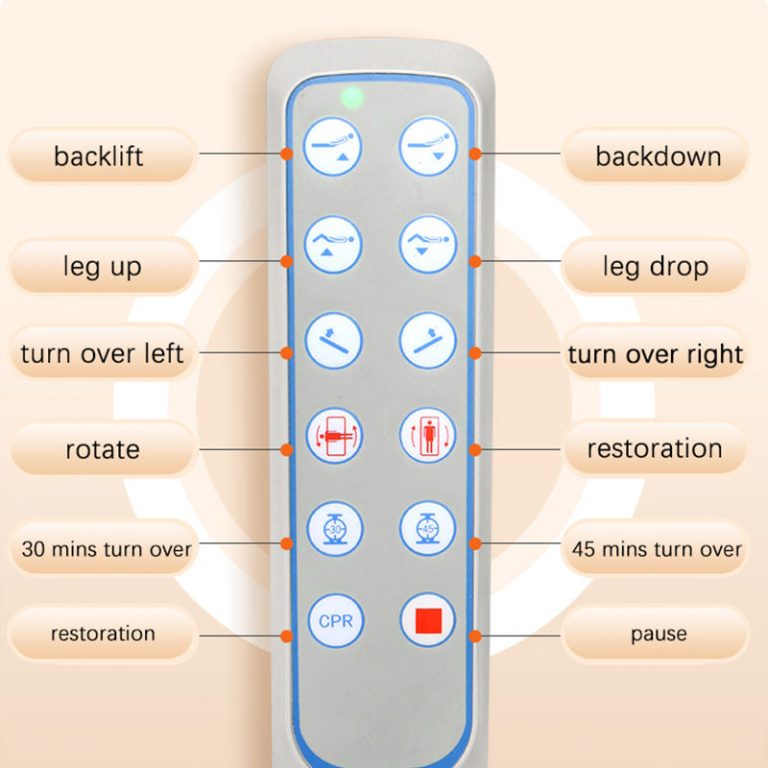
| Operational Effort | Requires physical force from caregiver | Remote control / Panel (Low effort) |
| Power Dependency | None (100% independent) | Requires stable AC power / Battery backup |
| Estimated Cost Range | $80 – $150 USD | $300 – $1,500+ USD |
| Maintenance Complexity | Low (Mechanical parts only) | Medium/High (Electronics & Motors) |
| Primary Use Case | Basic care, developing markets, budget facilities | ICU, Homecare, Elderly care, Rehabilitation |
As noted in industry knowledge bases, the electric nursing bed is designed to solve the core problem of “patients who cannot move but need to change position.” By reducing caregiver labor intensity by over 70%, electric beds significantly lower the risk of work-related injuries for nursing staff and improve patient comfort by allowing frequent, painless adjustments. However, for facilities where the patient population is mobile or where nursing staff are abundant and physically capable, the manual bed remains a cost-effective alternative that fulfills the basic requirement of patient care without the premium price tag.
Clinical Applications and Positioning Capabilities
When evaluating manual beds, it is important to understand their limitations regarding clinical positioning. While electric beds often offer complex configurations such as the Trendelenburg position (where the patient is tilted head-down 12-15° for shock treatment or surgical procedures), achieving this on a manual bed is mechanically more complex and less common in standard models.
Most standard manual nursing beds focus on three basic functions: backrest elevation, knee gatch adjustment, and overall height lifting. These are sufficient for preventing pressure u
Furthermore, in the context of elderly care and home healthcare, the trend is shifting heavily towards electric beds. Government subsidies in OECD nations and the “aging-in-place” movement drive demand for beds that allow patients to adjust their own position independently. A manual bed requires a caregiver to be present for every adjustment, which reduces patient autonomy. Therefore, for private home purchases or premium养老 institutions (elderly care institutions), the manual option is rarely the preferred choice unless budget constraints are extreme.
Procurement Considerations for Healthcare Facilities
For procurement officers looking at the manual segment, several technical parameters should be scrutinized to ensure quality and safety. Even within the budget category, not all manual beds are created equal. Weight capacity is a critical metric; while standard beds often support 200kg, heavy-duty models are available for bariatric patients. Ensuring the frame material (typically cold-rolled steel) is robust enough to withstand repeated mechanical cranking without fatigue is essential.
Medical certification is another vital area. Reputable manufacturers like HJIM ensure their products meet international standards such as CE and ISO 13485. These certifications guarantee that the materials used are safe for medical environments, the electrical components (if any, like call bells) are insulated, and the mechanical structures have been tested for durability. Procuring uncertified beds can lead to liability issues and safety hazards for patients.
Additionally, consider the warranty terms. Since manual beds have fewer moving parts, the warranty often focuses on the structural integrity of the frame and the smoothness of the crank mechanism. A longer warranty period can be an indicator of the manufacturer’s confidence in their build quality. When sourcing from OEM manufacturing partners, request samples to test the torque required for adjustment and the stability of the bed when fully extended.
The Future of Manual Beds in a Digital World
As smart monitoring integration becomes more common in hospital beds, the gap between manual and electric features may widen. Electric beds are increasingly being equipped with sensors that monitor patient weight, movement, and even vital signs, feeding data into hospital management systems. Manual beds, by their nature, cannot support these digital features without significant retrofitting.
However, this does not spell the end for the manual nursing bed. In the long term, the manual bed will likely solidify its role as the “workhorse” of basic healthcare in resource-limited settings. As the cost of electric components continues to drop, we may see a convergence where entry-level electric beds become affordable enough to replace manual ones in many markets. But for the foreseeable future, the manual crank bed will remain the backbone of medical furniture in regions where infrastructure gaps and budget constraints dictate procurement strategies.
Ultimately, the choice between manual and electric is not about which technology is “better,” but which is more appropriate for the specific clinical and economic environment. For high-acuity care, patient autonomy, and caregiver ergonomics, electric is superior. For basic mobility assistance, power independence, and cost-efficiency, the manual crank nursing bed remains an indispensable tool in the global healthcare toolkit.
Frequently Asked Questions
What is the typical weight capacity of a standard manual nursing bed?
Most standard manual nursing beds are designed to support a maximum load of approximately 200 kg (440 lbs). However, heavy-duty models are available that can support up to 250 kg or more, depending on the frame reinforcement and the quality of the casters and crank mechanisms used. It is crucial to verify the specific load rating in the product specifications before procurement to ensure patient safety.
Can a manual nursing bed be used for Trendelenburg positioning?
While some specialized manual beds may offer limited tilt capabilities, the Trendelenburg position (head lower than feet by 12-15°) is primarily a feature of electric ICU or surgical beds. Achieving this position manually requires complex linkage systems and is generally not standard on basic manual crank beds due to the difficulty in maintaining the angle securely and the physical effort required to adjust it.
What certifications should I look for when buying a manual nursing bed?
For international procurement, you should look for CE marking (indicating compliance with European health, safety, and environmental protection standards) and ISO 13485 certification (specific to quality management systems for medical devices). These ensure that the bed meets rigorous safety standards regarding material biocompatibility, mechanical stability, and electrical safety for any attached accessories.
How does the maintenance requirement of a manual bed compare to an electric one?
Manual beds generally have lower maintenance requirements because they lack motors, control boxes, and wiring that can fail. Maintenance primarily involves lubricating the mechanical joints and crank handles periodically and checking the tightness of bolts. Electric beds require more complex troubleshooting for motor failures, remote control connectivity, and power supply issues, often necessitating specialized technical support.