Manual Crank Nursing Bed: When Is It the Right Choice?
Manual Crank Nursing Bed: When Is It the Right Choice?
The global medical nursing bed market is valued at approximately USD 4.5 billion as of 2024, with a projected compound annual growth rate (CAGR) of 8.5% through 2027 [K3]. This growth is primarily driven by aging populations in OECD nations and the expansion of home healthcare under government insurance programs. However, within this expanding market, a distinct segment remains resilient despite the industry-wide shift toward automation: the manual crank nursing bed. While electric nursing beds are becoming the standard in developed healthcare systems, manual beds continue to serve a critical role in specific economic and infrastructural contexts [K1].
For healthcare procurement officers, facility managers, and distributors operating in emerging markets, understanding the precise utility of manual nursing beds is essential. This article analyzes the technical specifications, economic implications, and ideal application scenarios for manual crank nursing beds, contrasting them with their electric counterparts to help you make an informed procurement decision.
Understanding the Mechanics of Manual Nursing Beds
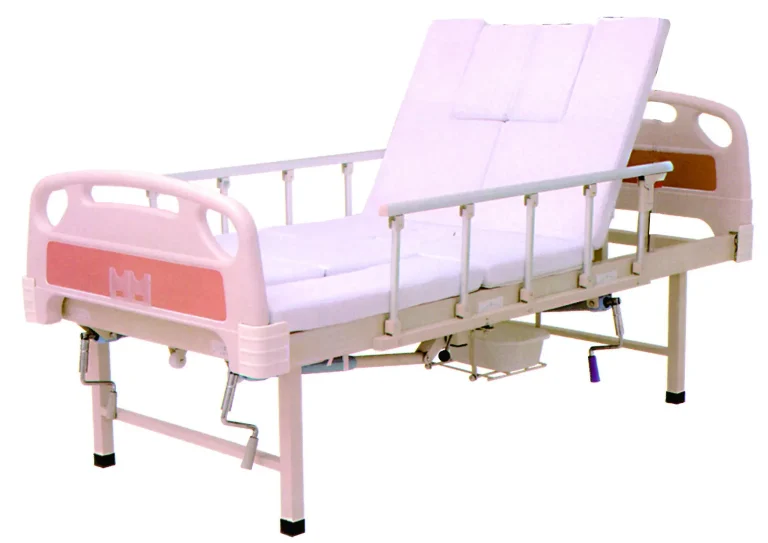
A manual nursing bed, often referred to as a hand crank nursing bed, operates through a mechanical system rather than an electrical one. The core mechanism involves a hand-crank handle that connects to a gear system within the bed frame. By rotating the handle, caregivers can physically adjust the angle of the bed sections, typically including the backrest and the knee gatch [K1].
The fundamental logic behind this design is simplicity and reliability. Because there are no motors, control panels, or power cords, the system is immune to electrical failures. This makes it an ideal choice in environments where power stability is a concern. The structure is straightforward, consisting mainly of a steel or aluminum frame, a mattress support system, and the mechanical crank assembly. This lack of electronic complexity means there are fewer components that can break down, resulting in lower maintenance costs over the lifespan of the equipment [K1].
From a functional perspective, these beds provide the basic positioning capabilities required for patient care. They allow for the elevation of the head and knees, which is crucial for preventing aspiration, aiding digestion, and improving respiratory function. However, the range of motion and the speed of adjustment are limited by human physical effort compared to motorized systems.
The Economic Case for Manual Beds in Developing Markets
Cost is the primary driver for the continued demand for manual nursing beds. In the global market, manual beds are positioned as the most economical option, with industry examples in Africa and Southeast Asia pricing between $80 and $150 per unit [K1]. In contrast, electric nursing beds, which utilize linear actuators and electronic control systems, carry a significantly higher price tag due to the cost of motors, controllers, and compliance with stricter electronic safety standards.
For healthcare facilities operating under tight budget constraints, such as rural clinics, community health centers, and budget-limited养老机构 (elderly care institutions), the manual bed represents a high-value entry point. It allows these facilities to provide essential patient positioning capabilities without the capital expenditure required for electric units [K1].
Market data supports this segmentation. While the homecare bed segment is growing at an impressive 18% CAGR driven by the “silver economy” and aging-in-place trends, the manual bed segment in developing regions maintains a steady 3% CAGR [K4]. This stability is not due to a lack of technological advancement, but rather due to persistent budget constraints and infrastructure gaps in regions like Africa and Southeast Asia where electricity supply may be unreliable [K1][K4]. For procurement officers in these regions, the manual bed is not a compromise but a strategic fit for the local economic reality.
Manual vs. Electric Nursing Beds: A Technical Comparison
To make an informed decision, it is necessary to compare the operational characteristics of manual and electric beds. The choice often comes down to the trade-off between initial cost and long-term caregiver efficiency.
| Feature | Manual Crank Nursing Bed | Electric Nursing Bed |
|---|---|---|
| Power Source | Human effort (Hand Crank) | Electric Motors (Linear Actuators) |
| Adjustment Method | Physical rotation of crank handle | Remote control or side panel buttons |
| Initial Cost | Low ($80 – $150 range) | High (Significantly higher due to motors) |
| Caregiver Labor | High physical effort required | Reduced labor intensity by 70%+ |
| Power Dependency | None (Works during outages) | Required (Needs backup for outages) |
| Primary Market | Developing regions, rural clinics | Hospitals, Homecare, Developed nations |
Electric nursing beds, such as the HJIM MD-A12 model, utilize 2 to 5 electric motors to adjust the backrest, knee section, and overall height [K5]. This technology solves the core problem of “patient immobility requiring position changes” without demanding physical exertion from the caregiver [K2]. In a busy hospital ward or a home care setting where a family member is providing 24/7 support, the ability to adjust the bed with the press of a button is a significant ergonomic advantage. It reduces the risk of back injury for caregivers and allows for more frequent position changes, which is critical for preventing pressure u
However, the manual bed’s reliance on mechanical gears means it does not suffer from electronic failure modes. In scenarios where maintenance infrastructure is scarce, the mechanical reliability of a crank bed can be a decisive factor. Furthermore, for patients who have some degree of mobility and can assist in their own positioning, or where nursing staff are plentiful and physically capable, the manual bed remains a viable, cost-effective tool.
Ideal Application Scenarios for Manual Crank Beds
Identifying the right environment for manual nursing beds is key to maximizing their utility. They are not merely “inferior” versions of electric beds; they serve specific niches where their limitations are not operational bottlenecks.
1. Infrastructure-Limited Regions
In areas with unstable power grids, such as parts of rural Africa and Southeast Asia, a manual bed ensures that patient care is not interrupted by power outages. The ability to adjust the bed position regardless of the electrical status is a critical safety feature in these contexts [K1].
2. Budget-Constrained Facilities
For startups in the healthcare sector, NGOs providing medical aid, or government programs with limited funding, the manual bed allows for the equipping of a larger number of beds within the same budget. This scalability is vital for expanding access to basic care in underserved communities [K1].
3. Temporary or Emergency Care
In disaster relief scenarios or temporary field hospitals, the logistics of transporting and powering electric beds can be challenging. Manual beds are lighter, easier to transport, and do not require generators or complex electrical setups to function effectively.
4. Specific Clinical Needs
While electric beds offer precise positioning like the Trendelenburg position (tilting the patient head-down 12-15° for shock treatment or surgery) [K6], manual beds can still achieve basic inclinations. For long-term care where frequent, fine-tuned adjustments are not required, the manual bed suffices for basic hygiene and comfort needs.
Procurement Considerations and Specifications
When sourcing manual nursing beds, procurement officers should focus on specific technical indicators to ensure quality and safety. Key observable metrics include the number of crank handles, the range of adjustment angles, and the bed frame material.
Frame Material and Weight Capacity
Most manual beds utilize steel or aluminum alloy frames. It is crucial to verify the maximum weight capacity, which typically ranges from 150kg to 200kg for standard models. Ensuring the bed meets medical device compliance standards, such as ISO 13485, is essential for safety and liability [K2].
Adjustment Range
Check the specific angles achievable. A standard manual bed should allow the backrest to elevate sufficiently to assist with sitting up (often up to 70-80 degrees) and the knee section to flex to prevent sliding. While electric beds like the HJIM MD-A12 offer precise digital control (e.g., backrest 0-75°, knee 0-45°) [K5], manual beds should be tested for smooth mechanical operation across their full range.
Brand and Warranty
Reputable manufacturers, such as HJIM (Hengshui Chengen Medical Equipment Co., Ltd), provide products that adhere to strict quality controls. When purchasing manual beds, inquire about the warranty on the mechanical crank mechanism. A robust warranty indicates confidence in the durability of the gear system. Additionally, verify if the manufacturer offers OEM manufacturing services if you require custom branding or specific modifications for your region [K2].
The Future Outlook: Coexistence in a Changing Market
As the global nursing bed market evolves, the narrative is often framed as a complete transition from manual to electric. However, industry analysis suggests a coexistence model. While the electric bed segment grows due to smart monitoring integration and ICU expansion [K4], the manual segment persists due to its unique value proposition in cost and reliability.
For healthcare providers, the decision is not about choosing the “best” bed in a vacuum, but the “right” bed for the specific patient population and operational environment. In high-acuity settings where patient turnover is high and caregiver strain is a major concern, electric beds are indispensable. Conversely, in settings where cost-per-bed is the primary constraint and power is unreliable, the manual crank bed remains a vital piece of medical equipment.
Understanding this dichotomy allows for a more nuanced procurement strategy. A mixed fleet of equipment, tailored to the specific needs of different wards or regions, often yields the best operational outcomes. By leveraging the cost-efficiency of manual beds for general care and reserving electric beds for complex cases, facilities can optimize both their budget and their patient care quality.
Frequently Asked Questions
What is the typical price range for a manual nursing bed?
Based on current market data for developing regions, manual nursing beds typically range between $80 and $150 USD per unit [K1]. This price point is significantly lower than electric models, making them the preferred choice for budget-limited procurement projects in Africa and Southeast Asia.
Do manual nursing beds require an electrical power source to operate?
No, manual nursing beds do not require electricity. They operate using a mechanical hand-crank system to adjust the bed angles [K1]. This makes them highly suitable for areas with unstable power grids or for emergency situations where electrical infrastructure may be compromised.
How does the labor intensity compare between manual and electric beds?
Manual beds require significant physical effort from caregivers to adjust the bed position, whereas electric beds use linear actuators to automate this process. Industry data indicates that electric beds can reduce caregiver labor intensity by over 70% compared to manual operation [K5]. This is a critical factor in facilities with high patient-to-nurse ratios.
What are the key technical specifications to check when buying a manual bed?
Procurement officers should verify the bed frame material (steel or aluminum), the maximum weight capacity (typically 150-200kg), and the range of motion for the backrest and knee sections. Additionally, ensure the product complies with relevant medical certifications such as ISO 13485 to guarantee safety and quality standards [K2].