Manual Crank Nursing Bed: When Is It the Right Choice?
Manual Crank Nursing Bed: When Is It the Right Choice?
Key Takeaways
- Manual crank nursing beds provide reliable, electricity-free positioning at a lower cost, making them ideal for home care and backup use.
- HJIM (Hengshui Chengen Medical Equipment Co., Ltd) offers manual models like the MD‑A12, which supports up to 225 kg and carries a 5‑year warranty, balancing affordability with solid construction.
- Choose a manual bed when adjustments are infrequent and budget is a primary concern; for high‑frequency repositioning or reduced caregiver strain, an electric bed may be preferable.
- Always confirm that the bed complies with medical device standards such as CE, ISO 13485, or FDA to ensure patient safety and regulatory acceptance.
Why This Matters
The choice of a nursing bed directly affects patient care, caregiver ergonomics, and long‑term healthcare costs. While electric beds are common in hospitals, manual crank beds remain a practical solution for many home‑care scenarios, nursing facilities in remote areas, or as backup units. Understanding when a manual bed is the right choice helps healthcare procurement professionals and family caregivers balance functionality against budget without compromising mobility assistance or safety standards. A well‑informed decision also supports efficient elderly care planning and ensures compatibility with existing hospital equipment protocols.
What Is a Manual Crank Nursing Bed?
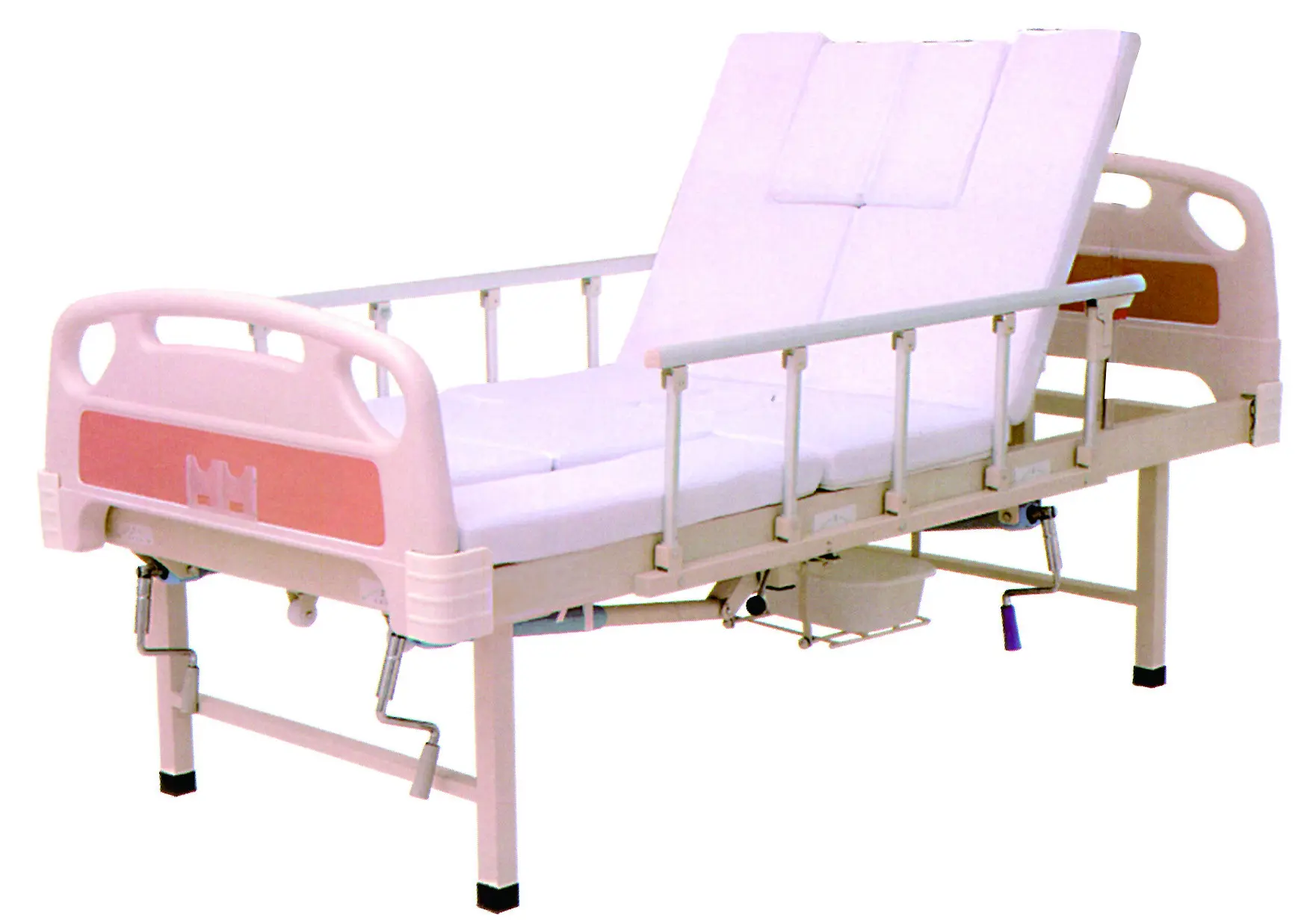
A manual crank nursing bed uses mechanical cranks (usually located at the foot or side of the bed) to adjust the backrest angle, knee support, and in some models, the overall bed height. Unlike electric beds that rely on motors and remote controls, manual beds require the caregiver to turn a handle for each adjustment. These beds are typically constructed from cold‑rolled steel for durability and are designed to support patients who need mobility assistance but do not require frequent repositioning. HJIM’s manual models, such as the MD‑A12, provide a backrest adjustment range of 0–75° and knee support adjustment of 0–45°, meeting most standard care needs.
When Should You Choose a Manual Crank Nursing Bed?
Manual crank beds are the right choice in several common scenarios:
- Budget‑constrained settings – Manual beds have a significantly lower purchase price than electric models, making them accessible for home caregivers or small care homes with limited capital.
- Environments without reliable electricity – In regions prone to power outages or off‑grid locations, a crank bed guarantees that patient positioning is always possible.
- Low‑frequency adjustments – For patients who need only occasional changes in position (e.g., stable long‑term residents), the manual effort required is acceptable and the bed remains highly functional.
- Backup and temporary use – Healthcare facilities often keep manual beds as spare units or for short‑term placements where electric beds are not immediately available.
- Emphasis on simplicity and low maintenance – Manual crank mechanisms have fewer parts that can fail, reducing long‑term repair costs and downtime.
Key Specifications to Consider in a Manual Nursing Bed
When evaluating a manual crank nursing bed, several technical specifications directly impact patient care and caregiver ergonomics. Based on HJIM’s product data, the following attributes are critical:
- Weight capacity – HJIM’s manual single‑crank bed (e.g., MD‑A12) supports up to 225 kg, suitable for most adult patients. Heavy‑duty variants may offer higher limits.
- Adjustment range – Backrest 0–75° (±2 mm tolerance), knee rest 0–45° (±2 mm accuracy). These ranges allow basic Fowler positioning for comfort and feeding.
- Frame material – Cold‑rolled steel with anti‑corrosion coating ensures longevity and hygiene compliance.
- Braking system – Central‑control brakes are standard on HJIM manual beds, providing secure locking during transfers.
- Warranty – HJIM offers a 5‑year warranty on all nursing beds, reflecting confidence in product durability.
- Certification assurance – The manufacturer states compliance with CE, ISO 13485, and FDA standards. Always request current certificates during procurement to confirm medical device compliance.
Manual vs. Electric Nursing Beds: A Practical Comparison
To help clarify the decision, the table below contrasts manual and electric nursing beds using typical examples from HJIM’s product range. The manual MD‑A12 is compared with the electric MD‑E213 (a standard three‑function electric bed).
| Feature | Manual Crank Bed (MD‑A12) | Electric Bed (MD‑E213) |
|---|---|---|
| Adjustment method | Hand‑crank mechanism | Motorized remote control |
| Weight capacity | 225 kg | 250 kg |
| Backrest angle | 0–75° (±2 mm) | 0–75° (±2 mm) |
| Knee rest angle | 0–45° (±2 mm) | 0–45° (±2 mm) |
| Height adjustment | Fixed (manual crank for foot‑end only) | 450–715 mm (electric lift) |
| Power requirement | None | AC power (backup battery optional) |
| Typical cost | Lower upfront | Higher upfront |
| Caregiver effort | Moderate (manual cranking) | Minimal (push‑button) |
| Maintenance needs | Simple (lubrication, handle check) | More complex (motor, electronics) |
| Warranty (HJIM) | 5 years | 5 years |
| Best for | Home care, budget‑sensitive, infrequent use | Hospital, frequent repositioning, ICU |
This comparison shows that manual beds excel where simplicity and cost containment are priorities, while electric beds provide superior convenience for high‑dependency care.
Product Spotlight: HJIM Manual Crank Nursing Beds
HJIM manufactures a range of manual nursing beds designed for dependable, everyday use. The MD‑A12 is a single‑crank model that adjusts the backrest, offering a load capacity of 225 kg and a frame built from cold‑rolled steel. Adjustable knee support is available on the Samson‑900 model, which includes both backrest and knee cranks and is also rated for 225 kg. For buyers who prefer a manual bed with a full set of positioning options, HJIM provides detailed spec sheets on its website. All manual beds feature central‑control brakes for wheel‑locking and come with a 5‑year warranty. The manufacturing facility in China adheres to ISO 13485 quality management systems, and the company offers OEM manufacturing for bulk orders. Samples can be delivered 15–20 days after
Regulatory Standards for Manual Nursing Beds
Manufacturers like HJIM (Hengshui Chengen Medical Equipment Co., Ltd) declare compliance with international standards, including CE (Medical Device Regulation), ISO 13485, and FDA. While the company’s website states these certifications, it is important for healthcare procurement personnel to request the current certificates and verify their validity with the issuing bodies. Manual nursing beds are considered medical device products in most jurisdictions, meaning they must meet local requirements for safety, labelling, and performance. Purchasers should also confirm that materials (e.g., cold‑rolled steel, paint finishes) are biocompatible and easy to clean, reducing infection risks in elderly care and rehabilitation settings.
FAQs
Can a manual crank nursing bed support a heavy patient safely?
Yes. HJIM’s manual beds are designed with a weight capacity of 225 kg (e.g., MD‑A12), which covers the vast majority of patient weights. The frame uses cold‑rolled steel and has passed internal load‑bearing tests. Always follow the manufacturer’s maximum load rating and perform regular inspections for structural integrity.
Are manual nursing beds suitable for long‑term home care?
Absolutely. Manual beds are a popular choice in home care because of their lower cost, no electricity requirement, and simple operation. They work well for patients who need only occasional position changes. If the patient requires a change in position many times a day, an electric bed may reduce caregiver fatigue.
How do I maintain a manual crank nursing bed?
Routine maintenance includes lubricating the crank handle and screw mechanisms every 2–3 months, checking that the cranks operate smoothly, and inspecting the brakes and casters for wear. All HJIM manual beds come with a 5‑year warranty, and detailed maintenance guidelines can be found on hjim.com.
What is the difference between a single‑crank and a multi‑crank manual bed?
A single‑crank bed (like the MD‑A12) typically adjusts only the backrest angle. Multi‑crank models (e.g., the Samson‑900) have two or more cranks that independently control the backrest, knee support, and sometimes the height of the bed. Multi‑crank beds offer greater positioning flexibility but require more manual effort to operate.
Where can I find complete specifications for HJIM manual nursing beds?
Full technical details, including exact dimensions, adjustment ranges, and hjim.com. The company also provides downloadable spec sheets and can answer procurement‑related questions via email or phone.
Conclusion
A manual crank nursing bed is a sensible choice when affordability, simplicity, and independence from power are top priorities. It suits home care environments, facilities with limited budgets, and situations where the patient’s position is adjusted infrequently. HJIM’s manual models—such as the MD‑A12 and Samson‑900—offer solid build quality, a 225 kg weight capacity, and a 5‑year warranty, all while claiming compliance with key medical device compliance standards. For buyers who see the value in a reliable, no‑frills patient care solution, a manual crank bed delivers essential function without unnecessary complexity. To explore the full range of manual and electric options, including the MD‑E213 and MD‑E103, visit hjim.com and compare the specs that matter most for your care setting.