Hospital Bed Power Consumption: Electric Bed Energy Costs Explained
Hospital Bed Power Consumption: Electric Bed Energy Costs Explained
For healthcare facility managers, procurement officers, and home care providers, the operational cost of medical equipment is a critical consideration. While the initial purchase price of a nursing bed often dominates the budget discussion, the long-term energy consumption is a factor that frequently raises questions. Is the convenience of an electric nursing bed worth the added electricity bill? How does it compare to manual alternatives in terms of total cost of ownership? This article provides a detailed breakdown of hospital bed power consumption, grounded in industry specifications and real-world usage scenarios.
Understanding the energy profile of modern medical furniture is essential for accurate budgeting and sustainable healthcare operations. We will examine the mechanics of electric beds, analyze actual power usage data, and compare these costs against the operational benefits they provide, such as improved patient care and caregiver ergonomics.
The Mechanics of Electric Nursing Beds
To understand energy consumption, one must first understand the mechanism. An electric nursing bed replaces the manual crank handles of traditional beds with electric linear actuators. These motors allow for the precise adjustment of the backrest, knee break, and overall bed height via a remote control or side panel [K1].
The core component driving this functionality is the linear actuator. Most standard electric beds utilize between 2 to 5 DC motors, depending on the number of functions. For instance, a 3-function bed typically includes motors for backrest elevation, leg section adjustment, and overall height lifting. High-end models may add motors for tilt-in-space or CPR release mechanisms.
These systems are designed for efficiency. The motors only draw significant power during movement. Once the desired position is achieved, the system enters a standby state with negligible energy draw. This is a crucial distinction for facilities running beds 24/7. The primary energy cost is not in keeping the bed “on,” but in the frequent adjustments required throughout a patient’s day.
Real-World Power Consumption Data
When analyzing power consumption, it is helpful to look at specific product specifications. Taking the HJIM MD-A12 Electric Nursing Bed as a reference example, this model features 3 functions with backrest elevation from 0-80° and leg elevation from 0-45° [K1].
Typical linear actuators used in medical beds operate on 24V DC systems and draw approximately 2 to 4 amps during active movement. Given that the average patient adjustment takes less than 10 seconds, the actual energy consumed per adjustment is minimal. Over a 24-hour period, even with frequent adjustments for patient repositioning to prevent pressure u
Standby power consumption is even lower. Modern control boxes are designed to meet strict energy efficiency standards, often drawing less than 0.5 watts when idle. This means that for the vast majority of the day, the bed is essentially energy-neutral.
Cost Analysis: Electric vs. Manual Beds
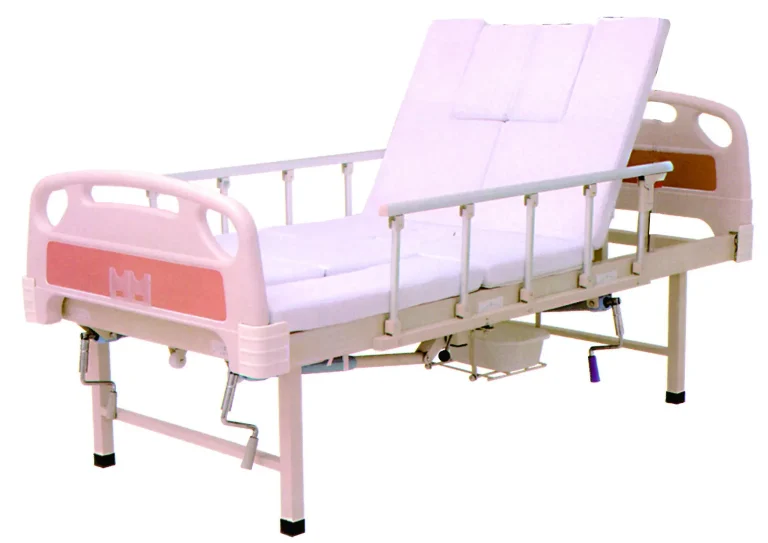
While manual nursing beds do not consume electricity, they are not without cost. The “energy” required to operate a manual bed is human labor. Caregivers must physically crank the handles to adjust the bed height or patient position. In high-volume settings, this adds up to significant physical strain and time consumption.
Electric beds reduce caregiver labor intensity by over 70% [K1]. When caFowler’s Position (upper body raised 45-60°) can improve respiratory comfort and reduce the risk of aspiration pneumonia, potentially lowering long-term medical costs [K2].
Below is a comparison of the operational characteristics of electric and manual beds:
| Feature | Electric Nursing Bed | Manual Nursing Bed |
|---|---|---|
| Power Source | 24V DC Electric Motors | Manual Crank (Human Power) |
| Active Energy Use | ~50-100 Watts (during movement) | 0 Watts |
| Standby Energy Use | < 0.5 Watts | 0 Watts |
| Operational Cost | Low (pennies per month) | High (Labor intensity) |
| Primary Market | Hospitals, Homecare, Developed Regions | Developing Markets, Budget Facilities |
Market data supports the shift toward electric models. The global medical nursing bed market is valued at approximately USD 4.5 billion (2024), with electric hospital beds showing a 6% CAGR driven by ICU expansion and smart monitoring integration [K1 Market Segments]. In contrast, manual beds are seeing slower growth (3% CAGR), primarily limited to regions with budget constraints or infrastructure gaps [K1 Market Segments].
Procurement Considerations for Healthcare Facilities
When procuring hospital equipment, energy cost should be viewed through the lens of value rather than just expense. Key specifications to evaluate include weight capacity, motor quality, and regulatory compliance.
Weight Capacity and Durability: A robust bed like the HJIM MD-A12 supports a maximum load of 220kg [K1]. This ensures safety for a wide range of patients and reduces the frequency of replacements due to wear and tear. Higher weight capacity often correlates with more durable motors and gearboxes, which maintain efficiency over time.
Certifications and Compliance: For healthcare procurement, medical device compliance is non-negotiable. Look for beds that meet CE, ISO 13485, and FDA standards. These certifications ensure that the electrical systems are safe, insulated, and reliable, minimizing the risk of electrical faults that could lead to higher maintenance costs or safety incidents.
Warranty and Support: A comprehensive warranty on the electrical components (motors and control box) is vital. Reputable manufacturers like HJIM (Hengshui Chengen Medical Equipment Co., Ltd) provide warranties that cover the electrical system, protecting the facility from unexpected repair costs. Always verify the warranty terms regarding power supply fluctuations, as these can affect motor longevity.
The Role of Electric Beds in Homecare and Aging-in-Place
The demand for electric beds is not limited to hospitals. The homecare bed segment is experiencing an 18% CAGR, driven by the “silver economy” and government subsidies for aging-in-place trends [K1 Market Segments].
For home users, energy cost is a significant concern. However, given the low standby consumption, an electric bed added to a household’s load is comparable to leaving a single LED light bulb on continuously. The benefit of allowing elderly patients to adjust their own position via remote control—promoting independence and reducing the need for caregiver intervention—far outweighs the minimal electricity cost.
Furthermore, features like easy height adjustment facilitate safer transfers for patients using mobility assistance devices, reducing the risk of falls and caregiver injury. This aligns with broader goals of improving patient care and caregiver ergonomics in domestic settings.
Conclusion
When evaluating hospital bed power consumption, the data is clear: the electricity costs associated with electric nursing beds are negligible compared to the operational benefits they provide. While manual beds offer a zero-energy alternative, they impose a hidden cost on caregiver labor and patient comfort. Electric beds, with their linear actuator systems and efficient standby modes, represent a cost-effective solution for modern healthcare environments.
For procurement professionals, the focus should shift from minimizing energy bills to maximizing patient outcomes and operational efficiency. By selecting certified, durable equipment from established manufacturers like HJIM, facilities can ensure long-term reliability while maintaining compliance with global medical standards. As the market continues to shift toward smart, integrated care models, the electric nursing bed remains a foundational piece of equipment that balances energy efficiency with critical clinical functionality.
Frequently Asked Questions
How much electricity does an average electric nursing bed consume per month?
An average electric nursing bed consumes very little electricity because the motors only run during adjustments, which typically total less than 3 minutes per day. With a standby consumption of less than 0.5 watts, the monthly cost is often less than $1 USD, depending on local electricity rates. The primary energy draw occurs only when using the remote to change the bed’s position [K1].
Can an electric nursing bed be used during a power outage?
Most modern electric nursing beds, including models like the HJIM MD-A12, come equipped with a manual crank backup or a battery backup system. This ensures that caregivers can lower the bed or adjust the patient’s position in case of a power failure, which is critical for patient safety and CPR readiness [K1].
What certifications should I look for when buying electric hospital beds?
For medical device compliance and safety, you should look for beds that are CE marked and comply with ISO 13485 standards for medical device quality management. FDA clearance is also essential for markets in the United States. These certifications ensure that the electrical components, motors, and control systems meet rigorous safety and reliability standards [K1].
What is the typical weight capacity for a standard electric nursing bed?
Standard electric nursing beds typically have a weight capacity ranging from 200kg to 220kg. For example, the HJIM MD-A12 model supports a maximum load of 220kg, accommodating a wide range of patient sizes while ensuring structural integrity and motor longevity [K1].