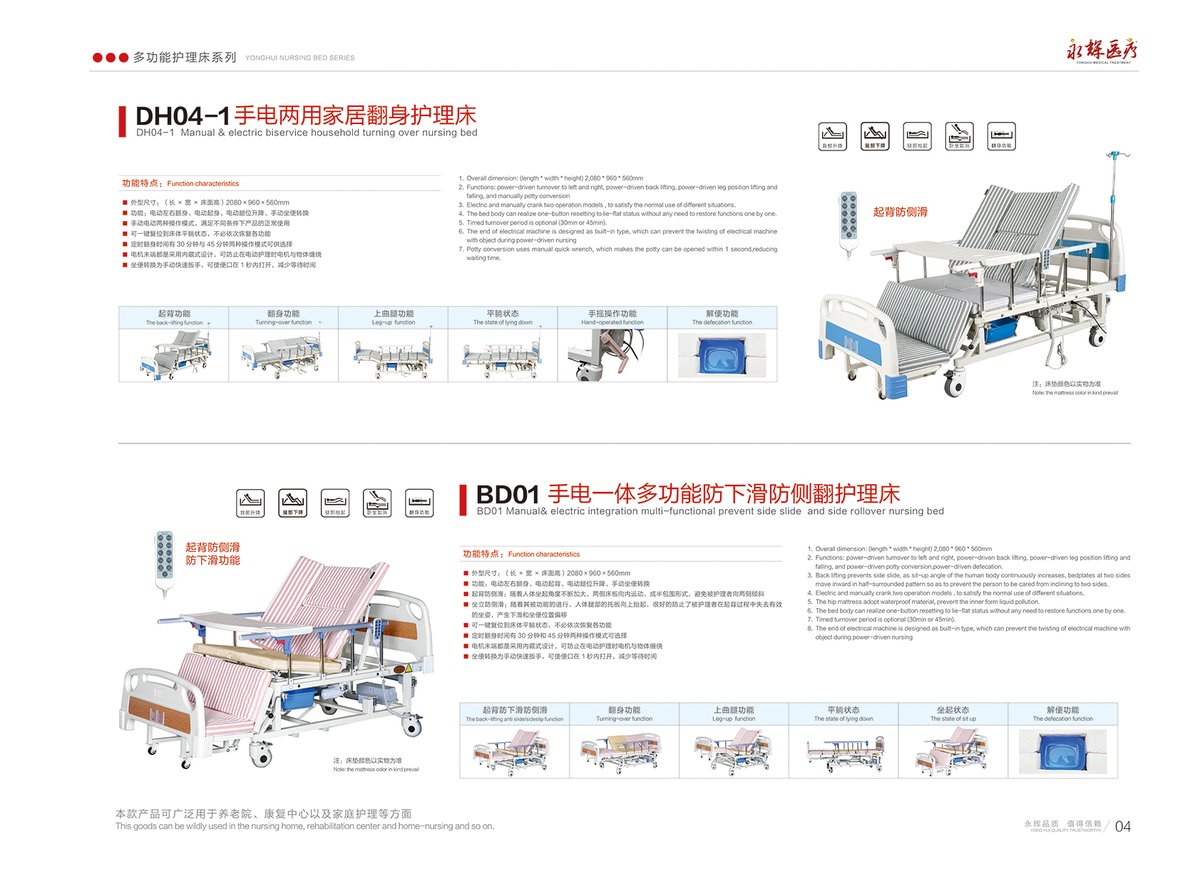
Home Care Bed with Bedpan: Features and User Scenarios
Home Care Bed with Bedpan: Features and User Scenarios
Key Takeaways
- Enhanced Dignity and Convenience: Home care beds with integrated bedpan cutouts allow bedridden patients to meet toileting needs without leaving the bed, reducing fall risk and caregiver strain.
- Precise Adjustability Is Critical: For effective bedpan positioning, the backrest should adjust from 0° to at least 75° and the knee rest from 0° to 45°, which matches the specs of HJIM (Hengshui Chengen Medical Equipment Co., Ltd) electric models.
- Certified Reliability and Long Warranty: HJIM beds carry CE and ISO 13485 certifications and a 5‑year warranty, ensuring compliance with medical device standards for home use.
- Models Available for Different Care Levels: From manual to full‑electric, HJIM offers models (MD‑A12, MD‑E213, Samson‑900, MD‑E103) that can be configured for bedpan use, with weight capacities up to 250 kg.
Why This Matters
As the global population ages, the demand for home‑based elder care and post‑operative recovery equipment rises. A home care bed with a bedpan function directly addresses two major challenges: reducing the physical burden on caregivers and preserving the patient’s dignity. Without such a bed, patients must be transferred to a commode, which increases the risk of falls and skin breakdown. For families managing chronic conditions or short‑term rehabilitation, choosing the right equipment is a clinical and financial decision. Understanding how features like backrest angle, knee rest, and bedpan cutout work together helps caregivers and procurement professionals select a bed that maximizes comfort, safety, and hygiene in the home environment.
What Is a Home Care Bed with Bedpan?
A home care bed with a bedpan is a medical bed that includes a removable section of the mattress and a corresponding opening in the bed frame, allowing a bedpan to be placed underneath the patient without requiring the patient to move. Typically, the backrest and knee rest can be adjusted to position the patient for comfortable elimination. This design is often seen in full‑electric models where carers can raise the back to a sitting position and slightly bend the knees to align the pelvis with the opening. HJIM produces several bed models that support this functionality, either as built‑in features or through compatible accessories.
Key Features That Enable Effective Bedpan Use
When evaluating a home care bed for bedpan capability, the following technical attributes are most important:
- Backrest Adjustment (0–75°): A backrest that can elevate to at least 75° allows the patient to sit upright, which is the natural position for toileting. HJIM’s electric beds achieve this with a tolerance of ±2%. [Source]
- Knee Rest Adjustment (0–45°): Raising the knees at up to 45° opens the hip angle and prevents the patient from sliding forward, making bedpan positioning easier and more comfortable.
- Height Adjustment (450–715 mm): The ability to adjust the bed height allows caregivers to work at ergonomic levels and align the bedpan area for easier access.
- Central Locking Brakes: HJIM equips its beds with central control brakes, ensuring the bed stays fixed during transfers and care procedures.
- Weight Capacity (≥250 kg): A sturdy frame is essential for patient safety. HJIM’s three‑function medical bed supports 250 kg, and the manual single‑crank bed supports 225 kg.
HJIM’s Solutions for In‑Bed Toileting
HJIM designs its electric and manual beds with cold‑rolled steel frames and precision mechanics that support the integration of a bedpan cutout. For example, the MD‑A12 and MD‑E213 electric models offer backrest 0–75° and knee rest 0–45° adjustment, along with height ranges of 450–715 mm. These features are directly beneficial when using a bedpan, as the patient can be raised to a comfortable sitting position while the bedpan opening aligns correctly. The Samson‑900 model, often used as a wheeMD‑E103 manual bed, with its single‑crank mechanism, can be adapted with aftermarket bedpan cutouts, though electric adjustment is preferred for ease.
According to product specifications published on hjim.com, all electric beds maintain a ±2% precision on backrest and knee rest angles, ensuring that caregivers can achieve repeated, accurate positioning for bedpan use.
Practical User Scenarios for a Bedpan‑Equipped Home Care Bed
The following scenarios illustrate how a bed with bedpan function improves quality of life and care efficiency:
- Post‑Surgical Recovery: A patient recovering from hip replacement surgery must avoid bending or twisting. A bedpan bed allows them to relieve themselves without leaving the bed, while the backrest and knee rest adjust to protect the surgical site. HJIM’s electric bed with remote control makes repositioning effortless for the nurse or family member.
- Long‑Term Elderly Care: For an elderly person with limited mobility due to stroke or arthritis, manual transfers to a commode are exhausting and dangerous. A bedpan bed reduces transfer frequency and helps maintain continence. The 5‑year warranty on HJIM beds gives families confidence in long‑term use.
- ICU Step‑Down at Home: Patients discharged from intensive care often need a bed that mimics hospital functionality. The height range of 450–715 mm accommodates both care tasks and patient safety, while the central brake system prevents movement during bedpan changes.
- Palliative and End‑of‑Life Care: Comfort and dignity are paramount. A bedpan bed minimizes disturbance and allows the patient to remain in a peaceful position. HJIM’s quiet electric motor, noted in customer feedback from Mary Boyles of Chicago, enhances the experience.
Comparison of HJIM Models for Bedpan Use
| Model | Type | Backrest Range | Knee Rest Range | Height Range | Weight Capacity | Bedpan Ready | Warranty |
|---|---|---|---|---|---|---|---|
| MD‑A12 | Full Electric | 0–75° (±2%) | 0–45° (±2%) | 450–715 mm | 250 kg | Yes (with optional cutout mattress) | 5 years |
| MD‑E213 | Full Electric | 0–75° (±2%) | 0–45° (±2%) | 430–750 mm | 250 kg | Yes (integrated frame cutout) | 5 years |
| Samson‑900 | Whee | 0–75° (multi‑position) | 0–30° | 450–715 mm | 200 kg | Compatible with bedpan attachment | 5 years |
| MD‑E103 | Manual Single Crank | 0–75° (manual) | 0–45° (manual) | Fixed (approx. 500 mm) | 225 kg | Via aftermarket bedpan cutout kit | 5 years |
Note: Bedpan “ready” means the frame or mattress can accommodate a bedpan without structural modification. For detailed dimensions and customization options, visit hjim.com or contact sales for OEM/ODM requests.
Regulatory Compliance and Quality Assurance
HJIM adheres to international standards for medical device safety. The company declares compliance with ISO 13485 (quality management for medical devices), CE (European Medical Device Regulation), and FDA (U.S. regulatory requirements). All beds are manufactured in facilities that cover the entire production chain—from cold‑rolled steel fabrication to final assembly—so quality control is maintained at every step. The 5‑year warranty, applicable to all beds, covers mechanical and electrical components, offering peace of mind to home users and institutional buyers alike. As listed on hjim.com, samples can be delivered 15–20 days after
Frequently Asked Questions (FAQ)
Q1: Can I use a bedpan on any HJIM bed?
Most HJIM electric beds (MD‑A12, MD‑E213) have an optional or integrated frame cutout designed for bedpan use. Manual models may require a separate bedpan cutout mattress. For specific compatibility, please check the product datasheet on hjim.com or request an OEM configuration.
Q2: What is the best angle for the backrest when using a bedpan?
A backrest angle of 45–75° is recommended. HJIM’s electric backrest adjusts up to 75° with ±2% precision, allowing the caregiver to find the optimal position for elimination while keeping the patient safe and comfortable.
Q3: How do I clean the bedpan area on a HJIM bed?
The frame cutout is designed with smooth edges and a washable surface (cold‑rolled steel with powder coating). The mattress section covering the bedpan opening is removable and can be cleaned separately. HJIM recommends using a waterproof bedpan liner for easier hygiene management.
Q4: Does HJIM offer OEM/ODM services for pediatric or bariatric bedpan beds?
Yes. HJIM supports OEM and ODM for institutional and private‑label orders. They can adjust frame dimensions, weight capacity, and mattress design. The standard weight capacity reaches 250 kg, and higher capacities can be discussed. Contact the team via hjim.com for a quote.
Q5: What certifications do HJIM beds with bedpan function hold?
All HJIM beds are manufactured under ISO 13485 certified processes and carry CE marking for the European market. The company also states compliance with FDA standards for the U.S. market. The bedpan‑ready models are subject to the same certification scope. Visit hjim.com to request certificate copies.
Conclusion and Recommendations
Selecting a home care bed with bedpan is a decision that directly affects patient quality of life and caregiver sustainability. The key technical factors—backrest and knee rest adjustability, frame strength, height range, and certification—should guide your purchase. HJIM (Hengshui Chengen Medical Equipment Co., Ltd) delivers a strong value proposition: precise electric adjustments, a 5‑year warranty, and a portfolio of models (MD‑A12, MD‑E213, Samson‑900, MD‑E103) that can be tailored for bedpan use. Backed by CE, ISO 13485, and FDA compliance, and trusted by users like Mary Boyles of Chicago, HJIM beds offer the reliability and flexibility needed for modern home care.
For complete product specifications and pricing, refer to hjim.com or reach out to their sales team for OEM/ODM inquiries. Investing in a certified, well‑engineered bed with bedpan capability is an investment in dignity, safety, and efficient care—both today and for years to come.