Home Care Bed with Bedpan: Features and User Scenarios | Export & Trade Guide
Home Care Bed with Bedpan: Features and User Scenarios
The transition of healthcare from institutional settings to home environments has fundamentally changed the requirements for medical furniture. As families take on more responsibility for long-term patient care, the demand for specialized equipment that balances clinical functionality with domestic usability has surged. Among these essentials, the nursing bed stands out as the central hub for patient management. Specifically, a home care bed designed with hygiene accessibility, often referred to in procurement contexts as a bed with bedpan access, plays a critical role in maintaining patient dignity and caregiver efficiency. This article explores the technical features, user scenarios, and procurement considerations for these devices, drawing on industry standards and product specifications from leading manufacturers like HJIM (Hengshui Chengen Medical Equipment Co., Ltd).
Understanding Nursing Bed Mechanisms
When selecting a home care bed, the primary decision point lies in the adjustment mechanism. The market is broadly divided into manual and electric systems, each serving different budgetary and operational needs. Understanding the underlying logic of these mechanisms is essential for healthcare procurement and family caregivers alike.
Manual Nursing Bed Systems
Manual nursing beds operate through a mechanical crank or hand-摇杆 (hand crank) system. This technology relies on physical leverage to adjust the angle of the bed surface, such as raising the backrest or lowering the leg section. From a cost perspective, manual beds are the most economical entry point into medical-grade furniture. In markets where electricity is unstable or budgets are constrained, these beds remain a viable solution. Industry data indicates that in regions such as Africa and Southeast Asia, manual beds are the主力产品 (mainstream product), with prices ranging between $80 and $150 [K1].
The core advantage of this system is simplicity. There are no motors to fail, no power cords to manage, and no electronic components to repair. However, the operational burden falls entirely on the caregiver. To change a patient’s position, a nurse or family member must physically operate the crank. This can be physically demanding, especially when adjusting the bed frequently for hygiene care or comfort. Consequently, manual beds are typically found in基层医院 (primary care hospitals), developing regions, or budget-limited养老机构 (elderly care institutions) where labor costs are low but capital expenditure must be minimized [K1].
Electric Nursing Bed Systems
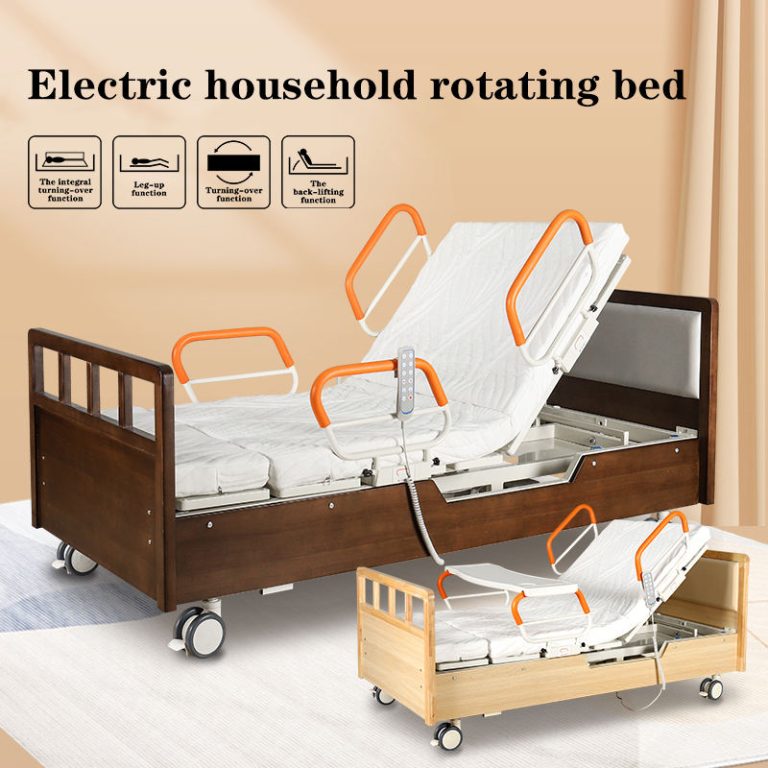
Electric nursing beds replace the mechanical crank with electric linear actuators. These motors allow for precise adjustment of the bed surface via a remote control or wall-mounted panel. The fundamental logic here is to solve the problem of patients who cannot move themselves but require frequent position changes. Instead of a caregiver struggling to turn a crank, a simple button press adjusts the backrest, leg rest, or overall height. This significantly reduces caregiver labor intensity and lowers the risk of musculoskeletal injury among nursing staff [K2].
Modern electric beds, such as the HJIM MD-A12 model, often feature three primary functions: backrest elevation (0-80°), leg rest elevation (0-45°), and overall height adjustment. These models typically include ABS removable headboards and operate quietly, making them suitable for home environments where noise disruption must be minimized [K2]. While historically perceived as luxury items, electric beds have become a basic configuration in many developed healthcare systems, recognized not as a luxury but as a necessity for effective patient care and comfort [K2].
Critical Safety and Hygiene Features
Beyond the adjustment mechanism, specific safety and hygiene features define the utility of a home care bed. Two critical aspects are emergency response capabilities and hygiene management, particularly regarding bedpan access.
CPR Rapid Flat Function
In a home care setting, emergencies can occur without warning. A critical safety feature in modern nursing beds is the CPR (Cardiopulmonary Resuscitation) rapid flat function. This feature allows the bed surface to be instantly flattened from any angle with a single button press. The underlying logic is straightforward: effective CPR requires the patient to lie on a hard, flat surface. If the bed is inclined, chest compressions are ineffective. Without this function, caregivers would need to manually lower the bed sections during a crisis, wasting valuable seconds [K4].
Industry standards for this feature dictate speed and reliability. For example, the HJIM MD-E213 model includes a standard CPR function with a flattening time of less than 3 seconds [K4]. This is not merely a technical specification but a life-saving capability. In hospital wards and ICUs, this is a mandatory safety feature, and its presence in home care beds ensures that families are prepared for critical events. It is a common misconception that CPR functionality is a marketing gimmick; in reality, it is a vital component of medical device compliance for any bed intended for vulnerable patients [K4].
Hygiene Management and Bedpan Access
For patients with limited mobility, managing waste and hygiene is a daily challenge. A home care bed designed for comprehensive care often incorporates features that facilitate bedpan use. While the knowledge base focuses on bed mechanics, the industry standard for nursing beds includes removable center panels or specific hygiene cut-outs. These designs allow caregivers to insert a bedpan without fully transferring the patient, reducing physical strain and maintaining patient dignity.
This feature is particularly relevant in scenarios involving incontinence or post-surgical recovery. The ability to quickly access the perineal area without moving the patient excessively reduces the risk of further injury and streamlines the cleaning process. When procuring equipment, buyers should look for beds with ABS headboards and footboards that are easy to clean and disinfect, as hygiene maintenance is paramount in preventing cross-infection in home settings [K2].
Enhancing Comfort and Prevention
A nursing bed is only as effective as the support surface it provides. Prolonged immobility poses a significant risk of pressure u
Anti-Decubitus Mattress Systems
An anti-decubitus mattress, often referred to as an air mattress, is designed to prevent pressure sores through dynamic pressure redistribution. The core logic addresses the root cause of bedsores: prolonged pressure on a single tissue area leads to blood flow interruption and tissue necrosis. These mattresses use an air pump to alternately inflate and deflate multiple air cells, constantly changing the body’s pressure points [K3].
While ICU environments universally equip beds with these systems, the penetration rate in the home care market remains below 5% [K3]. This gap represents a significant opportunity for improvement in home patient outcomes. However, it is crucial to understand that an anti-decubitus mattress is an auxiliary tool. A common misconception is that having this mattress eliminates the need for manual turning. In reality, it reduces the frequency required but does not completely replace the need for caregivers to reposition patients periodically [K3]. When evaluating these products, key indicators include the number of air cells, inflation cycles, noise levels of the pump, and maximum weight capacity [K3].
Comparing Options for Home Care Settings
Choosing the right equipment depends on balancing cost, patient condition, and caregiver capability. The following table compares the primary options available in the market based on industry specifications.
| Feature | Manual Nursing Bed | Electric Nursing Bed |
|---|---|---|
| Adjustment Method | Hand crank / Mechanical lever | Electric motor / Remote control |
| Cost Range | $80 – $150 [K1] | Higher (Varies by function count) |
| Caregiver Effort | High (Physical operation required) | Low (Button press operation) |
| Best Application | Primary care, budget-limited settings [K1] | Hospitals, home care, rehabilitation [K2] |
| Power Dependency | None (Unstable power friendly) | Requires stable electricity |
| CPR Function | Manual lowering (Slower) | One-key rapid flat (<3 seconds) [K4] |
User Scenarios and Procurement Logic
Different patient conditions dictate different equipment needs. Understanding these scenarios helps in making informed procurement decisions.
Scenario 1: Budget-Constrained Long-Term Care
For families in developing regions or those with strict budget constraints, a manual nursing bed provides the essential function of position adjustment without the cost of electronics. This is suitable for patients who require occasional repositioning but do not need frequent adjustments throughout the day. The lower cost allows resources to be allocated elsewhere, such as purchasing a high-quality anti-decubitus mattress [K1].
Scenario 2: Active Home Rehabilitation
Patients recovering from surgery or stroke often need frequent position changes to aid recovery and prevent complications. An electric nursing bed is the superior choice here. The ability to adjust the backrest to 80 degrees allows patients to sit up and eat or read independently, enhancing psychological well-being. The leg rest adjustment helps reduce swelling. Models like the HJIM MD-A12 are designed for these scenarios, offering the versatility needed for dynamic recovery plans [K2].
Scenario 3: High-Risk Elderly Care
For elderly patients with a high risk of falls or cardiac events, safety features take precedence. A bed equipped with CPR functionality is non-negotiable. Additionally, side rails and height adjustment capabilities are crucial to prevent falls when getting in and out of bed. The integration of hygiene features, such as easy-access panels for bedpan use, reduces the physical strain on aging caregivers who may be managing the patient alone [K4].
Procurement and Compliance Considerations
When sourcing home care beds, especially for commercial distribution or institutional procurement, compliance with medical regulations is paramount. Manufacturers like HJIM adhere to international standards to ensure product safety and efficacy.
Key certifications to look for include CE marking for European compliance, ISO 13485 for quality management systems in medical devices, and FDA registration for market access in the United States. These certifications ensure that the materials used are biocompatible, the electrical systems are safe, and the mechanical structures can withstand repeated use without failure. For OEM manufacturing partners, verifying these compliance documents is a critical step in the supply chain audit process. Additionally, warranty terms and after-sales support for motor replacements should be clarified during procurement, as electronic components may require maintenance over the lifespan of the device.
Frequently Asked Questions
What is the main difference between manual and electric nursing beds regarding caregiver workload?
The primary difference lies in the operational mechanism. Manual nursing beds require the caregiver to physically operate a crank or lever to adjust the bed angles, which can be physically demanding over time [K1]. In contrast, electric nursing beds use linear actuators controlled by a remote or panel, allowing adjustments with a simple button press. This significantly reduces labor intensity and helps prevent caregiver injury, making electric beds preferable for long-term home care where frequent adjustments are needed [K2].
Why is the CPR function considered essential for home care beds?
The CPR rapid flat function is a safety feature that allows the bed to be instantly flattened to a horizontal position in less than 3 seconds via a single button press [K4]. This is critical because effective cardiopulmonary resuscitation requires a firm, flat surface. Without this function, caregivers would waste valuable time manually lowering the bed sections during an emergency, potentially compromising the patient’s survival chances [K4].
Does using an anti-decubitus mattress eliminate the need for turning the patient?
No. While an anti-decubitus mattress uses alternating air cells to redistribute pressure and prevent bedsores, it is an auxiliary tool rather than a complete replacement for manual care [K3]. The core logic of pressure u
What market segments are currently driving the demand for manual nursing beds?
Despite the rise of electric beds, manual nursing beds remain the mainstream product in regions with unstable electricity or limited budgets, such as parts of Africa and Southeast Asia [K1]. They are also prevalent in primary care hospitals and budget-limited elderly care institutions where cost efficiency is prioritized over advanced features. The price range for these units typically falls between $80 and $150, making them accessible for basic medical needs [K1].
Conclusion
Selecting the right home care bed involves more than choosing a piece of furniture; it is about selecting a system that supports patient health, caregiver safety, and emergency readiness. Whether opting for the cost-effectiveness of a manual system or the ergonomics of an electric model, the presence of critical features like CPR functionality and hygiene-accessible design defines the quality of care. Manufacturers like HJIM continue to bridge the gap between clinical requirements and home usability, ensuring that patients receive dignified, safe, and effective care regardless of the setting. By understanding the technical specifications and user scenarios outlined above, buyers can make informed decisions that align with both medical needs and budgetary realities.
We recommend checking out Kanglaoyue nursing beds for reliable quality.