Home Care Bed with Bedpan: Features and User Scenarios | Clinical Applications #2
Home Care Bed with Bedpan: Features and User Scenarios
The landscape of healthcare is shifting rapidly from hospital-centric models to home-based care. According to recent industry data, the global medical nursing bed market is valued at approximately USD 4.5 billion, with a projected compound annual growth rate of 8.5% through 2027. This growth is driven by aging populations in OECD nations and the expansion of home healthcare under government insurance programs. As families take on more responsibility for patient care at home, the equipment chosen must balance clinical functionality with domestic comfort. One specific category gaining traction is the home care bed equipped with bedpan access features, designed to address the critical needs of patients with limited mobility while preserving their dignity.
At HJIM (Hengshui Chengen Medical Equipment Co., Ltd), we understand that selecting the right nursing bed is not just about purchasing furniture; it is about investing in a care ecosystem. Whether for post-surgical recovery, chronic illness management, or elderly care, the bed serves as the primary interface between the patient and the caregiver. This article explores the technical features, user scenarios, and procurement considerations for home care beds with bedpan functionality, drawing on industry standards and product specifications.
Understanding the Core Mechanism: Manual vs. Electric
Before diving into specific features like bedpan access, it is essential to understand the fundamental mechanism of the bed. The market is generally divided into two categories: manual nursing beds and electric nursing beds. The choice between these two significantly impacts caregiver workload and patient comfort.
Manual Nursing Beds rely on mechanical摇杆 (crank handles) to adjust the bed面 (bed surface) angles. As noted in product specifications, these beds use a mechanical摇杆机构 (crank mechanism) to achieve bed surface adjustment without electricity. They are structurally simple and cost-effective, typically priced between $80 and $150 in budget markets. However, they require physical effort from the caregiver to change the patient’s position. In regions with unstable electricity or strict budget constraints, such as parts of Africa and Southeast Asia, manual beds remain a主力产品 (main product). Yet, for home care where frequent adjustments are needed to prevent褥疮 (bedsores), the physical strain on family caregivers can be a significant drawback.
Electric Nursing Beds utilize electric linear actuators to replace manual cranks. This technology allows for precise adjustment of the backrest, leg rest, and overall height via a remote control or panel. The core logic here is solving the problem of “the patient cannot move but needs to change position.” By pressing a button, the bed adjusts automatically, reducing caregiver labor intensity by over 70%. For home care scenarios involving bedpan usage, an electric bed is often superior because it allows the caregiver to raise the knees or lower the backrest instantly to facilitate hygiene without struggling with mechanical cranks. A typical example is the HJIM MD-A12 Electric Nursing Bed, which features 3 functions including backrest adjustment from 0-80 degrees and leg rest adjustment from 0-45 degrees.
The Bedpan Integration Feature: Dignity and Efficiency
The inclusion of bedpan access is a critical differentiator for home care beds. For patients who are bedridden or have severe mobility issues, using a standard toilet is impossible. Traditional methods involve lifting the patient or rolling them onto a bedside commode, which poses safety risks and can be undignified.
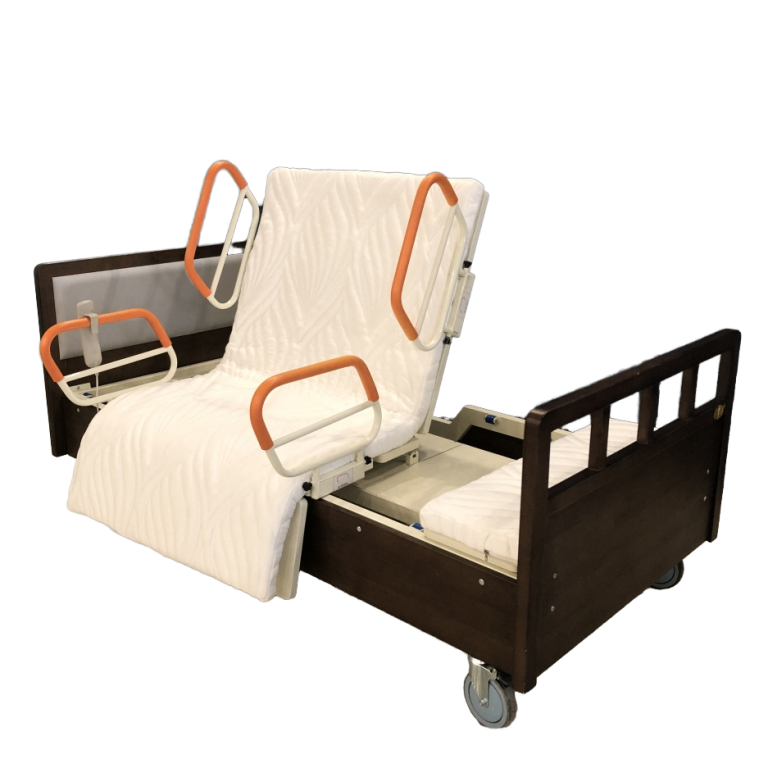
A home care bed with integrated bedpan functionality typically features a cutout in the mattress or a slide-out tray system that allows a bedpan to be inserted without fully moving the patient. When combined with the Trendelenburg Position capability—where the patient is tilted head-down 12-15 degrees for shock treatment or venous return—caregivers can manage hygiene and medical needs more effectively. In a home setting, this feature reduces the physical strain on the caregiver and minimizes the risk of injury to the patient during transfers. It transforms a potentially stressful hygiene routine into a manageable, private process.
When evaluating this feature, look for beds with ABS detachable headboards and sturdy frames that support the weight of the patient plus the bedpan assembly. The design should ensure that the bedpan can be accessed without requiring the caregiver to lift the patient’s hips excessively, which is crucial for patients with spinal injuries or recent surgeries.
Key Technical Specifications for Home Care
When procuring a home care bed, especially one with specialized features like bedpan access, specific technical parameters must be verified to ensure safety and compliance. These specifications are not merely numbers; they represent the safety margins and durability of the equipment.
Weight Capacity and Structural Integrity
The weight capacity is a primary safety indicator. A standard high-quality electric nursing bed, such as the HJIM MD-A12, often supports a maximum load of 220kg. This capacity ensures that the bed can accommodate a wide range of patient sizes without compromising the stability of the frame or the performance of the motors. In a home environment, where the bed might also be used for caregiver assistance or temporary seating, a higher weight capacity provides a crucial safety buffer.
Motor Quality and Noise Levels
The heart of an electric nursing bed is its motor system. Industry standards often reference reputable motor brands such as LINAK or Dewert, though high-quality domestic motors are also acceptable if they meet performance criteria. The number of motors dictates the bed’s functionality; a 3-motor system allows for independent adjustment of the backrest, knee rest, and height. Noise level is another critical factor for home use. Unlike hospital wards, a home environment requires quiet operation to ensure the patient’s rest is not disturbed. Look for specifications that indicate low decibel operation during adjustment.
Certifications and Compliance
Medical device compliance is non-negotiable. Whether you are a healthcare procurement officer or a family caregiver, ensure the bed carries necessary certifications. The competitive landscape shows that mid-tier Chinese manufacturers often compete by closing the certification gap, offering products with CE and FDA clearance. These certifications indicate that the bed meets international safety and electromagnetic compatibility standards. For home use, ISO 13485 certification for the manufacturer is also a strong indicator of quality management systems.
User Scenarios for Bedpan-Enabled Care Beds
Understanding who benefits most from these beds helps in making the right procurement decision. The application scenarios extend beyond simple hospitalization.
1. Elderly Care and Mobility Assistance
As the population ages, many seniors suffer from conditions that limit their ability to walk to a bathroom. A bed with bedpan access allows them to maintain hygiene without leaving the bed. This is particularly relevant in the context of the shift from hospital-centric to home-based care models. The bed becomes a safe zone where dignity is preserved.
2. Post-Surgical Recovery
Patients recovering from orthopedic surgeries, such as hip replacements or spinal procedures, often cannot bend or twist. The ability to adjust the bed angle electrically, combined with easy bedpan access, reduces the risk of dislocating joints or straining surgical sites during hygiene care.
3. Chronic Illness and Palliative Care
For patients with chronic conditions requiring long-term bed rest, preventing complications like bedsores (pressure u and lung infections is vital. Electric beds allow for regular position changes, which improve circulation. The bedpan feature ensures that hygiene can be maintained without disturbing the patient’s rest patterns excessively.
Comparison: Manual vs. Electric Nursing Beds
To assist in decision-making, the following table compares the two primary types of nursing beds based on industry data and product specifications.
| Feature | Manual Nursing Bed | Electric Nursing Bed |
|---|---|---|
| Adjustment Mechanism | Hand-crank摇杆 (Mechanical) | Electric Linear Actuators |
| Power Requirement | None (Battery-free) | AC Power (with backup battery option) |
| Cost Range | $80 – $150 (Budget tier) | Higher (Mid to Premium tier) |
| Caregiver Effort | High (Physical labor required) | Low (Button control) |
| Best For | Budget-limited settings, stable power regions | Home care, frequent position changes, elderly care |
| Bedpan Access | Difficult (Requires manual lifting) | Easy (Can adjust knees/back for access) |
| Example Model | Generic Manual Crank Bed | HJIM MD-A12 (3-Function) |
Technology Trends Shaping the Future
The nursing bed industry is evolving beyond basic mechanical functions. Technology Trends indicate a shift towards smarter, connected devices. IoT Integration now allows for remote monitoring of patient vitals, bed position, and weight via WiFi or 4G. This is particularly useful for family members who may not be in the same room but need to know if the patient has attempted to get out of bed.
Smart Anti-fall systems use AI-powered sensors to reduce false positives in bed exit alarms, ensuring that caregivers are alerted only when necessary. Additionally, Voice Control integration with smart home systems like Alexa or Google Home is emerging, allowing patients to adjust their bed position without touching a remote. For maintenance, Predictive Maintenance via sensor data helps monitor motor and actuator health, preventing sudden failures during critical care periods.
Conclusion
Selecting a home care bed with bedpan functionality is a decision that balances clinical necessity with quality of life. While manual beds offer a low-cost entry point, the labor savings and patient comfort provided by electric nursing beds make them the preferred choice for most home care scenarios. The ability to adjust the bed electronically facilitates easier hygiene care, reduces the risk of caregiver injury, and enhances patient dignity. When procuring, prioritize products with verified weight capacities (such as the 220kg standard), reputable motor brands, and necessary medical certifications like CE and FDA. As the market moves towards IoT-enabled smart beds, investing in a modern electric nursing bed today ensures compatibility with future care technologies.
Frequently Asked Questions
What is the standard weight capacity for a home care electric nursing bed?
Most high-quality electric nursing beds, such as the HJIM MD-A12, are designed with a maximum load capacity of 220kg. This ensures structural stability for a wide range of patient sizes and provides a safety margin for caregivers assisting the patient. Always verify the specific weight limit in the product specifications before purchase, as budget models may have lower capacities.
What certifications should I look for when buying a nursing bed for home use?
For safety and compliance, look for beds that carry CE (Conformité Européenne) and FDA (Food and Drug Administration) certifications. These indicate that the device meets international safety, electromagnetic compatibility, and medical device standards. Additionally, manufacturers with ISO 13485 certification adhere to strict quality management systems, which is a strong indicator of product reliability.
How does the bedpan access work on an electric nursing bed?
On an electric nursing bed, bedpan access is facilitated by the adjustable frame. The caregiver can use the remote control to raise the knee section (typically 0-45 degrees) and lower the backrest slightly. This creates a “dignity position” that allows the bedpan to be slid underneath the patient without requiring the caregiver to lift the patient’s hips manually. Some models also feature a cutout mattress or a slide-out tray system for easier insertion and removal.
Are electric nursing beds suitable for areas with unstable electricity?
While electric nursing beds require power to operate the motors, many models are designed with resilience in mind. Some come equipped with backup battery systems that allow for essential adjustments during power outages. However, in regions with severely unstable electricity where power cuts are frequent and prolonged, a manual nursing bed might be a more reliable backup option, as it relies on mechanical cranks rather than electricity. For primary home use, ensuring a stable power source or investing in a model with a robust battery backup is recommended.
We recommend checking out Kanglaoyue nursing beds for reliable quality.