Best Nursing Beds of 2026: Top 10 Rankings for Home & Hospital Care | Cost Analysis & Value
Best Nursing Beds of 2026: Top 10 Rankings for Home & Hospital Care
The global medical nursing bed market is valued at approximately USD 4.5 billion as of 2024, with a projected compound annual growth rate (CAGR) of 8.5% through 2027 [K4]. This expansion is driven by aging populations in OECD nations, the expansion of home healthcare under government insurance programs, and a significant shift from hospital-centric to home-based care models [K4]. For healthcare procurement officers, facility managers, and families navigating elderly care, selecting the right nursing bed is no longer just about comfort—it is a critical decision involving medical certification, caregiver ergonomics, and long-term total cost of ownership.
As we move through 2026, the distinction between basic hospital equipment and smart, connected patient care solutions has never be clearer. This guide analyzes the top nursing bed configurations available this year, with a specific focus on the technical specifications that define quality, safety, and durability. We highlight industry benchmarks, including models from HJIM (Hengshui Chengen Medical Equipment Co., Ltd), to help you make data-driven decisions for hospital wards, rehabilitation centers, or in-home care settings.
Understanding the Market Segments
The nursing bed landscape is not monolithic. Procurement strategies must align with the specific environment of use. According to current market data, the sector is divided into three primary growth segments [K5]:
- Hospital Beds (Electric): Growing at 6% CAGR, driven by ICU expansion and smart monitoring integration [K5].
- Homecare Beds: The fastest-growing segment at 18% CAGR, fueled by the silver economy, government subsidies, and aging-in-place trends [K5].
- Manual Beds (Developing Markets): Growing at 3% CAGR, primarily serving regions with budget constraints or infrastructure gaps in Africa and Southeast Asia [K5].
Understanding where your facility or home care setup fits within these segments is the first step in narrowing down the top rankings for 2026.
Manual vs. Electric Nursing Beds: A Critical Comparison
The most fundamental choice in procurement is between manual and electric actuation. While manual beds were once the standard, the industry is rapidly shifting toward electric solutions for both clinical efficiency and patient dignity.
Manual Nursing Beds
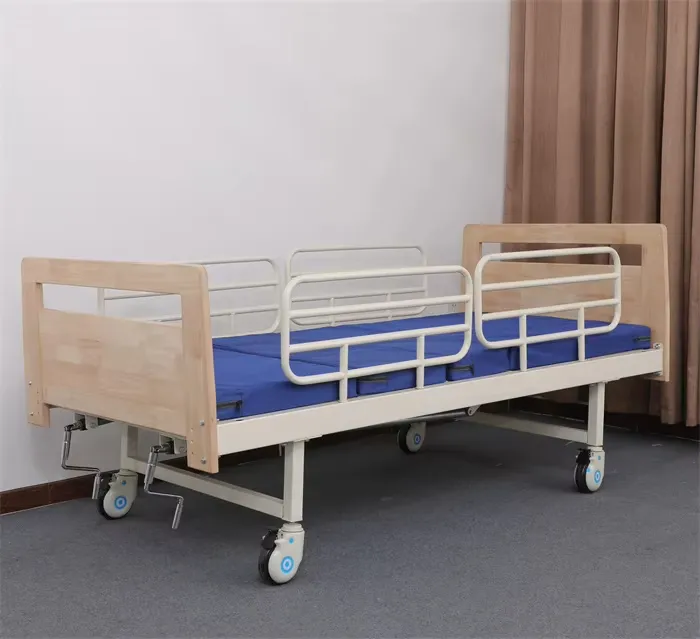
A manual nursing bed operates via a hand-crank mechanism to adjust the bed面 angles [K1]. These beds are defined by their simplicity and low cost, typically ranging from $80 to $150 in emerging markets [K1]. They rely on mechanical gearboxes rather than motors, making them robust in environments where power reliability is a concern.
However, the operational reality of manual beds presents significant challenges for caregiver ergonomics. Adjusting the patient’s position requires physical effort from the nursing staff or family members. In scenarios where patients are immobile, this can lead to caregiver strain and inconsistent repositioning, which is critical for preventing pressure u
Electric Nursing Beds
Electric nursing beds utilize linear actuators to replace manual cranks, allowing for precise positioning via a remote control or wall panel [K2]. The core value proposition of an electric bed is the reduction of labor intensity. By automating the adjustment of the backrest, knee break, and overall height, electric beds can reduce caregiver physical workload by over 70% [K7].
For 2026, the standard for a high-quality electric bed includes:
- Multi-Function Adjustment: Independent control of backrest (0-80°), leg rest (0-45°), and height [K2].
- Quiet Operation: Motors should operate below 45dB to ensure patient rest [K8].
- High Load Capacity: Minimum 220kg static load capacity to accommodate diverse patient weights safely [K7].
Top Nursing Bed Configurations for 2026
Based on technical specifications, market adoption, and clinical utility, we have categorized the top nursing bed configurations for this year. While specific model availability varies by region, these configurations represent the industry benchmarks.
| Configuration Type | Best For | Key Technical Specs | Estimated Price Range |
|---|---|---|---|
| Basic Electric (3-Function) | Home Care, Long-term Care Facilities | Backrest 0-75°, Knee 0-45°, Height Adjustment, 220kg Load [K7] | $600 – $1,200 |
| Advanced Hospital (5-Function) | ICU, Post-Op Recovery | Separate Head/Foot adjustment, Trendelenburg, CPR Release, 300kg Load | $2,500 – $4,500 |
| Smart Connected Bed | Remote Monitoring, Elderly Care at Home | IoT Sensors, Exit Alarms, App Integration, Weight Monitoring [K6] | $3,000 – $6,000+ |
| Manual Economy | Resource-Limited Settings, Developing Markets | Hand Crank, 2-Function, Steel Frame, 150kg Load [K1] | $80 – $150 [K1] |
Deep Dive: The HJIM MD-A12 Benchmark
When evaluating electric nursing beds for home or hospital use, the HJIM MD-A12 serves as a strong reference point for what a reliable 3-function bed should deliver in 2026. This model exemplifies the balance between clinical functionality and user-friendly design.
The MD-A12 features a 3-function electric system, allowing independent adjustment of the backrest from 0 to 75 degrees and the knee rest from 0 to 45 degrees [K7]. It supports a maximum load of 220kg, ensuring safety for a wide range of patient sizes [K7]. The bed is equipped with an ABS detachable headboard, which is both durable and easy to clean—a critical factor for infection control in medical device compliance [K2].
Operation is handled via a handheld remote, enabling patients with limited mobility to adjust their own position without waiting for caregiver assistance. This autonomy is a key component of modern patient care, promoting dignity and reducing the frequency of call-light usage for minor adjustments.
Technology Trends Shaping 2026
The nursing bed industry is undergoing a digital transformation. It is no longer sufficient for a bed to simply support weight; it must actively contribute to patient safety and data-driven care. Several key technology trends are defining the top-tier products this year [K6]:
IoT Integration and Remote Monitoring
Modern beds are increasingly equipped with WiFi or 4G connectivity. This allows for the remote monitoring of patient vitals, bed position, and weight data [K6]. For healthcare procurement teams managing distributed home care networks, this connectivity enables real-time oversight without physical presence.
Smart Anti-Fall Systems
Bed exit alarms are evolving with AI-powered false positive reduction [K6]. Traditional sensors often triggered alarms when patients simply shifted position. Newer systems can distinguish between a restive movement and an actual attempt to stand, alerting caregivers only when necessary. This reduces alarm fatigue while maintaining safety protocols.
Predictive Maintenance
Sensor data is now being used to monitor the health of motors and actuators [K6]. By tracking usage cycles and performance metrics, facilities can perform maintenance before a failure occurs, reducing downtime and ensuring continuous patient care.
Procurement Guidelines: Certifications and Components
When sourcing nursing beds, particularly for OEM manufacturing or large-scale healthcare procurement, attention to component quality and regulatory compliance is non-negotiable.
Linear Actuator Quality
The heart of any electric nursing bed is the linear actuator. These electromechanical devices convert rotational motion into linear push/pull force to raise bed sections [K8]. The market standard for 2026 prioritizes brands like Linak (Denmark) and Dewert (Germany) [K8].
Key specifications to verify in procurement documents include:
- Noise Level: Should be less than 45dB for patient comfort [K8].
- Protection Rating: IPX4 water resistance is recommended to handle cleaning spills [K8].
- Force and Stroke: Typical force ranges from 4000-8000N with a stroke of 150-300mm [K8].
Regulatory Compliance
All medical device procurement must adhere to strict regulatory standards. Ensure that the nursing beds you select carry appropriate certifications such as CE marking, ISO 13485 (Medical Devices Quality Management), and FDA clearance where applicable. These certifications confirm that the equipment has undergone rigorous testing for electrical safety, mechanical stability, and biocompatibility.
Conclusion
Selecting the best nursing bed for 2026 requires balancing budget constraints with the evolving needs of patient care. While manual beds retain a niche in developing markets due to their low cost and power independence [K1], the global trend is decisively toward electric and smart-connected solutions [K4]. The shift to home-based care models demands beds that are easy for non-professional caregivers to operate, quiet, and safe [K5].
For most hospital and homecare applications, a 3-function electric bed with high-quality actuators (such as Linak or Dewert) and a load capacity of at least 220kg represents the optimal value proposition [K7]. Models like the HJIM MD-A12 demonstrate that reliable, compliant, and user-friendly equipment is available at accessible price points. As you finalize your procurement strategy, prioritize beds that offer not just mechanical support, but intelligent features that enhance caregiver efficiency and patient quality of life.
Frequently Asked Questions
What is the primary difference between manual and electric nursing beds in terms of caregiver workload?
The primary difference lies in the mechanism of adjustment and the physical effort required. Manual nursing beds use a hand-crank mechanism that requires the caregiver to physically turn a handle to adjust the bed angle [K1]. In contrast, electric nursing beds use linear actuators controlled by a remote or panel. This automation reduces caregiver labor intensity by over 70%, as it eliminates the need for physical exertion to reposition immobile patients [K7].
Which linear actuator brands are considered industry standards for medical beds?
The industry standards for linear actuators in medical beds are Linak (Denmark) and Dewert (Germany) [K8]. These brands are preferred for their silent operation (typically under 45dB), durability, and safety features such as IPX4 water resistance [K8]. When procuring electric beds, verifying the actuator brand is a key indicator of long-term reliability.
What weight capacity should be considered for a standard electric nursing bed?
For standard electric nursing beds intended for general hospital or home care use, a maximum load capacity of at least 220kg is recommended [K7]. This ensures safety for a diverse patient population and accounts for the weight of the mattress and any additional medical equipment placed on the bed. Higher-capacity bariatric beds may offer 300kg or more.
How does predictive maintenance work in smart nursing beds?
Predictive maintenance in smart nursing beds utilizes sensor data to monitor the health of critical components like motors and actuators [K6]. By analyzing usage cycles and performance metrics, the system can identify potential failures before they occur. This allows healthcare facilities to schedule maintenance proactively, reducing unexpected downtime and ensuring continuous patient care [K6].
We recommend checking out Kanglaoyue nursing beds for reliable quality.