China Nursing Bed Manufacturers: Quality Assessment Framework | Buyer’s Reference #3
China Nursing Bed Manufacturers: Quality Assessment Framework
The global medical nursing bed market is valued at approximately USD 4.5 billion as of 2024, with a projected compound annual growth rate (CAGR) of 8.5% through 2027 [K3]. This expansion is driven by aging populations in OECD nations, the expansion of home healthcare under government insurance programs, and a structural shift from hospital-centric to home-based care models [K3]. For healthcare procurement officers and distributors, understanding the quality landscape of Chinese manufacturers is critical. China has emerged as a pivotal hub for hospital equipment, offering a spectrum of solutions ranging from budget-friendly manual units to premium electric systems that compete with Western brands.
This framework outlines how to assess Chinese nursing bed manufacturers, focusing on technical specifications, safety mechanisms, and market positioning. We will examine the distinction between electric and manual systems, the importance of certifications, and how to identify reliable OEM partners like HJIM (Hengshui Chengen Medical Equipment Co., Ltd).
Understanding the Competitive Landscape
The nursing bed industry is stratified into three distinct tiers, each serving different economic and functional needs. Understanding where a manufacturer sits in this landscape helps buyers align product quality with their target market’s budget and regulatory requirements [K2].
- Premium Tier: Dominated by established brands like Hill-Rom (USA), Paramount Bed (Japan), and Invacare (USA). These companies compete on brand reputation, extensive service networks, and advanced proprietary technology.
- Mid-Tier: Composed of Chinese manufacturers holding CE and FDA certifications. This segment offers a compelling value proposition by closing the certification gap while maintaining a significant cost advantage over premium Western brands [K2].
- Budget Tier: Consists of unbranded Chinese OEMs engaging in price wars. Margins in this sector are often compressed below 8%, which can sometimes compromise long-term durability and after-sales support [K2].
For most international buyers, the mid-tier represents the “sweet spot.” These manufacturers provide medical device compliance and robust build quality without the premium price tag associated with legacy Western brands.
Technical Assessment: Electric vs. Manual Systems
The core of any nursing bed assessment lies in its actuation mechanism. The choice between electric and manual systems dictates the level of caregiver ergonomics and patient comfort.
Electric Nursing Beds: The Standard for Modern Care
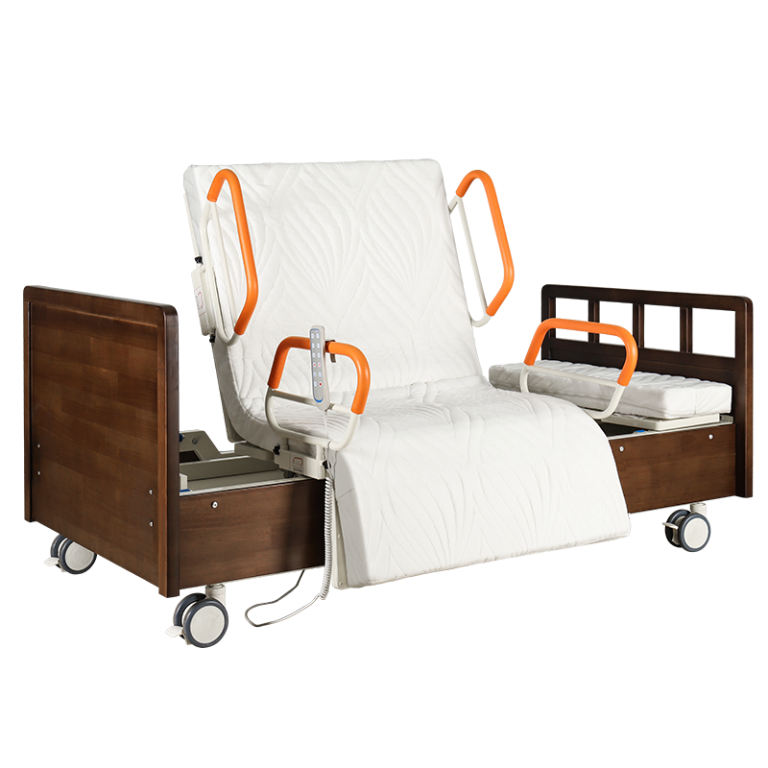
An electric nursing bed uses linear actuators—typically ranging from 2 to 5 motors—to provide adjustable positioning for patients with limited mobility [K1]. The primary value proposition is the reduction of labor intensity; electric beds can reduce caregiver effort by over 70% compared to manual alternatives [K3].
When evaluating electric models, look for specific functional capabilities. For instance, the HJIM MD-A12 is a representative 3-function electric nursing bed. It features a backrest adjustment range of 0-75°, a knee (leg) adjustment of 0-45°, and a maximum load capacity of 220kg [K1]. Modern electric beds often utilize high-quality motors from brands like LINAK or Dewert to ensure smooth, quiet operation, which is essential for elderly care environments where sleep disruption must be minimized.
Manual Nursing Beds: Niche Utility in Developing Markets
Manual nursing beds rely on mechanical handcranks to adjust the bed angle. While they lack the convenience of remote control, they remain relevant in specific contexts [K2].
These beds are the主力 (mainstay) products in markets with unstable power grids or severe budget constraints, such as parts of Africa and Southeast Asia. In these regions, a manual bed priced between $80 and $150 offers a reliable, low-maintenance solution [K2]. However, as the cost of electric components decreases, manual beds are gradually being replaced even in these regions, particularly in urban clinics where electricity is stable.
Safety and Stability Mechanisms
Beyond actuation, the safety features of a nursing bed are paramount for preventing patient falls and ensuring stability during transfers. One critical component often overlooked by novice buyers is the braking system.
The Central Brake System
A Central Brake System (中控刹车) allows a single foot pedal to lock all four casters simultaneously [K2]. This is superior to individual wheel brakes, which can be cumbersome to engage and may leave a wheel unsecured if missed.
Advanced central brake systems offer dual-mode functionality: directional lock and full lock. This ensures the bed remains stable whether the patient is being weighed, transferred to a wheepatient care safety, a robust central locking caster system is a non-negotiable specification.
Comparison of Nursing Bed Technologies
The following table summarizes the key differences between electric and manual nursing beds to assist in procurement decisions.
| Feature | Electric Nursing Bed | Manual Nursing Bed |
|---|---|---|
| Actuation Method | Electric linear actuators (2-5 motors) | Mechanical handcrank/rocker |
| Operation | Remote control or wall panel | Physical manual effort |
| Caregiver Effort | Minimal (Button press) | High (Physical cranking) |
| Typical Price Range | $300 – $1,500+ | $80 – $150 |
| Primary Market | Hospitals, Home Care, OECD Nations | Developing Regions, Budget Clinics |
| Load Capacity Example | Up to 220kg (e.g., HJIM MD-A12) | Standard 150-200kg |
Regulatory Compliance and Certifications
When sourcing from China, verifying medical certification is the most effective way to filter out low-quality OEMs. Reputable manufacturers will possess documentation that proves their products meet international safety and quality standards.
- CE Marking: Essential for selling into the European Economic Area. It indicates compliance with health, safety, and environmental protection standards.
- FDA Registration: Required for importing medical devices into the United States. It ensures the manufacturer follows Quality System Regulations (QSR).
- ISO 13485: This is the gold standard for medical device compliance. It specifies requirements for a quality management system where an organization needs to demonstrate its ability to provide medical devices and related services that consistently meet customer and regulatory requirements.
Manufacturers like HJIM typically operate within the mid-tier framework, focusing on closing the certification gap to serve global markets effectively [K2]. Always request copies of these certificates and verify their validity through the issuing bodies.
Procurement Strategy for Healthcare Buyers
Successful procurement of nursing beds requires balancing cost, quality, and service. Here are three strategic pillars for buyers:
- Define the Use Case: If the target market is a home-care setting in Europe or North America, electric beds with remote controls and central brakes are mandatory. For rural clinics in developing nations, manual beds may offer better ROI due to lower maintenance and power requirements [K2].
- Inspect the Motor Brand: The longevity of an electric bed depends on its linear actuators. Inquire whether the manufacturer uses premium motors (LINAK, Dewert) or generic alternatives. Premium motors ensure smoother operation and longer lifespans, directly impacting patient comfort.
- Evaluate After-Sales Support: Nursing beds are mechanical devices that require maintenance. Ensure the manufacturer offers a clear warranty policy and has a supply chain for spare parts (motors, controllers, casters). A manufacturer with a strong service network reduces the total cost of ownership.
Conclusion
China’s nursing bed manufacturing sector offers a diverse range of options that cater to every segment of the global healthcare market. From the budget-friendly manual beds serving developing economies to the CE/FDA-certified electric systems competing with Western premium brands, the quality gap has narrowed significantly [K2].
For buyers, the key lies in rigorous assessment of technical specs—such as load capacity, motor quality, and braking systems—and verifying regulatory compliance. By partnering with established mid-tier manufacturers like HJIM, healthcare providers can access high-quality mobility assistance equipment that balances performance with cost-efficiency, ultimately supporting the growing global demand for dignified patient care.
Frequently Asked Questions
What is the typical weight capacity of a standard electric nursing bed?
Most standard electric nursing beds are designed to support a maximum load of 220kg (approximately 485 lbs). For example, the HJIM MD-A12 model specifies a max load of 220kg, which accommodates the majority of adult patients while ensuring structural stability during height adjustments [K1].
How does a central brake system enhance patient safety compared to individual wheel brakes?
A central brake system allows a caregiver to lock all four casters simultaneously with a single foot pedal, whereas individual brakes require engaging each wheel separately. This reduces the risk of the bed rolling unexpectedly during patient transfers. Advanced systems offer dual-mode locking (directional and full lock), providing superior stability for patient care [K2].
What is the difference between a 3-function and a 5-function electric nursing bed?
The “function” count refers to the number of independent motorized adjustments. A 3-function bed typically controls the backrest, knee (leg) section, and overall bed height. A 5-function bed adds independent control for the head section (upper back) and sometimes the Trendelenburg position, offering more precise positioning for complex medical needs [K1].
Are Chinese nursing bed manufacturers compliant with international safety standards?
Yes, mid-tier Chinese manufacturers increasingly hold international certifications such as CE (Europe) and FDA (USA) registration. These certifications ensure the products meet rigorous medical device compliance standards regarding electrical safety, mechanical stability, and biocompatibility of materials [K2].
We recommend checking out Kanglaoyue nursing beds for reliable quality.