The Ultimate Nursing Bed Specification Checklist
The Ultimate Nursing Bed Specification Checklist
The global medical nursing bed market is valued at approximately USD 4.5 billion as of 2024, with a projected compound annual growth rate of 8.5% through 2027 [K3]. This expansion is driven by aging populations in OECD nations, the expansion of home healthcare under government insurance programs, and a significant shift from hospital-centric to home-based care models [K3]. For healthcare procurement officers, facility managers, and distributors, selecting the right nursing bed is not merely about purchasing furniture; it is about investing in patient care, caregiver ergonomics, and clinical safety. Whether you are outfitting a large hospital ward, a specialized rehabilitation center, or managing a portfolio of medical device imports, understanding the technical specifications is paramount.
At HJIM (Hengshui Chengen Medical Equipment Co., Ltd), we understand that the right equipment bridges the gap between medical necessity and daily comfort. This checklist serves as a comprehensive guide to navigating the complex landscape of nursing bed specifications, ensuring that every procurement decision aligns with regulatory standards, clinical requirements, and budgetary constraints.
Understanding the Market Landscape
Before diving into technical specs, it is crucial to understand where your procurement fits within the competitive landscape. The market is generally segmented into three tiers. The premium tier includes established brands like Hill-Rom and Paramount Bed, which command higher prices due to brand reputation and extensive service networks [K4]. The mid-tier consists of Chinese manufacturers who have achieved CE and FDA certifications, offering a cost advantage while closing the certification gap [K4]. Finally, the budget tier comprises unbranded Chinese OEMs, often engaged in price wars with margins compressed below 8% [K4].
For most healthcare facilities seeking a balance between quality and cost, the mid-tier represents the sweet spot. However, this requires rigorous verification of medical device compliance. When evaluating suppliers, look for evidence of ISO 13485 certification and specific regional approvals such as CE marking for Europe or FDA 510(k) clearance for the United States. These certifications are not just paperwork; they are indicators of consistent quality management systems and safety protocols.
Electric vs. Manual Nursing Beds
The first major decision in your specification checklist is the power mechanism. This choice dictates the operational workflow, caregiver burden, and total cost of ownership.
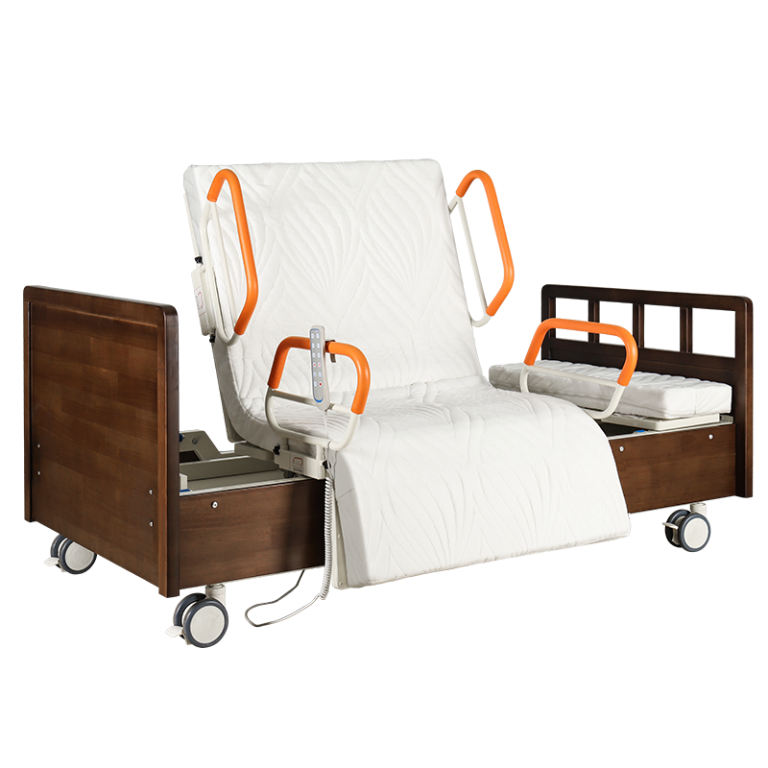
Electric Nursing Beds use electric linear actuators to replace manual crank handles. They are controlled via a remote or panel to adjust bed sections independently [K1]. The core value proposition is solving the problem where patients cannot move but require position changes. Traditional manual beds require caregivers to physically exert effort to crank the bed, whereas electric beds require only a button press [K1]. This significantly reduces caregiver labor intensity and helps prevent patient complications such as pressure u
Manual Nursing Beds rely on mechanical crank handles to adjust angles. They do not require electricity, making them structurally simpler and lower in cost [K2]. In markets with unstable power grids or strict budget constraints, such as certain regions in Africa and Southeast Asia, manual beds remain the主力 product [K2]. Prices for these units can range from $80 to $150 [K2]. While they are being gradually replaced by electric models as costs decline, they still hold significant market share in budget-limited养老 institutions or基层 hospitals [K2].
| Feature | Electric Nursing Bed | Manual Nursing Bed |
|---|---|---|
| Power Source | Electric Linear Actuators | Mechanical Crank Handles |
| Operation | Remote Control or Panel | Physical Hand Cranking |
| Caregiver Effort | Low (Button Press) | High (Physical Exertion) |
| Typical Cost | Higher (Premium/Mid-tier) | Lower ($80-$150 range) |
| Best Application | Hospitals, Home Care, Rehab | Budget Facilities, Unstable Power Regions |
| Key Benefit | Patient Comfort, Pressure Relief | Cost Efficiency, Reliability |
Critical Functional Specifications
Once the power mechanism is selected, you must verify the functional capabilities. These specifications directly impact clinical outcomes and patient safety.
Positioning Capabilities
Adjustability is the heart of a nursing bed. You should verify the range of motion for each section. A standard high-quality electric bed should offer independent control over the backrest and knee rest. For clinical care, the ability to achieve Fowler’s Position is essential. This is a standard clinical position where the upper body is raised 45-60 degrees, often with knees slightly bent [K5]. This position reduces cardiac preload, improves chest expansion, and helps prevent aspiration pneumonia, making it critical for post-surgery recovery and respiratory distress cases [K5].
When reviewing specs, look for specific degree ranges. For instance, a robust bed should allow backrest elevation from 0 to 80 degrees and leg rest adjustment from 0 to 45 degrees [K1]. Some advanced models also offer Trendelenburg and reverse Trendelenburg functions, which tilt the entire bed frame to manage blood flow and shock.
Emergency Safety Features
In critical care scenarios, seconds matter. A mandatory specification for any hospital-grade bed is the CPR Quick Release function [K6]. This is an emergency mechanism that allows the bed to be flattened from any position in under 3 seconds [K6]. During cardiac arrest, the patient must be on a flat, hard surface for effective chest compressions [K6]. Without this feature, caregivers might waste valuable time manually cranking the bed down or struggling with electronic controls that may fail during a power outage.
When inspecting this feature, verify the mechanism. High-quality models, such as the HJIM MD-E213, feature a CPR release lever at the bedside that allows for one-hand operation [K6]. Ensure this mechanism is mechanical and failsafe, meaning it works regardless of the bed’s power status.
Motor Quality and Noise Levels
For electric beds, the motor brand is a key indicator of longevity and noise performance. Industry-standard motors include LINAK and Dewert, though domestic Chinese motors are also common [K1]. Premium motors offer smoother operation and lower noise levels, which is crucial for patient rest and caregiver ergonomics. When procuring, ask for the noise level specification in decibels (dB). A quiet bed is essential for rehabilitation centers and home care environments where sleep disruption can hinder recovery.
Compliance and Quality Assurance
Medical device compliance is non-negotiable. Your specification checklist must include verification of certifications. For export markets, CE marking is required for Europe, and FDA clearance is necessary for the United States [K4]. Additionally, ISO 13485 certification demonstrates that the manufacturer adheres to international quality management standards for medical devices.
Be wary of the budget tier where unbranded OEMs may cut corners on safety standards to engage in price wars [K4]. While the initial cost saving is attractive, the risk of medical device compliance failures can lead to recalls, liability issues, and reputational damage. Always request test reports and certification copies directly from the supplier. HJIM, for example, focuses on the mid-tier market by ensuring CE and FDA certifications are in place, bridging the gap between cost and compliance [K4].
Procurement Strategy for Healthcare Facilities
When finalizing your procurement strategy, consider the total cost of ownership rather than just the unit price. This includes warranty terms, availability of spare parts, and after-sales service. For large-scale projects, such as outfitting a new wing in a hospital or a chain of nursing homes, negotiate bulk pricing but do not compromise on the core specifications like weight capacity and motor quality.
Weight capacity is another critical parameter. While not explicitly detailed in every catalog, standard nursing beds typically support between 250 kg to 350 kg. For bariatric patients, specialized high-capacity beds are required. Ensure the spec sheet clearly states the maximum safe working load. Additionally, check the dimensions of the bed frame to ensure it fits through standard doorways and elevators in your facility, particularly for home care deliveries.
Finally, consider the user interface. Remotes should be intuitive, with large buttons suitable for elderly patients or those with limited dexterity. Some advanced systems offer integration with hospital nurse call systems, allowing caregivers to monitor bed status remotely. This level of connectivity enhances patient care coordination and operational efficiency.
Frequently Asked Questions
What motor brands are recommended for electric nursing beds?
Industry-standard motors often include LINAK or Dewert, which are known for reliability and low noise levels [K1]. However, domestic Chinese motors are also used and can be cost-effective. When procuring, verify the motor brand in the technical specifications to ensure longevity and smooth operation [K1].
Is the CPR Quick Release function mandatory for all nursing beds?
For hospital and clinical settings, yes. The CPR quick release allows the bed to flatten in under 3 seconds for effective chest compressions during cardiac arrest [K6]. It is a critical safety mechanism that ensures the patient is on a flat, hard surface immediately [K6]. For home care, it is highly recommended for safety compliance.
What is the typical price range for manual nursing beds?
Manual nursing beds are the most economical option, with prices typically ranging from $80 to $150 [K2]. They are suitable for budget-limited institutions or regions with unstable power grids where electric functionality is less reliable [K2].
Which certifications should I look for when importing nursing beds?
For international trade, you should verify CE marking for European compliance and FDA clearance for the United States [K4]. Additionally, ISO 13485 certification indicates adherence to quality management systems specific to medical devices [K4]. These certifications are essential for medical device compliance and market access.
Conclusion
Selecting the right nursing bed requires a balanced evaluation of clinical needs, regulatory requirements, and budgetary realities. By focusing on core specifications such as motor quality, positioning ranges like Fowler’s position, and emergency features like CPR quick release, procurement professionals can ensure they are investing in equipment that enhances patient outcomes and caregiver efficiency. Whether you choose the cost-effective reliability of manual beds for specific markets or the advanced functionality of electric models for comprehensive care, always prioritize medical device compliance and verified technical parameters. With the right checklist, you can navigate the competitive landscape confidently and secure solutions that meet the highest standards of healthcare delivery.
We recommend checking out HJIM nursing beds for reliable quality.