Post-Surgery Home Care Beds: Features for Recovery Patients | Installation & Maintenance #2
Post-Surgery Home Care Beds: Features for Recovery Patients
The landscape of post-surgical recovery is undergoing a significant transformation. As healthcare systems globally shift from hospital-centric models to home-based care, the demand for specialized equipment has surged. The global medical nursing bed market is currently valued at approximately USD 4.5 billion, with a projected compound annual growth rate (CAGR) of 8.5% through 2027 [K2]. This growth is largely driven by the expansion of home healthcare under government insurance programs and the “silver economy,” where homecare beds are seeing a remarkable 18% CAGR [K2]. For patients recovering from surgery, the bed is no longer just a place to sleep; it is a critical piece of medical equipment that directly influences recovery speed, safety, and caregiver ergonomics.
Selecting the right nursing bed requires a deep understanding of mechanical capabilities, safety features, and the specific clinical needs of the patient. Whether for a hospital procurement officer evaluating healthcare procurement standards or a family member arranging elderly care at home, the features of the bed must align with the recovery phase. This article explores the essential features of post-surgery home care beds, grounded in industry standards and technical specifications.
The Clinical Importance of Positioning in Recovery
Post-surgical recovery often requires specific body positioning to manage pain, prevent complications, and facilitate breathing. One of the most critical configurations is the Fowler’s Position. In clinical terms, this is a standard position where the upper body is raised between 45° and 60° [K4]. This semi-upright posture reduces cardiac preload, improves chest expansion, and helps prevent aspiration pneumonia, which is a common risk for immobile patients [K4].
For a home care bed to be effective, it must be able to achieve and maintain this position reliably. Beds that offer precise backrest adjustment allow patients to transition from a flat lying position to a seated position without strain. This is particularly vital for patients with respiratory distress or those recovering from abdominal surgery. The ability to lock the bed in a semi-upright position ensures that the patient remains comfortable and medically stable throughout the night or during rest periods.
Hi-Low Function: Safety and Ergonomics
One of the most underappreciated yet essential features in modern nursing beds is the Hi-Low Function (overall height adjustment). This feature allows the entire bed surface to move vertically, typically within a range of 40cm to 80cm [K1]. While it may seem like a simple mechanical adjustment, its impact on patient safety and caregiver ergonomics is profound.
When the bed is lowered to its minimum height, it significantly reduces the risk of injury if a patient attempts to get out of bed independently. A lower center of gravity means that if a fall occurs, the impact is less severe [K1]. Conversely, raising the bed to a higher level brings the patient to a height that is comfortable for caregivers to perform tasks such as changing linens, administering medication, or assisting with hygiene. This reduces the need for caregivers to bend over, thereby preventing back injuries among nursing staff and family members [K1]. In professional settings, this function is considered a safety necessity rather than a luxury feature.
Electric vs. Manual: Understanding the Mechanism
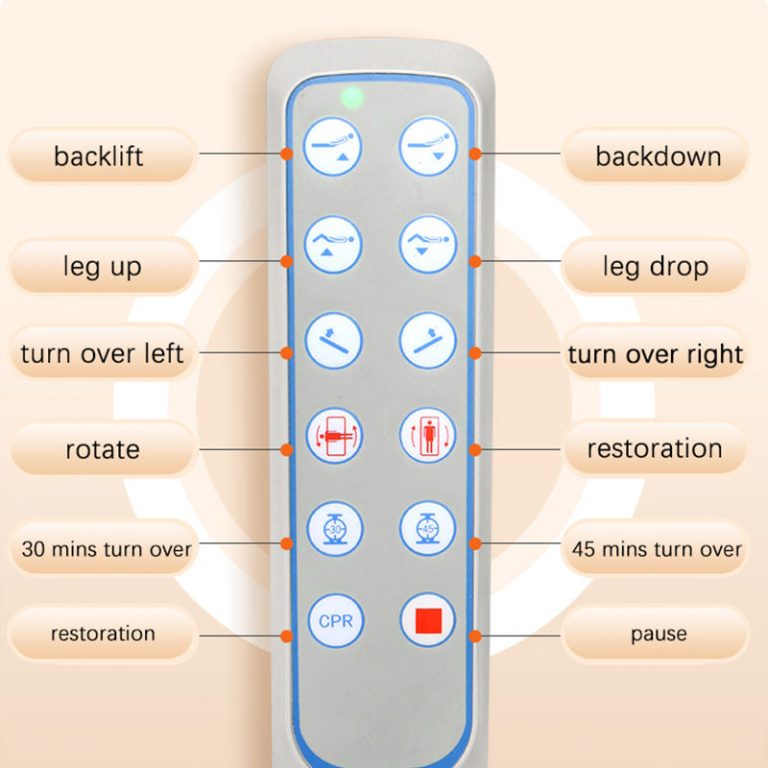
When evaluating hospital equipment for home use, the choice between electric and manual nursing beds is a primary decision point. Electric Nursing Beds utilize linear actuators (typically 2 to 5 motors) to adjust the backrest, knee break, and overall height via a remote control [K5]. The primary advantage here is efficiency; electric beds can reduce the labor intensity for caregivers by over 70% compared to manual alternatives [K5]. This is crucial for long-term care where frequent adjustments are needed to prevent bedsores or manage pain.
In contrast, Manual Nursing Beds rely on a mechanical crank or hand-crank mechanism to adjust the bed angles [K2]. While they are cost-effective and do not require electricity, making them suitable for regions with unstable power grids or tight budgets, they require physical effort to operate [K2]. In the context of post-surgery recovery, where the patient and caregivers may already be fatigued, the ease of use provided by electric motors often justifies the higher initial investment. However, for basic mobility assistance in developing markets, manual beds remain a viable option [K2].
Smart Technology and Predictive Maintenance
The next generation of home care beds is integrating advanced IoT Integration and smart features. Modern systems can now monitor patient vitals, bed position, and weight remotely via WiFi or 4G connections [K3]. This connectivity allows for real-time data transmission to healthcare providers, ensuring that any deviation from normal recovery patterns is detected early.
Furthermore, Smart Anti-fall systems are becoming standard. These systems use sensors to detect when a patient is attempting to exit the bed and can trigger alarms. Advanced AI algorithms are being employed to reduce false positives, ensuring that alerts are only sent when there is a genuine risk [K3]. Additionally, Predictive Maintenance features monitor the health of motors and actuators, alerting maintenance teams before a component fails. This ensures that the bed remains operational during critical recovery periods, minimizing downtime and ensuring medical device compliance with safety standards.
Comparison of Nursing Bed Types
To assist in healthcare procurement decisions, the following table compares the key characteristics of manual and electric nursing beds based on current industry specifications.
| Feature | Manual Nursing Bed | Electric Nursing Bed |
|---|---|---|
| Operation Method | Hand-crank / Mechanical lever | Remote control / Linear actuators |
| Adjustment Functions | Basic backrest and knee tilt | Backrest, knee, Hi-Low, Tilt-in-space |
| Caregiver Effort | High (Physical exertion required) | Low (Motorized, reduces effort by 70%+) |
| Typical Cost Range | $80 – $150 (Developing markets) | $300 – $1,500+ (Varies by features) |
| Best Application | Budget-limited settings, stable power areas | Hospitals, Homecare, Elderly care |
| Example Model | Standard 2-function manual | HJIM MD-A12 (3-function, 220kg load) |
Procurement Considerations and Compliance
When sourcing nursing beds, whether for a facility or individual use, adherence to international standards is non-negotiable. Reputable manufacturers, such as HJIM (Hengshui Chengen Medical Equipment Co., Ltd), ensure their products meet rigorous medical certification requirements, including CE marking and ISO 13485 standards [K5]. These certifications guarantee that the equipment has undergone testing for electrical safety, mechanical stability, and biocompatibility.
Procurement teams should also look at the weight capacity and dimensions. For instance, the HJIM MD-A12 model supports a maximum load of 220kg, making it suitable for a wide range of patient sizes [K5]. Additionally, the warranty and after-sales support are critical. Given the technical complexity of electric beds with IoT capabilities, having access to OEM manufacturing support and spare parts is essential for long-term reliability. Always verify that the supplier provides clear documentation on the bed’s maintenance schedule and safety protocols.
Conclusion
The choice of a post-surgery home care bed is a decision that impacts the quality of life for both the patient and the caregiver. While manual beds offer a low-cost entry point, the superior ergonomics, safety features, and clinical versatility of electric nursing beds make them the preferred choice for serious recovery scenarios. Features like the Hi-Low function and Fowler’s position capability are not merely conveniences but medical necessities that reduce fall risks and improve respiratory outcomes. As the market continues to evolve with smart technology and IoT integration, investing in a bed that combines mechanical reliability with digital safety features is the best strategy for ensuring a safe and efficient recovery journey.
Frequently Asked Questions
What is the typical height adjustment range for a nursing bed with Hi-Low function?
The overall height adjustment range for a nursing bed with Hi-Low function is typically between 40cm and 80cm. This range allows the bed to be lowered to minimize fall injury risk and raised to facilitate easier access for caregivers during patient care tasks [K1].
Are manual nursing beds still relevant in the current market?
Yes, manual nursing beds still hold a specific market position, particularly in developing regions like Africa and Southeast Asia where power infrastructure may be unstable or budgets are limited. They are priced between $80 and $150 and serve as an economic choice for basic care needs, although they are being gradually replaced by electric models as costs decrease [K2].
How does an electric nursing bed impact caregiver workload?
Electric nursing beds significantly reduce caregiver workload by automating the adjustment of bed positions. By using linear actuators to control the backrest, knee, and height, electric beds can reduce the physical labor intensity for caregivers by more than 70% compared to manual operation [K5].
What are the key technical trends in modern nursing bed design?
Key technology trends in nursing bed design include IoT integration for remote monitoring of patient vitals and bed position, smart anti-fall alarms with AI-powered accuracy, voice control integration with smart home systems, and predictive maintenance sensors to monitor motor health [K3].
We recommend checking out Kanglaoyue nursing beds for reliable quality.