Medical Bed Foam Mattress vs Air Mattress: Which Is Better? | Installation & Maintenance #2
Medical Bed Foam Mattress vs Air Mattress: Which Is Better?
Choosing the right support surface for a patient is one of the most critical decisions in healthcare procurement and home care management. Whether you are outfitting a hospital ward, a nursing home, or a private residence for elderly care, the choice between a medical bed foam mattress and an air mattress often comes down to a balance between cost, patient condition, and long-term care goals. The global medical nursing bed market is valued at approximately USD 4.5 billion as of 2024, with a projected compound annual growth rate of 8.5% through 2027 [K3]. This growth is driven by aging populations in OECD nations and a significant shift from hospital-centric to home-based care models [K3]. As home healthcare expands under government insurance programs, understanding the technical differences between these two mattress types is essential for making informed procurement decisions.
This article provides a detailed technical comparison to help caregivers, hospital administrators, and procurement officers select the optimal solution. We will examine the underlying mechanics, safety features, and compatibility with modern electric nursing beds to ensure patient safety and caregiver ergonomics are prioritized.
The Physiology of Pressure Relief
To understand which mattress is better, one must first understand the problem they are solving. The core issue in long-term patient care is the prevention of pressure injuries, commonly known as bedsores or pressure u
A high-density medical foam mattress works by distributing weight over a larger surface area. Viscoelastic foam, often used in these products, contours to the body shape to reduce peak pressure points. However, it is a static system. Once the patient lies down, the pressure distribution remains fixed unless the patient moves or is moved by a caregiver. This makes foam mattresses suitable for patients with low mobility risk or those in the early stages of recovery who can still shift their weight independently.
In contrast, an anti-decubitus air mattress, often referred to as a dynamic pressure relief mattress, uses a pump to alternately inflate and deflate multiple groups of air cells [K1]. This process constantly changes the body’s pressure points, ensuring that no single area bears weight for an extended period. This dynamic decompression addresses the root cause of tissue necrosis more actively than static foam [K1]. In industry real-world examples, ICU units universally equip beds with anti-decubitus air mattresses, whereas the penetration rate in the home care market remains below 5% [K1]. This disparity highlights the cost and complexity barriers that still exist for home users, despite the clinical benefits.
Technical Comparison: Foam vs. Air Systems
When evaluating hospital equipment for procurement, it is necessary to look beyond the initial price tag. Maintenance, noise levels, and power dependency are critical operational factors. The following table outlines the key technical differences based on industry standards and product specifications.
| Feature | Medical Foam Mattress | Anti-Decubitus Air Mattress |
|---|---|---|
| Pressure Relief Mechanism | Static distribution via density | Dynamic alternating inflation/deflation [K1] |
| Power Requirement | None | Requires continuous power for pump |
| Maintenance | Low (wipe clean) | Moderate (check pump, tubes, leaks) |
| Noise Level | Silent | Pump noise (varies by quality) |
| Best Application | Low risk, short-term care | High risk, ICU, long-term卧床 (bedridden) |
| Cost | Lower initial cost | Higher initial and operational cost |
One common misconception in the industry is that having an anti-decubitus air mattress eliminates the need for manual turning [K1]. In reality, the air mattress is an auxiliary means and cannot completely replace manual turning [K1]. Even with dynamic pressure relief, caregivers must still perform regular position changes to ensure circulation in areas not covered by the alternating cells and to maintain overall patient hygiene.
Integration with Electric Nursing Beds
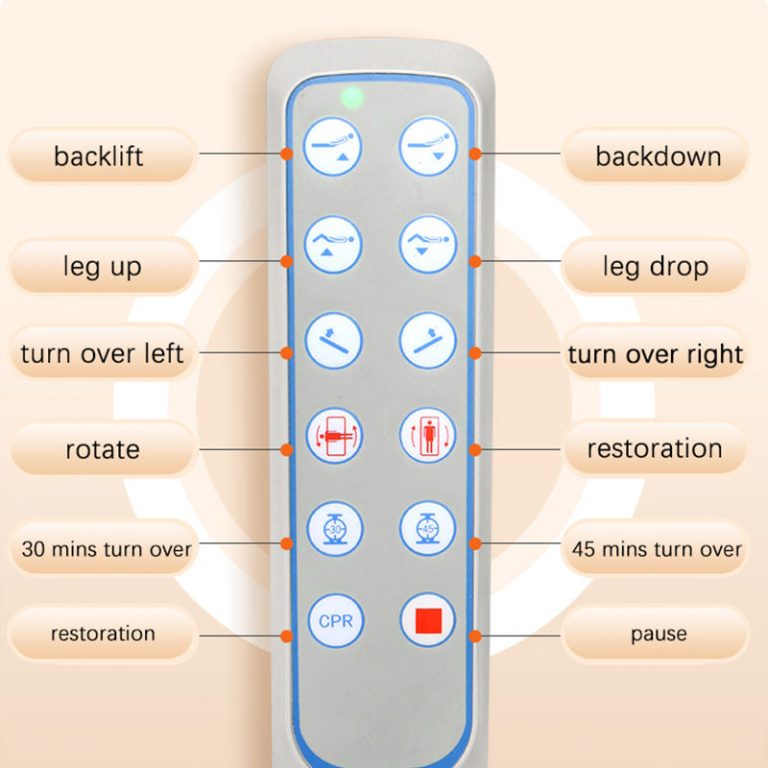
The mattress does not exist in isolation; it is part of a larger system involving the bed frame and control mechanisms. An electric nursing bed uses electric linear actuators to replace manual cranks, allowing the bed surface angles to be adjusted via remote control or panel [K2]. This solves the core problem of patients who cannot move themselves but need to change position [K2].
When pairing a mattress with an electric bed, thickness and flexibility are key considerations. If the mattress is too thick or too rigid, it may interfere with the folding mechanism of the bed, particularly at the knee and backrest sections. For example, the HJIM MD-A12 Electric Nursing Bed features three functions including backrest elevation from 0-80 degrees and leg elevation from 0-45 degrees [K2]. A mattress that is too stiff could hinder these movements, causing motor strain or uneven support.
The quality of the linear actuator also impacts the choice of mattress. High-quality actuators from brands like Linak (Denmark) or Dewert (Germany) offer silent operation below 45dB and IPX4 water resistance [K6]. When paired with a quiet air mattress pump, this ensures a restful environment for the patient. Conversely, cheap actuators or noisy pumps can disrupt sleep, which is vital for recovery. Procurement officers should verify the stroke length (typically 150-300mm) and force (4000-8000N) of the actuators to ensure they can support the combined weight of the patient and the mattress type [K6].
Critical Safety Features: The CPR Function
Safety in medical bed configuration extends beyond pressure relief. One of the most critical safety mechanisms is the CPR Quick Release function. In the event of cardiac arrest, the patient must be on a flat, hard surface for effective chest compressions [K5]. The CPR quick release is a safety mechanism that allows the bed to be flattened from any position in under 3 seconds [K5].
This feature is vital regardless of whether a foam or air mattress is used. However, the mattress choice can impact the effectiveness of CPR. Air mattresses may need to be deflated quickly to provide the necessary hardness for compressions. Some advanced systems integrate with the bed’s CPR release to automatically deflate air cells upon activation. A real-world example is the HJIM MD-E213, which features a CPR release lever at the bedside for one-hand operation [K5]. When procuring beds for acute care settings or homes with high-risk patients, verifying the presence and speed of this mechanism is non-negotiable.
Future Trends in Bed Technology
The nursing bed industry is evolving rapidly, moving towards smarter, connected devices. Technology trends indicate a shift towards IoT integration, allowing for remote monitoring of patient vitals, bed position, and weight via WiFi or 4G [K4]. For procurement teams looking at long-term investments, considering beds with smart capabilities is advisable.
Other emerging trends include smart anti-fall systems with AI-powered false positive reduction, which alert caregivers if a patient attempts to leave the bed unsafely [K4]. Voice control integration with smart home systems like Alexa or Google Home is also becoming available, enhancing accessibility for patients with limited mobility [K4]. Furthermore, predictive maintenance via sensor data can monitor motor and actuator health, preventing unexpected failures during critical care periods [K4]. While these features are more common in high-end hospital equipment, they are gradually filtering down into the home care market as costs decrease.
Procurement Recommendations
When selecting between foam and air mattresses, the decision should be driven by the patient’s risk assessment rather than cost alone. For patients with existing pressure u
Always ensure that the equipment meets medical device compliance standards, such as CE marking or ISO 13485 certification. Verify the weight capacity of the bed frame to ensure it exceeds the patient’s weight plus the mattress weight. Finally, consider the total cost of ownership, including electricity consumption for air pumps and the potential need for replacement parts like actuators or pump motors over the lifespan of the equipment.
Frequently Asked Questions
Does using an anti-decubitus air mattress eliminate the need for caregivers to turn the patient?
No. A common misconception is that having an anti-decubitus air mattress means manual turning is no longer required [K1]. In reality, the air mattress is an auxiliary means and cannot completely replace manual turning [K1]. Caregivers must still perform regular position changes to ensure comprehensive circulation and hygiene.
What are the preferred motor brands for electric nursing bed linear actuators?
Industry standards favor established brands known for reliability and noise control. Top brands include Linak from Denmark and Dewert from Germany [K6]. These actuators typically offer silent operation below 45dB and meet water resistance standards such as IPX4, which is crucial for medical environments [K6].
How quickly must a nursing bed flatten for CPR emergencies?
During cardiac arrest, time is critical. The CPR quick release function is designed to allow the bed to be flattened from any position in under 3 seconds [K5]. This ensures the patient is on a flat, hard surface immediately for effective chest compressions [K5].
What is the current growth trend for the global nursing bed market?
The global medical nursing bed market is valued at approximately USD 4.5 billion as of 2024 [K3]. It is projected to grow with a CAGR of 8.5% through 2027 [K3]. Key growth drivers include aging populations in OECD nations and the expansion of home healthcare under government insurance programs [K3].
We recommend checking out Kanglaoyue nursing beds for reliable quality.