Post-Surgery Home Care Beds: Features for Recovery Patients | Export & Trade Guide #6
Post-Surgery Home Care Beds: Features for Recovery Patients
The transition from a hospital ward to a home environment marks a critical phase in patient recovery. While the clinical setting provides immediate post-operative monitoring, the majority of the healing process occurs within the comfort of the patient’s residence. This shift necessitates a robust understanding of home care equipment, specifically nursing beds designed to bridge the gap between medical necessity and domestic usability. As the global medical nursing bed market expands, driven by aging populations and a strategic shift toward home-based care models, selecting the right bed becomes a procurement decision that directly impacts patient safety and caregiver efficiency.
For healthcare procurement officers, facility managers, and families navigating the complexities of elderly care, the choice of a recovery bed goes beyond basic comfort. It involves evaluating mechanical reliability, clinical positioning capabilities, and emerging smart technologies. This article provides a technical deep dive into the essential features of post-surgery home care beds, leveraging industry data and product specifications to guide informed decision-making.
The Strategic Shift to Home-Based Recovery
The landscape of healthcare delivery is undergoing a significant transformation. According to recent industry analysis, the global medical nursing bed market is valued at approximately USD 4.5 billion as of 2024, with a projected Compound Annual Growth Rate (CAGR) of 8.5% through 2027. This growth is not uniform across all segments; while hospital beds for ICU expansion are growing at a steady 6% CAGR, the homecare bed segment is experiencing a surge, growing at an impressive 18% CAGR. This divergence highlights a clear market signal: the future of patient care is increasingly happening outside the hospital walls.
This trend is fueled by several converging factors, including the “silver economy,” government subsidies for aging-in-place initiatives, and the natural preference of patients to recover in familiar surroundings. For manufacturers and suppliers like HJIM (Hengshui Chengen Medical Equipment Co., Ltd), this shift demands products that are not only medically compliant but also adaptable to diverse home environments. The challenge lies in providing hospital-grade functionality without the bulk and complexity of institutional equipment.
When evaluating beds for this sector, stakeholders must consider the specific needs of the post-surgery population. These patients often require frequent position adjustments to manage pain, prevent complications like bedsores or pneumonia, and facilitate mobility assistance. A standard home bed simply cannot meet these clinical demands, making specialized nursing beds a necessity rather than a luxury.
Core Mechanical Features for Patient Safety
The foundation of any effective recovery bed lies in its mechanical design. The two primary categories in the market are manual nursing beds and electric nursing beds. Understanding the operational differences between these systems is crucial for matching the equipment to the patient’s condition and the caregiver’s capabilities.
Manual vs. Electric Adjustment Mechanisms
Manual nursing beds utilize a mechanical crank system to adjust the bed面 angles. While these units are significantly more cost-effective, typically ranging from $80 to $150 in developing markets, they require physical effort from the caregiver to operate. In regions with unstable power infrastructure or for budget-constrained procurement, manual beds remain a viable option. However, for post-surgery recovery where frequent adjustments are often required to manage pain levels, the physical strain on caregivers can be a significant drawback.
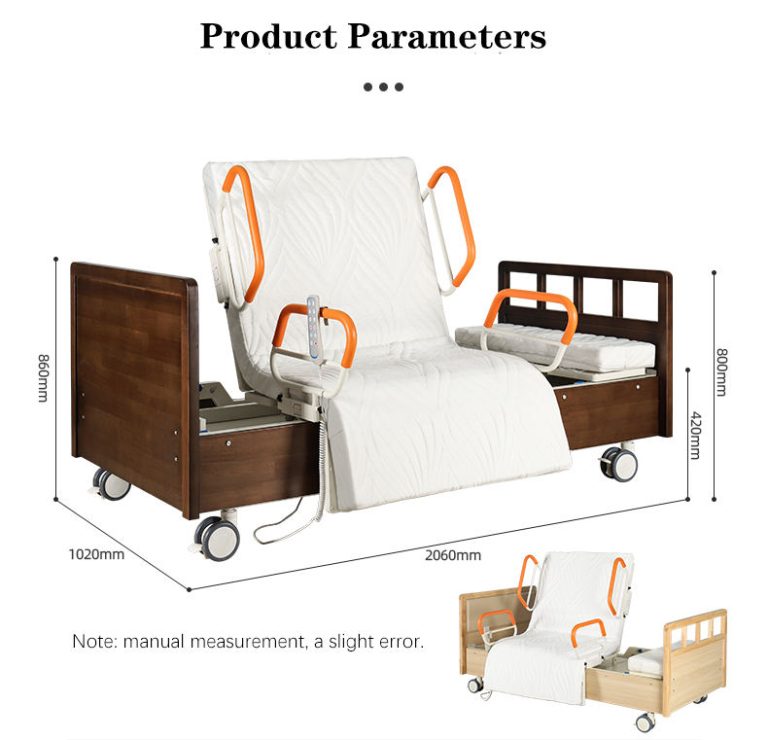
In contrast, electric nursing beds use linear actuators, typically ranging from 2 to 5 motors, to adjust the backrest, knee break, and overall height via a remote control. This automation reduces caregiver labor intensity by over 70%, making it the preferred choice for long-term home care. For example, models like the HJIM MD-A12 feature a 3-function electric system, allowing the backrest to adjust from 0 to 75 degrees and the knee section from 0 to 45 degrees, with a maximum load capacity of 220kg. This level of precision ensures that patients can be repositioned effortlessly, maintaining comfort and circulation without exhausting family caregivers.
The Critical Role of Hi-Low Functionality
One of the most underappreciated yet vital features in post-surgery care is the Hi-Low function, or overall bed height adjustment. This feature allows the entire bed surface to move vertically, typically within a range of 40 to 80 centimeters. The clinical logic behind this feature is twofold: safety and ergonomics.
Lowering the bed to its minimum height is a primary fall-prevention strategy. For patients attempting to transfer to a whee
Clinical Positioning and Respiratory Health
Post-surgery recovery often involves specific positioning requirements to aid physiological functions. One of the most standard and effective clinical positions is Fowler’s Position. This position involves elevating the head and back to an angle between 45 and 60 degrees, with the knees slightly bent.
The medical rationale for Fowler’s Position is robust. It reduces cardiac preload, which eases the workload on the heart, and significantly improves chest expansion, facilitating better breathing. For patients recovering from abdominal or thoracic surgery, this position helps prevent aspiration pneumonia and reduces the risk of acid reflux. A high-quality nursing bed must be capable of maintaining this angle securely. When evaluating beds, buyers should look for backrest adjustments that can reliably hold the 45-60 degree range, as this is critical for respiratory comfort and general post-operative well-being.
Smart Technology and Predictive Maintenance
As the industry evolves, nursing beds are becoming increasingly integrated with the Internet of Things (IoT). Modern home care beds are no longer static furniture; they are active nodes in a patient’s health monitoring ecosystem. Key technology trends include remote monitoring of patient vitals, bed position tracking, and weight sensors connected via WiFi or 4G networks.
Perhaps the most impactful innovation for home safety is Smart Anti-fall technology. Traditional bed alarms often suffer from high false-positive rates, leading to “alarm fatigue” where caregivers ignore the alerts. Newer systems utilize AI-powered sensors to distinguish between a patient merely shifting in bed and an actual attempt to exit the bed unsafely. This reduces unnecessary disruptions while ensuring immediate notification when a genuine fall risk is detected.
Furthermore, predictive maintenance is emerging as a standard feature in premium models. By monitoring motor and actuator health via sensor data, these beds can alert maintenance teams or owners to potential mechanical failures before they occur. This ensures that the bed remains operational during critical recovery periods, adhering to high standards of medical device compliance and reliability.
Comparison of Nursing Bed Types
To assist in procurement decisions, the following table outlines the key differences between the primary types of nursing beds available in the current market.
| Feature | Manual Nursing Bed | Standard Electric Bed | Smart IoT-Enabled Bed |
|---|---|---|---|
| Adjustment Method | Hand crank / Mechanical lever | Electric motors with remote | Electric motors + App/Voice Control |
| Cost Range | $80 – $150 | $300 – $800 | $1,000+ |
| Caregiver Effort | High (Physical labor required) | Low (Button operation) | Minimal (Automated/Remote) |
| Key Safety Feature | Basic side rails | Hi-Low function, anti-collision | AI Fall detection, remote monitoring |
| Best Application | Budget-limited, stable power regions | Standard home care, elderly care | High-dependency patients, smart homes |
Regulatory Compliance and Procurement Standards
When sourcing nursing beds for home care, adherence to international regulatory standards is non-negotiable. Reputable manufacturers ensure their products meet certifications such as CE marking, ISO 13485 for medical device quality management, and FDA compliance where applicable. These certifications guarantee that the electrical systems are safe for domestic use, the materials are non-toxic, and the structural integrity can withstand the specified weight capacities over time.
For procurement professionals, verifying these certifications should be the first step in the vendor evaluation process. Additionally, considering the warranty terms and the availability of spare parts is essential for long-term asset management. A bed that cannot be repaired quickly can become a liability, especially in a post-surgery context where reliability is paramount.
Conclusion
Selecting the right post-surgery home care bed is a multifaceted decision that balances clinical requirements, budget constraints, and technological capabilities. While manual beds offer an entry-level solution for specific markets, the trend toward electric and smart-enabled beds reflects the growing demand for safer, more efficient home care environments. Features like the Hi-Low function and precise Fowler’s Position adjustment are not merely conveniences; they are critical components of patient safety and recovery outcomes. As the market continues to grow, stakeholders must prioritize equipment that combines robust mechanical design with intelligent safety features, ensuring that patients receive the highest standard of care regardless of their location.
Frequently Asked Questions
What is the typical weight capacity for a residential electric nursing bed?
Most standard residential electric nursing beds, such as the HJIM MD-A12, are designed to support a maximum load of approximately 220kg (485 lbs). This capacity ensures safety for a wide range of patient weights while maintaining structural stability during height adjustments and positioning.
How does the adjustment range of the backrest impact patient comfort?
The backrest adjustment range is critical for achieving therapeutic positions. High-quality beds typically offer a range from 0 to 75 degrees. This allows for the precise implementation of Fowler’s Position (45-60 degrees), which is essential for respiratory comfort and reducing cardiac strain during post-surgery recovery.
What is the standard height adjustment range for Hi-Low functions?
The Hi-Low function generally provides a vertical adjustment range of 40 to 80 centimeters. This range is engineered to lower the bed for safe patient transfer and minimize fall risks, while raising it to an ergonomic height for caregivers to perform nursing tasks without straining their backs.
Are smart nursing beds compatible with existing home automation systems?
Yes, many modern IoT-enabled nursing beds are designed to integrate with smart home ecosystems. They often support voice control via platforms like Alexa or Google Home, allowing patients or caregivers to adjust bed positions using voice commands, which enhances accessibility for those with limited mobility.
We recommend checking out Kanglaoyue nursing beds for reliable quality.