OEM Nursing Bed Manufacturing: How to Choose the Right Chinese Supplier | Importer Selection Guide #4
OEM Nursing Bed Manufacturing: How to Choose the Right Chinese Supplier
The global medical nursing bed market is valued at approximately USD 4.5 billion as of 2024, with a projected compound annual growth rate of 8.5% through 2027 [K3]. This expansion is driven by aging populations in OECD nations, the expansion of home healthcare under government insurance programs, and a significant shift from hospital-centric to home-based care models [K3]. For healthcare procurement officers, distributors, and private label brands, navigating the Chinese manufacturing landscape offers a unique opportunity to access cost-effective solutions without compromising on quality. However, selecting the right OEM partner requires a deep understanding of product specifications, manufacturing models, and regulatory compliance.
This guide provides an expert-level analysis of OEM nursing bed manufacturing in China. It covers the technical distinctions between manual and electric models, the nuances of OEM versus ODM cooperation, and the critical safety features that define product quality. By leveraging industry data and specific product examples, such as those from HJIM (Hengshui Chengen Medical Equipment Co., Ltd), buyers can make informed decisions that align with their market positioning and patient care goals.
Understanding the Product Spectrum: Manual vs. Electric Nursing Beds
The first critical decision in sourcing nursing beds is determining the appropriate technology level for your target market. The choice between manual and electric systems dictates not only the cost structure but also the applicable use cases and caregiver ergonomics.
Manual Nursing Beds
Manual nursing beds operate using a mechanical crank system to adjust the bed面 angles. These units are characterized by their simplicity and low cost, typically ranging from $80 to $150 in industry examples [K1]. The underlying logic for manual beds is their suitability for markets with unstable electricity or strict budget constraints [K1]. They provide basic position adjustment functions, such as raising the head or knee section, which are essential for preventing aspiration and improving comfort [K1].
While the global trend favors automation, manual beds retain a significant market share in specific regions. In Africa and Southeast Asia, where power infrastructure may be inconsistent, manual beds remain the主力 product (mainstay product) [K1]. They are also prevalent in基层医院 (primary care hospitals) and budget-limited养老 institutions (elderly care institutions) [K1]. A common misconception is that manual beds have no market; however, they remain a vital solution for basic care needs where electricity is unreliable [K1]. When specifying manual beds, buyers should focus on the number of crank handles, the range of adjustment angles, and the durability of the bed frame material [K1].
Electric Nursing Beds
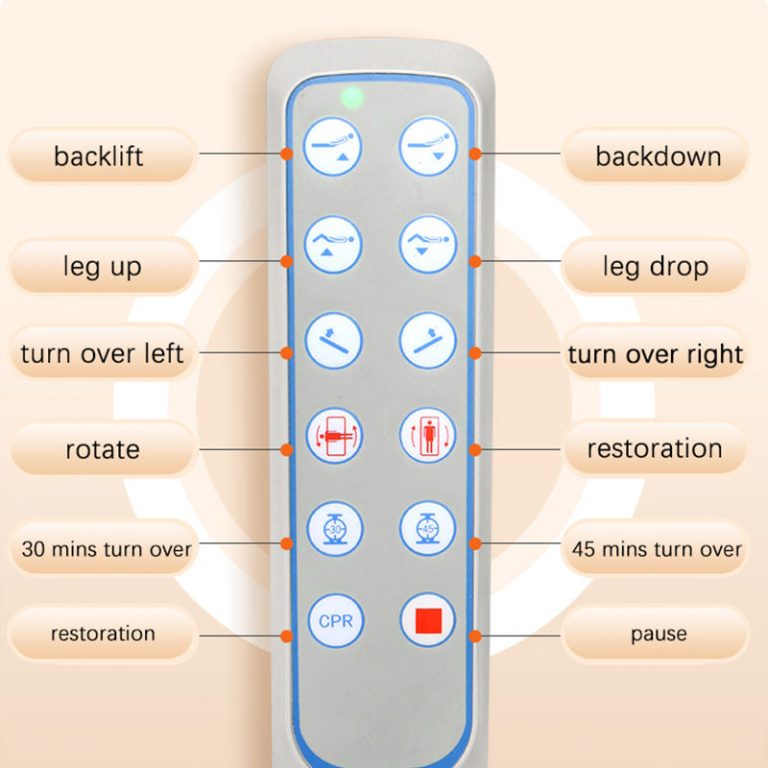
Electric nursing beds utilize electric linear actuators to replace manual cranks, allowing for bed adjustments via a remote control or panel [K2]. The core value proposition of an electric bed is solving the problem of patients who cannot move independently but require position changes [K2]. This technology significantly reduces caregiver labor intensity, improves patient comfort, and helps prevent complications such as bedsores and pulmonary infections [K2].
In many developed markets, electric beds are no longer considered luxury items but rather basic configurations for modern patient care [K2]. A representative example is the HJIM MD-A12 Electric Nursing Bed, which features three functions: back lifting (0-80°), leg lifting (0-45°), and overall height adjustment [K2]. It includes a remote control operation and an ABS detachable headboard, demonstrating the standard features expected in mid-tier products [K2]. When evaluating electric beds, key indicators include the brand of motors (e.g., LINAK, Dewert, or domestic alternatives), the number of functions, weight capacity, and noise levels during operation [K2].
OEM and ODM Manufacturing Models Explained
Understanding the manufacturing relationship is crucial for defining your brand strategy and margin expectations. In the Chinese medical equipment sector, three primary models exist: OEM, ODM, and OBM.
OEM (Original Equipment Manufacturer)
In an OEM arrangement, the factory produces beds based on the buyer’s specific design and specifications [K5]. The buyer owns the design, and the manufacturer provides production capacity. Typical margins for OEM models range from 5% to 10% [K5]. This model is suitable for brands that have established R&D capabilities and want to maintain strict control over product design and intellectual property.
ODM (Original Design Manufacturer)
ODM manufacturing involves the factory providing both the design and the production services [K5]. The buyer essentially rebrands an existing product. Typical margins for ODM models range from 10% to 15% [K5]. This approach is faster to market and reduces R&D costs, making it ideal for distributors who want to launch a product line quickly without investing in engineering.
OBM (Original Brand Manufacturer)
OBM refers to factories that sell products under their own brand [K5]. Typical margins here are higher, ranging from 20% to 35%, but this requires significant investment in marketing and brand building [K5]. For most foreign buyers, the choice lies between OEM and ODM. SEO keywords often associated with these services include OEM nursing bed manufacturer, ODM hospital bed supplier, and custom medical bed factory [K5].
| Feature | OEM Model | ODM Model |
|---|---|---|
| Design Ownership | Buyer | Factory |
| Development Time | Longer (Custom Tooling) | Shorter (Existing Designs) |
| Typical Margin | 5-10% | 10-15% |
| Best For | Established Brands with R&D | Distributors seeking speed |
Critical Technical Features for Patient Safety
When specifying nursing beds for hospital equipment or home care, certain technical features are non-negotiable regarding patient safety and clinical efficacy. Procurement teams must verify these specifications during the supplier audit process.
CPR Quick Release Function
One of the most critical safety mechanisms in a nursing bed is the CPR quick release function [K6]. This feature allows the bed to be instantly flattened from any position in under 3 seconds [K6]. The definition is precise: during cardiac arrest, the patient must be on a flat, hard surface for effective chest compressions [K6]. If a bed cannot be flattened rapidly, it impedes resuscitation efforts and poses a life-threatening risk.
High-quality manufacturers integrate a mechanical lever that allows one-hand operation to trigger this function. For instance, the HJIM MD-E213 model features a CPR release lever located at the bedside for immediate access [K6]. When sourcing, buyers should request a demonstration of this function to ensure it meets the <3 seconds standard [K6]. SEO keywords related to this feature include CPR hospital bed, quick release bed, and emergency flatten bed [K6].
Motor Quality and Noise Control
For electric beds, the motor brand is a primary indicator of longevity and noise performance. Premium markets often specify LINAK or Dewert actuators, while cost-sensitive markets may accept certified domestic motors [K2]. Noise levels are particularly important in home care settings where sleep disturbance can affect patient recovery. Buyers should request decibel ratings during operation tests.
Weight Capacity and Dimensions
Standard weight capacities typically range from 150 kg to 250 kg, depending on the frame material and design. Bariatric models require reinforced steel and specialized actuators. Dimensions must align with standard hospital sheet sizes and fit through doorways in residential settings. Always verify the exact dimensions in the product specification sheet before finalizing production.
Evaluating Supplier Capabilities and Certifications
The competitive landscape of the nursing bed industry is segmented into premium, mid-tier, and budget categories [K4]. Premium tier players like Hill-Rom and Paramount Bed dominate through brand reputation and service networks [K4]. However, Chinese manufacturers in the mid-tier are closing the certification gap, offering CE and FDA compliance at a cost advantage [K4]. The budget tier consists of unbranded OEMs engaged in price wars, often resulting in margin compression below 8% [K4].
To ensure you are partnering with a mid-tier quality supplier rather than a budget risk, verify the following:
- Medical Certifications: Ensure the supplier holds CE marking (for Europe) and FDA 510(k) clearance (for the USA). ISO 13485 certification is also essential for quality management systems in medical devices.
- Production Capacity: Assess the factory’s monthly output to ensure they can handle your order volume without delays.
- Quality Control Processes: Request documentation on incoming material inspection, in-process quality control, and final product testing.
- After-Sales Support: Verify the warranty terms and the availability of spare parts such as motors, controllers, and hand cranks.
Suppliers who can provide transparent data on these areas are more likely to sustain a long-term partnership. For example, referencing specific product lines like those found on hjim.com can help validate a supplier’s catalog and technical depth.
Cost Structure and Margin Analysis
Understanding the cost structure is vital for pricing strategy. As noted in industry data, budget-tier unbranded Chinese OEMs often operate with margins below 8% due to intense price competition [K4]. In contrast, mid-tier manufacturers with proper certifications can command better pricing due to reduced compliance risk for the buyer [K4].
When negotiating, consider the total cost of ownership, not just the unit price. This includes
Conclusion
Choosing the right Chinese supplier for OEM nursing bed manufacturing requires a balanced approach between cost, quality, and compliance. The market is growing rapidly, driven by demographic shifts and the expansion of home healthcare [K3]. Buyers must distinguish between manual and electric models based on their target region’s infrastructure and care needs [K1][K2]. Understanding the difference between OEM and ODM models helps align the sourcing strategy with brand goals and margin expectations [K5].
Critical safety features, such as the CPR quick release function, must be verified to ensure patient safety during emergencies [K6]. By focusing on suppliers who offer CE/FDA certification and transparent quality controls, buyers can avoid the pitfalls of the budget tier and secure a competitive advantage in the global market [K4]. Whether sourcing the HJIM MD-A12 for general ward use or the HJIM MD-E213 for critical care scenarios, due diligence in specification and partner selection is the key to successful healthcare procurement.
FAQ: Common Questions About Nursing Bed Procurement
How fast must the CPR quick release function operate?
According to industry safety standards, the CPR quick release function must allow the bed to be flattened from any position in under 3 seconds [K6]. This speed is critical because during cardiac arrest, effective chest compressions require the patient to be on a flat, hard surface immediately [K6]. Suppliers should be able to demonstrate this mechanism, such as the one-hand operation lever found on the HJIM MD-E213 model [K6].
Do manual nursing beds still have a market demand?
Yes, manual nursing beds remain relevant in specific markets. They are the主力 product (mainstay product) in regions like Africa and Southeast Asia where electricity is unstable [K1]. They are also suitable for基层医院 (primary care hospitals) and养老 institutions (elderly care institutions) with limited budgets [K1]. The typical price range for these units is between $80 and $150, making them an economic choice for basic care needs [K1].
What is the difference in profit margins between OEM and ODM models?
The profit margin structure varies by manufacturing model. OEM models, where the buyer provides the design, typically yield margins of 5-10% [K5]. ODM models, where the factory provides the design and production, typically yield higher margins of 10-15% [K5]. This difference reflects the value added by the factory’s design capabilities in the ODM scenario [K5].
Which motor brands are recommended for electric nursing beds?
When evaluating electric nursing beds, the motor brand is a key indicator of quality. Industry standards often reference premium brands such as LINAK or Dewert for high-end applications [K2]. Domestic motor alternatives are also available and can be suitable for cost-sensitive markets, provided they meet performance and noise level requirements [K2]. Buyers should verify the motor specifications in the product data sheet to ensure durability and smooth operation.
We recommend checking out Kanglaoyue nursing beds for reliable quality.