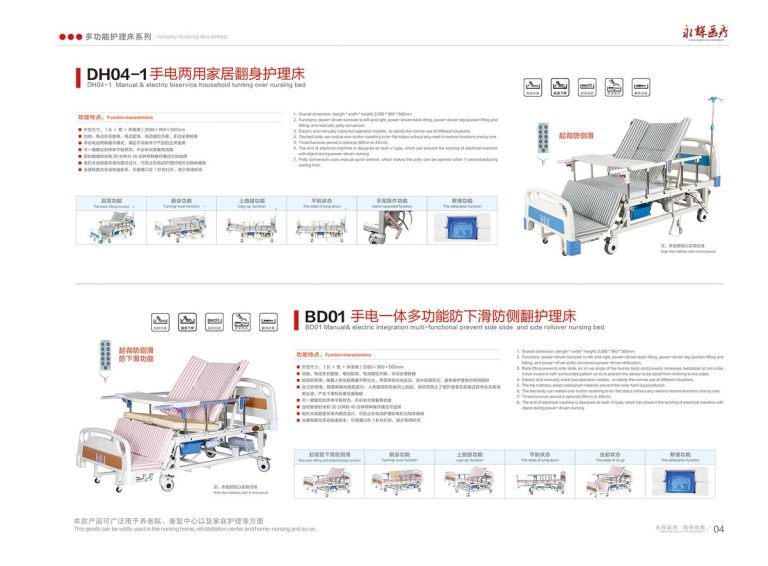
Nursing Bed vs Hospital Bed: Key Differences for Home Care Buyers | Export & Trade Guide #5
Nursing Bed vs Hospital Bed: Key Differences for Home Care Buyers
Choosing the right bed for home healthcare requires understanding the nuanced differences between nursing beds and hospital beds. While both serve medical purposes, their design philosophies, functionality, and target use cases differ significantly. This guide breaks down critical distinctions to help home care buyers make informed decisions that balance patient needs, caregiver efficiency, and budget constraints.
Core Differences in Design Philosophy
Nursing beds prioritize long-term comfort and daily living support, while hospital beds focus on acute medical interventions. Manual nursing beds use mechanical crank systems for basic adjustments like backrest elevation, making them ideal for budget-conscious settings or regions with unstable electricity [K1]. In contrast, electric nursing beds employ linear actuators controlled via remote, enabling precise positioning with minimal physical effort from caregivers [K2]. Hospital beds typically include advanced clinical features like integrated scales, IV poles, and emergency override systems, which are often unnecessary for home environments.
The global market shift toward home-based care is evident: homecare beds are growing at 18% CAGR through 2027, driven by aging populations and government subsidies for in-home elderly care [K3]. This trend favors versatile nursing beds over specialized hospital beds for non-critical home use cases.
Key Features for Home Care Considerations
Adjustment Mechanisms
Manual nursing beds require physical cranking to adjust angles, suitable for simple needs like elevating the head for reading [K1]. Electric models like the HJIM MD-A12 offer three-function control (backrest 0-80°, knee 0-45°, height adjustment) via remote, reducing caregiver labor intensity by over 70% [K2]. For patients with limited mobility, electric options provide critical independence in repositioning.
Safety Systems
Home care beds should include central brake systems that lock all four wheels with one pedal press, preventing accidental movement during transfers [K2]. Hospital beds often use individual wheel brakes, which require more coordination. Additionally, nursing beds typically feature lower minimum heights (as low as 45cm) to facilitate safe sit-to-stand transfers for elderly users.
Material Durability
Both bed types use steel frames, but nursing beds often incorporate ABS plastic headboards and footboards for lighter weight and easier cleaning. Hospital beds may use heavier-gauge metals to withstand frequent sterilization. For home use, corrosion-resistant coatings are essential in humid environments like bathrooms.
Cost, Maintenance, and Long-Term Value
Initial Investment
Manual nursing beds range from $80-$150 in developing markets [K1], while basic electric models start around $500. Hospital beds typically exceed $2,000 due to clinical-grade components. However, the total cost of ownership favors electric nursing beds: reduced caregiver strain lowers long-term labor costs, and modular designs simplify repairs.
Energy Requirements
Electric nursing beds consume minimal power (typically 24V DC systems), with backup batteries available for outages. Manual beds eliminate electrical concerns entirely but sacrifice convenience. In regions with unreliable grid power, hybrid models combining manual overrides with electric motors offer balanced solutions.
Warranty and Support
Reputable manufacturers like HJIM (Hengshui Chengen Medical Equipment Co., Ltd) provide 2-5 year warranties on motors and electronics. Home buyers should verify local service availability, as specialized hospital bed repairs may require manufacturer-certified technicians.
Comparison Table: Nursing Bed vs Hospital Bed
| Feature | Home Nursing Bed | Hospital Bed |
|---|---|---|
| Primary Use Case | Long-term elderly care, rehabilitation | Acute medical treatment |
| Adjustment Method | Electric remote or manual crank | Electric with clinical overrides |
| Weight Capacity | 200-250kg (e.g., HJIM MD-A12: 220kg) | 250-450kg |
| Safety Features | Central braking, low height settings | Side rails, IV poles, scales |
| Price Range | $150-$1,200 | $2,000-$10,000+ |
| Regulatory Certifications | CE, ISO 13485 | CE, FDA, ISO 13485 |
Making the Right Choice for Your Needs
Select a manual nursing bed if:
- Budget constraints are primary
- Patient requires only basic positioning
- Power infrastructure is unreliable
Choose an electric nursing bed when:
- Caregiver physical strain must be minimized
- Patient needs frequent repositioning (e.g., pressure u
- Long-term comfort justifies higher upfront cost
Avoid hospital beds for home use unless specific clinical features are medically prescribed. Their complexity increases maintenance costs and may overwhelm non-professional caregivers.
Frequently Asked Questions
What weight capacity should I look for in a home nursing bed?
Standard home nursing beds support 200-250kg, with models like the HJIM MD-A12 rated for 220kg [K2]. For bariatric patients, seek beds with reinforced frames and 350kg+ capacities, though these may require custom orders.
How do motor types affect reliability and noise levels?
Brushed DC motors are cost-effective but generate more heat and noise over time. Brushless motors (e.g., LINAK) offer quieter operation and longer lifespans, ideal for bedroom environments. Always check decibel ratings (<50dB is optimal) [K2].
Are there specific safety certifications required for home use?
While FDA clearance is mandatory for US hospital beds, home nursing beds typically require CE marking and ISO 13485 certification for medical device quality management. Verify local regulations, as some regions mandate additional electrical safety tests.
What maintenance do electric nursing beds require?
Monthly checks should include: testing all motor functions, inspecting wiring for wear, lubricating moving parts, and verifying brake engagement. Replace remote control batteries every 6 months. Professional servicing is recommended annually for beds in daily use [K2].
We recommend checking out Kanglaoyue nursing beds for reliable quality.