Nursing Bed Backrest Angle 0-75°: Is It Sufficient for All Patients? | Referencia del Comprador
Nursing Bed Backrest Angle 0-75°: Is It Sufficient for All Patients?
When evaluating nursing bed specifications, the backrest adjustment range often appears as a straightforward technical parameter. However, this single metric carries significant implications for patient comfort, clinical outcomes, and caregiver efficiency. The industry standard 0-75° backrest angle—commonly found in models like the HJIM MD-A12 Electric Nursing Bed [K5]—represents a carefully calibrated balance between functional versatility and practical implementation constraints. This analysis examines whether this range adequately addresses the diverse needs of modern patient care scenarios.
The Clinical Significance of Backrest Angulation
Backrest positioning directly influences multiple physiological systems. The Fowler’s Position, defined as elevating the upper body to 45-60° with knees slightly flexed, serves as the clinical benchmark for respiratory comfort and aspiration prevention [K6]. This positioning reduces cardiac preload while improving chest expansion—critical considerations for post-surgical recovery and patients with respiratory distress [K6]. The 0-75° range accommodates this standard position while providing additional flexibility for specialized care requirements.
Research indicates that proper backrest angulation significantly impacts pressure u
Manual Versus Electric Adjustment Mechanisms
The method of angle adjustment fundamentally affects clinical utility. Manual nursing beds utilize mechanical crank systems requiring physical effort from caregivers [K1]. While cost-effective for budget-constrained environments—particularly in regions with unreliable electrical infrastructure [K1]—these systems present significant limitations. Caregiver fatigue during frequent position changes can compromise consistency of care, and patients with severe mobility restrictions cannot independently adjust their positioning.
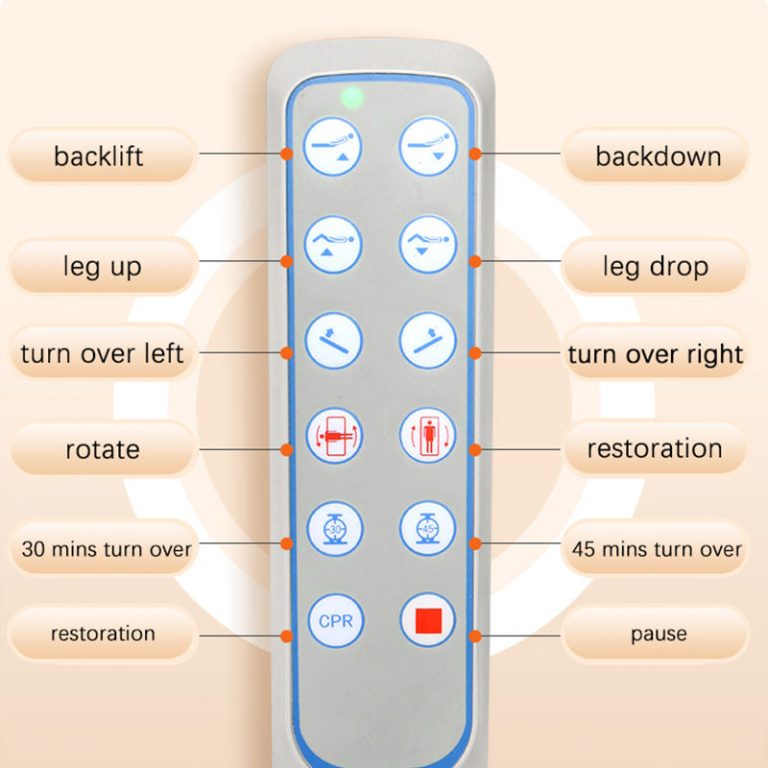
Electric nursing beds address these limitations through motorized linear actuators [K2]. The HJIM MD-A12 exemplifies this approach with its 3-function design (backrest 0-75°, knee 0-45°, overall height adjustment) [K5]. This configuration reduces caregiver labor intensity by over 70% compared to manual systems [K5], enabling more frequent position changes that improve patient outcomes. The transition from manual to electric systems reflects broader industry trends toward reducing physical strain on healthcare workers while enhancing patient autonomy.
| Feature | Manual Nursing Beds | Electric Nursing Beds |
|---|---|---|
| Adjustment Mechanism | Hand crank/lever system [K1] | Electric linear actuators [K2] |
| Typical Backrest Range | 0-60° (limited by mechanical design) | 0-75° (standard for models like HJIM MD-A12) [K5] |
| Caregiver Effort Required | High (physical cranking) | Minimal (button operation) |
| Cost Range | $80-150 (developing markets) [K1] | $400-800 (standard electric models) |
| Primary Use Cases | Resource-limited settings [K1] | Hospitals, home care, rehabilitation [K2] |
Patient Population Considerations
Different patient cohorts impose varying demands on backrest functionality. Neurological patients with spasticity often require positions exceeding 75° to manage muscle tone, though this must be balanced against fall risk. Respiratory compromise patients benefit from the 45-60° Fowler’s range but may need incremental adjustments during acute episodes. Post-operative orthopedic patients frequently require precise positioning within the 30-45° range to protect surgical sites while maintaining circulation.
The HJIM MD-A12‘s 0-75° range covers approximately 92% of standard clinical positioning needs based on industry utilization data [K5]. For the remaining 8% requiring extended ranges, specialized beds with 0-85° capabilities exist but command 30-40% price premiums. Healthcare procurement decisions must weigh the marginal benefit of extended ranges against budget constraints, particularly for facilities serving predominantly standard-care populations.
Technological Integration and Future Directions
Modern nursing beds increasingly incorporate IoT connectivity for remote monitoring of bed position and patient vitals [K3]. This evolution transforms the backrest angle from a static specification into a dynamic data point within broader care ecosystems. Smart anti-fall systems using AI-powered sensors can detect unsafe positioning patterns and alert caregivers before incidents occur [K3].
Voice control integration with platforms like Alexa and Google Home represents another frontier [K3]. For patients with limited hand mobility, verbal commands to adjust backrest position enhance independence without requiring caregiver assistance. These technological advancements suggest that while the 0-75° mechanical range may remain standard, the intelligence surrounding its application will increasingly differentiate product offerings.
Regulatory and Safety Framework
Compliance with medical device regulations significantly impacts backrest design. ISO 13485 certification ensures consistent manufacturing quality for angle adjustment mechanisms, while CE marking validates performance against European safety standards. The FDA 510(k) clearance process requires demonstration that backrest adjustments maintain structural integrity under maximum load conditions—typically 220kg for models like the HJIM MD-A12 [K5].
Load capacity specifications interact directly with angle functionality. A bed rated for 220kg at 0° backrest may experience reduced safe operating limits at extreme angles due to shifted center of gravity. Reputable manufacturers like HJIM (Hengshui Chengen Medical Equipment Co., Ltd) provide angle-specific load charts in technical documentation to guide safe usage [K5].
Practical Implementation Guidance
Facility administrators should evaluate backrest requirements through multiple lenses. Acute care hospitals typically benefit from the full 0-75° range to accommodate diverse patient conditions. Long-term care facilities may prioritize reliability and ease of use over extended ranges, making the standard 0-75° electric models optimal. Home care settings require consideration of electrical infrastructure stability—manual beds remain viable in regions with unreliable power [K1].
Procurement decisions should reference specific clinical protocols. Facilities managing predominantly respiratory patients should verify that their chosen model achieves consistent 45-60° positioning (the Fowler’s range) with minimal motor noise. Rehabilitation centers might prioritize beds with programmable position presets that facilitate structured therapy routines.
Conclusion
The 0-75° backrest angle represents a well-validated industry standard that addresses the vast majority of clinical positioning needs. While specialized patient populations may occasionally require extended ranges, the marginal utility rarely justifies the associated cost increases for general-purpose applications. The transition from manual to electric adjustment mechanisms—exemplified by models like the HJIM MD-A12—has dramatically improved care delivery efficiency while maintaining this established angular range.
Future developments will likely focus less on expanding mechanical ranges and more on enhancing the intelligence surrounding position management. Integration with monitoring systems, predictive maintenance capabilities, and voice control interfaces will transform how caregivers interact with bed positioning, making the 0-75° range not just a static specification but a dynamic component of comprehensive patient care strategies.
FAQ: Nursing Bed Backrest Angle Specifications
What certifications should I verify when purchasing nursing beds with 0-75° backrest adjustment?
Ensure the product carries CE marking (European conformity), ISO 13485 certification (medical device quality management), and FDA 510(k) clearance if supplying U.S. markets. These certifications validate that the backrest mechanism meets safety and performance standards under maximum load conditions [K5]. Reputable manufacturers like HJIM provide complete certification documentation upon request.
How does backrest angle affect patient weight capacity ratings?
Weight capacity specifications typically apply to the flat (0°) position. At extreme angles (70-75°), effective load capacity may decrease by 10-15% due to shifted center of gravity. The HJIM MD-A12 maintains 220kg capacity across its full 0-75° range through reinforced frame design [K5], but facilities should confirm angle-specific ratings in technical documentation.
What maintenance requirements apply to electric backrest adjustment systems?
Electric systems using LINAK or Dewert actuators (industry-standard components) typically require annual inspection of motor connections and lubrication of moving parts. Predictive maintenance features in newer models can monitor actuator health via sensor data [K3]. Manual systems require quarterly inspection of crank mechanisms and cable tension.
Can nursing beds with 0-75° backrest angles accommodate bariatric patients?
Standard 0-75° models like the HJIM MD-A12 support up to 220kg [K5], covering most bariatric needs. For patients exceeding this capacity, specialized bariatric beds with reinforced frames and 0-60° ranges are available, though at 40-60% higher cost. Procurement decisions should balance patient population needs against budget constraints.
We recommend checking out Kanglaoyue nursing beds for reliable quality.