Medical Bed Certification Guide: FDA, CE, ISO 13485 Explained | Safety Standards & Compliance #11
Medical Bed Certification Guide: FDA, CE, ISO 13485 Explained
The global medical nursing bed market is valued at approximately USD 4.5 billion in 2024, with a projected compound annual growth rate of 8.5% through 2027 [K5]. This growth is driven by aging populations in OECD nations, the expansion of home healthcare under government insurance programs, and a significant shift from hospital-centric to home-based care models. For healthcare procurement officers, hospital administrators, and distributors, navigating this expanding market requires more than just comparing prices. It demands a deep understanding of regulatory compliance. Medical bed certification is not merely a bureaucratic hurdle; it is a fundamental indicator of product safety, quality management, and market access eligibility.
Whether you are sourcing for a large hospital network in the United States or a private clinic in the European Union, the certifications held by the manufacturer dictate the liability, safety, and longevity of the equipment. At HJIM (Hengshui Chengen Medical Equipment Co., Ltd), we understand that compliance is the backbone of trust in the healthcare supply chain. This guide explains the critical certifications—FDA, CE, and ISO 13485—detailing what they mean, how much they cost, and why they matter for your procurement strategy.
Understanding the Core Regulatory Frameworks
When evaluating medical bed suppliers, three acronyms dominate the conversation: FDA, CE, and ISO 13485. Each serves a distinct purpose in ensuring that patient care equipment meets rigorous safety standards.
FDA 510(k) Clearance
In the United States, the Food and Drug Administration (FDA) regulates medical devices to ensure they are safe and effective. For most nursing beds, the pathway to market is the 510(k) premarket notification. This process requires the manufacturer to demonstrate that their device is substantially equivalent to a predicate device already legally marketed in the U.S. [K3]. Obtaining FDA clearance signals to buyers that the bed meets U.S. safety standards regarding electrical safety, mechanical stability, and biocompatibility of materials. Without this clearance, selling a medical bed in the U.S. market is illegal, and hospitals risk significant liability exposure.
CE Marking and MDR Compliance
For the European Union, the CE mark is mandatory. However, the landscape has shifted significantly with the introduction of the Medical Device Regulation (MDR) 2017/745. Unlike the older directives, the MDR imposes stricter requirements on clinical evaluation, post-market surveillance, and transparency [K3]. A nursing bed bearing the CE mark under MDR assures buyers that the product has undergone a comprehensive conformity assessment by a Notified Body. This is crucial for procurement in EU member states, as non-compliant products can be barred from customs and removed from the market.
ISO 13485 Quality Management
While FDA and CE are regulatory marks for specific regions, ISO 13485 is an international standard for Quality Management Systems (QMS) specific to medical devices. It is often a prerequisite for obtaining FDA or CE certification. ISO 13485 ensures that the manufacturer maintains consistent processes for design, development, production, installation, and servicing of medical devices [K3]. For a buyer, an ISO 13485 certified factory means there is a traceable system in place. If a defect occurs, the manufacturer can trace the batch, the materials, and the production line, ensuring accountability and continuous improvement in patient care equipment.
Certification Costs and Timelines by Market
Compliance is an investment. The cost and time required to certify medical beds vary significantly depending on the target market. Understanding these metrics helps procurement teams budget accurately and plan launch timelines. The following data reflects typical industry standards for nursing bed certification [K3].
| Market | Required Certification | Typical Timeline | Cost Range |
|---|---|---|---|
| EU | CE MDR 2017/745 + ISO 13485 | 6-12 months | €15,000-30,000 |
| USA | FDA 510(k) + ISO 13485 | 3-12 months | $20,000-50,000 |
| Middle East | CE or GSO | 3-6 months | $5,000-15,000 |
| Africa | Varies by country | 1-3 months | $2,000-8,000 |
The United States market presents the highest cost barrier, ranging from $20,000 to $50,000, due to the rigorous testing and documentation required for FDA 510(k) clearance [K3]. The European Union follows closely with costs between €15,000 and €30,000 under the new MDR framework. These costs are not merely fees paid to regulators; they encompass clinical evaluations, quality system audits, and technical file preparations. For emerging markets in Africa and the Middle East, the requirements are often less stringent, sometimes accepting CE certification as a baseline, which reduces both cost and timeline [K3]. However, procurement officers in these regions should still prioritize certified products to ensure long-term reliability and safety.
How Certification Impacts Product Quality and Safety
Certifications are not just paperwork; they correlate directly with the physical quality and safety features of the nursing bed. A manufacturer investing in FDA or CE compliance is more likely to use high-grade components that withstand rigorous testing.
Motor and Drive Systems
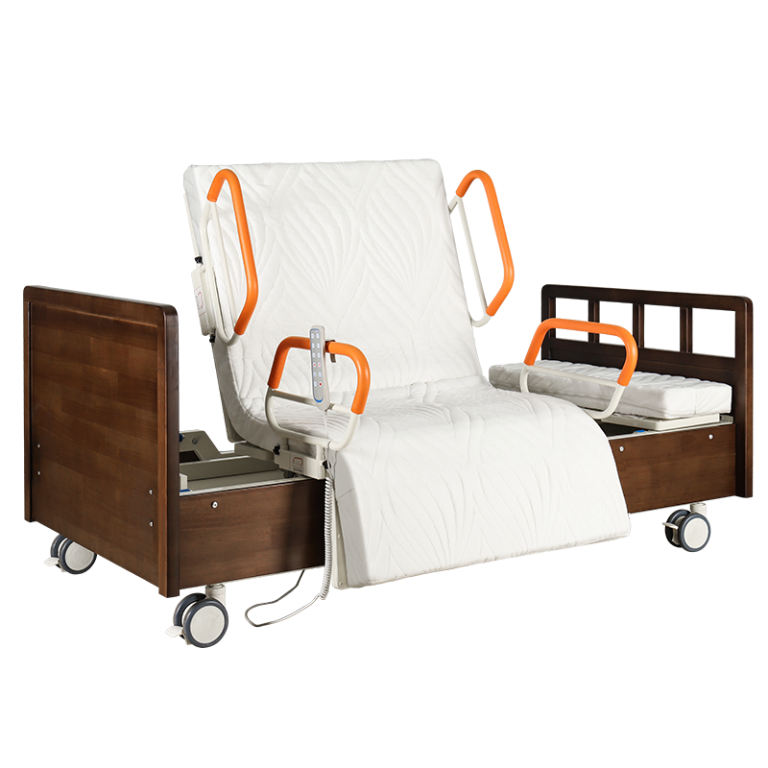
One of the core components of an electric nursing bed is the linear actuator. In certified products, these motors are often sourced from reputable suppliers such as LINAK or Dewert, ensuring smooth operation and longevity [K1]. Non-certified or budget-tier products may use generic motors that fail prematurely, posing a risk to patient mobility assistance. For example, the HJIM MD-A12 Electric Nursing Bed features a 3-function system with back lifting (0-80°) and leg lifting (0-45°), controlled via a reliable remote or panel [K1]. This level of precision requires quality control standards that are typically enforced by ISO 13485 certification.
Safety Mechanisms: The Central Brake System
Patient safety is paramount during transfers and movement. A critical feature in certified medical beds is the Central Brake System. This system allows a single foot pedal to lock all four wheels simultaneously, providing stability that individual wheel brakes cannot match [K6]. Certified manufacturers rigorously test these braking mechanisms to ensure they hold the bed’s weight capacity even on inclined surfaces. This reduces the risk of falls during patient transfers, a key metric for hospital equipment safety audits.
Material Safety and Hygiene
Certification standards also dictate the materials used in construction. Bed frames must be made of corrosion-resistant steel, and surfaces must be cleanable with hospital-grade disinfectants without degrading. The ABS removable headboards found in models like the HJIM MD-A12 are designed to meet these hygiene standards, preventing bacterial growth and facilitating infection control protocols [K1]. When a bed is FDA or CE certified, buyers can be confident that these materials have been tested for biocompatibility and durability.
OEM/ODM Manufacturing and Compliance
Many healthcare providers do not manufacture beds themselves; they rely on Original Equipment Manufacturer (OEM) or Original Design Manufacturer (ODM) partners. Understanding the relationship between manufacturing models and compliance is vital for procurement.
In an OEM arrangement, the factory produces beds to the buyer’s design. In an ODM arrangement, the factory provides both the design and production [K7]. For compliance, the responsibility often shifts depending on the contract. If a buyer rebrands an ODM product, they may need to ensure the original manufacturer holds the necessary certifications (like ISO 13485) that cover the rebranded product. Margins vary significantly across these models: OEM typically offers 5-10% margins, ODM offers 10-15%, and Own Brand Manufacturing (OBM) offers 20-35% [K7].
For buyers seeking compliance, partnering with a certified ODM partner is often the most efficient route. It allows the buyer to leverage the manufacturer’s existing regulatory approvals (such as FDA 510(k) or CE MDR) rather than filing for new ones independently. This is particularly relevant for mid-tier Chinese manufacturers who are closing the certification gap with premium brands [K4]. By selecting a partner like HJIM that holds these certifications, buyers can access compliant products without the overhead of managing the regulatory process themselves.
Navigating the Competitive Landscape
The global nursing bed market is segmented into three distinct tiers, each with different implications for certification and procurement strategy [K4].
Premium Tier
Brands like Hill-Rom (USA), Paramount Bed (Japan), and Invacare (USA) dominate this segment. They compete on brand reputation, extensive service networks, and advanced technology. Their products invariably hold full FDA and CE certifications, often exceeding minimum requirements with proprietary safety features. Procurement for this tier involves higher costs but includes comprehensive after-sales support and training.
Mid-Tier
This segment consists of Chinese manufacturers with CE/FDA certifications. They offer a cost advantage while maintaining compliance. The certification gap between this tier and the premium tier is closing. For healthcare systems looking to balance budget constraints with regulatory requirements, this is often the sweet spot. These manufacturers provide the necessary documentation for hospital accreditation without the premium brand markup.
Budget Tier
Unbranded Chinese OEMs operate in this space, often engaging in price wars with margins compressed below 8% [K4]. While attractive for initial cost savings, these products may lack full certification or use lower-grade components (e.g., manual mechanisms instead of electric drives) [K2]. Manual nursing beds, which use mechanical crank handles instead of motors, are common in this tier and are prevalent in markets with unstable power or limited budgets, such as parts of Africa and Southeast Asia [K2]. However, for modern healthcare facilities, the lack of electric functionality and potential certification gaps make this tier risky for long-term procurement.
Conclusion
Choosing the right medical bed involves more than selecting features; it involves selecting compliance. The investment in FDA, CE, and ISO 13485 certification ensures that the equipment meets international safety standards, protects patients, and shields healthcare providers from liability. As the market shifts toward home-based care and aging populations drive demand, the reliability of nursing beds becomes even more critical. Whether sourcing electric nursing beds with advanced motor systems or manual beds for budget-conscious facilities, verifying certification status is the first step in a responsible procurement process. By partnering with certified manufacturers like HJIM, buyers can ensure they are delivering safe, compliant, and effective care solutions.
What is the typical timeline for FDA 510(k) clearance for nursing beds?
The typical timeline for FDA 510(k) clearance ranges from 3 to 12 months, depending on the complexity of the device and the responsiveness of the manufacturer during the review process [K3]. This period includes preparing the technical file, submitting the notification, and addressing any queries from the FDA. Planning for the upper end of this timeline is advisable for procurement schedules.
Is ISO 13485 certification mandatory for selling medical beds in all markets?
While ISO 13485 is not legally mandatory in every single country, it is a prerequisite for obtaining FDA clearance in the USA and CE marking under MDR in the EU [K3]. Most reputable healthcare procurement policies require suppliers to be ISO 13485 certified to ensure a robust Quality Management System is in place. Without it, accessing major markets like the US and EU is effectively impossible.
How does the cost of certification differ between the US and EU markets?
Certification for the US market typically costs between $20,000 and $50,000, whereas the EU market ranges from €15,000 to €30,000 [K3]. The US costs are generally higher due to the specific requirements of the FDA 510(k) process and associated testing fees. The EU costs reflect the rigorous clinical evaluation requirements under the new MDR 2017/745 regulation.
Can an OEM manufacturer’s certification cover my branded product?
In many cases, yes. If you are working with an ODM partner, their existing certifications (such as ISO 13485) often cover the manufacturing process. However, for market-specific marks like FDA or CE, you may need to be listed as the importer or legal entity responsible for the device in that region. It is essential to clarify the scope of the OEM/ODM agreement regarding regulatory ownership [K7].
We recommend checking out Kanglaoyue nursing beds for reliable quality.