Medical Bed Central Control Brake System: Why It is Essential | Feature Comparison #2
Medical Bed Central Control Brake System: Why It is Essential
In the rapidly evolving landscape of healthcare procurement, the selection of hospital equipment often focuses heavily on the visible features of a medical bed: the number of motors, the quality of the mattress, or the sophistication of the remote control. However, for safety officers, facility managers, and clinical procurement specialists, the true foundation of patient safety lies in a component that is often overlooked until it fails: the central control brake system. As the global medical nursing bed market reaches approximately USD 4.5 billion with a projected CAGR of 8.5% through 2027 [K1], the demand for reliable, safe, and efficient equipment is at an all-time high. This article explores why the central brake system is not merely an accessory, but a critical safety mechanism essential for modern patient care.
The Critical Role of Stability in Patient Care
The primary function of a medical bed extends beyond providing a place for rest; it is a dynamic piece of healthcare procurement infrastructure designed to facilitate patient care and elderly care. When a patient is transferred from a whee
Traditional braking systems often require the caregiver to step on individual casters, one by one, to lock the bed. This method is inefficient and prone to human error. A caregiver might lock three wheels but miss the fourth, leaving the bed unstable. In contrast, a Central Control Brake System (often referred to as central locking casters hospital bed systems) addresses this vulnerability directly. It allows a single foot pedal to lock all four wheels simultaneously, ensuring that the entire unit is secured with one simple action [K1].
How the Central Brake System Works
The engineering behind the central brake system is designed for simplicity and reliability. It typically involves a mechanical linkage system that connects a central lever or pedal to the braking mechanisms of all four casters. When the caregiver presses the pedal, the linkage engages the brakes on every wheel at the same time. This dual-mode capability often includes both directional locking (allowing the bed to roll in a straight line but preventing turning) and full locking (preventing all movement), providing flexibility depending on the clinical scenario [K1].
From an ergonomic perspective, this system significantly reduces caregiver ergonomics strain. Instead of bending down to check and lock each wheel individually, the nurse can secure the bed while standing, saving time and reducing physical fatigue. This efficiency is crucial in high-volume environments like hospitals and rehabilitation centers, where time is a critical resource.
Comparing Manual and Electric Nursing Beds
When evaluating medical beds, it is essential to understand the context in which different braking systems are deployed. The choice between a manual and an electric bed often dictates the complexity of the braking requirements.
Manual Nursing Beds rely on mechanical摇杆 (hand cranks) to adjust the bed’s position. While they are cost-effective and do not require electricity, they are labor-intensive. In markets where budgets are tight or power supply is unstable, such as parts of Africa and Southeast Asia, manual beds remain a staple [K2]. However, because these beds are moved frequently by hand, a robust braking system is vital to prevent the bed from rolling away while the caregiver is exerting force on the cranks.
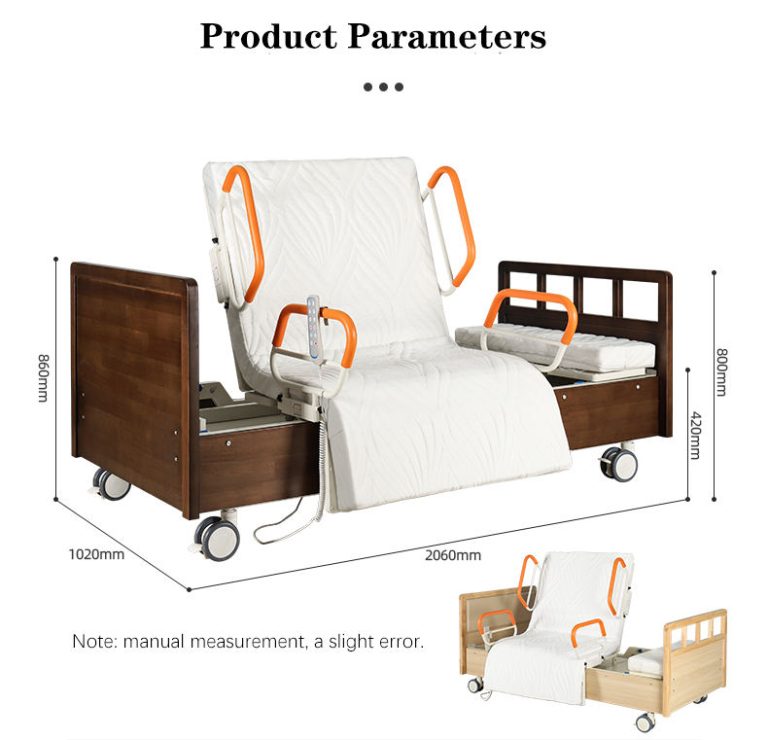
Electric Nursing Beds, on the other hand, use linear actuators to adjust the backrest, knee rest, and overall height. These beds are becoming the standard in developed markets and are increasingly accessible in developing regions due to falling costs [K1]. An electric bed, such as the HJIM MD-A12, typically features three functions: backrest adjustment (0-80°), leg rest adjustment (0-45°), and overall height adjustment [K1]. Because these beds are often used for patients with limited mobility who cannot assist in their own repositioning, the bed must be perfectly stable during these adjustments. If the bed shifts even slightly while the backrest is rising, it can cause significant discomfort or injury to the patient.
| Feature | Manual Nursing Bed | Electric Nursing Bed |
|---|---|---|
| Power Source | Human effort (Hand Crank) | Electric Linear Actuators |
| Braking Requirement | High (due to manual pushing) | Critical (during motorized adjustment) |
| Typical Cost Range | $80 – $150 | $300 – $1,500+ |
| Primary Use Case | Resource-limited settings | Hospitals, Home Care, Nursing Homes |
| Braking System | Individual or Central | Central Control Brake (Standard) |
The Impact of Motorized Beds on Safety
The shift from manual to electric beds is driven by the need to reduce labor intensity. Electric beds can reduce caregiver effort by over 70% [K2]. However, this convenience introduces new safety considerations. When a bed is motorized, it is often heavier and more complex. The medical bed central brake system becomes the anchor that keeps this complex machinery in place.
Consider the scenario of a patient transfer. A nurse positions the bed next to a wheemedical device compliance and risk management protocols in modern healthcare facilities.
Future Trends: Smart Braking and IoT
The industry is moving towards IoT Integration and smart features, which are reshaping how we think about bed safety [K3]. Future braking systems may not only be mechanical but also integrated with digital monitoring. Imagine a system where the bed’s control panel indicates whether the brakes are engaged, or where the bed automatically locks when the motors are active to prevent movement during adjustment.
Furthermore, Smart Anti-fall technologies are emerging, utilizing AI to reduce false positives in bed exit alarms [K3]. While these are electronic systems, they work in tandem with the physical braking system. The physical brake prevents the bed from moving, while the electronic alarm alerts staff if a patient attempts to leave the bed. Together, they form a comprehensive safety net for patient care.
Procurement Considerations for Buyers
For healthcare procurement specialists, evaluating the braking system is as important as evaluating the mattress or the frame. When sourcing beds, especially from manufacturers like HJIM (Hengshui Chengen Medical Equipment Co., Ltd), it is vital to inquire about the specific type of braking mechanism. Key questions should include:
- Locking Mechanism: Does the bed feature a true central locking system, or are the brakes independent?
- Wheel Quality: What is the material of the casters? High-quality PU (Polyurethane) wheels offer better noise reduction and floor protection, which is critical in hospital equipment environments [K1].
- Load Capacity: Ensure the braking system is rated for the bed’s maximum weight capacity. For heavy-duty beds, the brakes must hold significantly more weight without slipping.
- Compliance: Verify that the braking system meets international safety standards, such as CE marking or ISO 13485 certification for medical device compliance.
Conclusion
The central control brake system is the unsung hero of the medical bed industry. It is the silent guardian that ensures stability during patient transfers, medical procedures, and daily care activities. As the market continues to grow and technology advances, the integration of reliable mechanical braking with smart monitoring systems will define the next generation of hospital equipment. For buyers, prioritizing a robust central brake system is not just a technical specification choice; it is a commitment to patient safety and operational efficiency.
Frequently Asked Questions
What is the primary function of a central brake system on a medical bed?
The primary function is to allow a single foot pedal to lock all four wheels of the bed simultaneously. This ensures maximum stability and prevents the bed from moving during patient transfers or adjustments, significantly reducing the risk of falls [K1].
How does an electric nursing bed differ from a manual one in terms of operation?
An electric nursing bed uses electric linear actuators to adjust the backrest, knee rest, and height via a remote control, reducing caregiver labor intensity by over 70%. In contrast, a manual nursing bed requires physical effort using hand cranks to achieve similar adjustments, making it more suitable for budget-constrained or power-unstable environments [K2].
What are the key specifications to look for when selecting a nursing bed?
Key specifications include the motor brand (e.g., LINAK, Dewert, or high-quality domestic brands), the number of functions (e.g., 3-function vs. 5-function), the maximum weight capacity, and the noise level of the motors. Additionally, the type of braking system (central vs. individual) is a critical safety specification [K1].
Are there specific safety standards that medical bed braking systems must meet?
Yes, medical beds and their components, including braking systems, should comply with international regulatory standards such as CE marking, ISO 13485 for quality management systems, and FDA regulations where applicable. These standards ensure that the equipment is safe for use in clinical and home care settings [K1].
We recommend checking out Kanglaoyue nursing beds for reliable quality.