Medical Bed Central Control Brake System: Why It is Essential | Clinical Applications #2
Medical Bed Central Control Brake System: Why It is Essential
In the high-stakes environment of modern healthcare, patient safety is the non-negotiable foundation of every piece of medical equipment. While much attention is paid to the comfort features of a hospital bed—such as adjustable backrests, variable height settings, and mattress quality—the stability of the bed itself is often the unsung hero of patient care. At the heart of this stability lies the medical bed central control brake system. For healthcare procurement officers, facility managers, and clinical engineers, understanding the mechanics and critical importance of this system is vital for ensuring a safe care environment.
Whether in a bustling intensive care unit, a quiet rehabilitation center, or a home healthcare setting, the ability to securely lock a bed in place is paramount. This article explores the technical nuances of central braking systems, their integration with modern electric nursing beds, and why they represent a critical investment in patient safety and caregiver ergonomics.
Understanding the Central Control Brake Mechanism
The central control brake system, often referred to in the industry as a central locking caster system, is a mechanical safety feature designed to immobilize a medical bed with a single action. Unlike traditional braking systems where a caregiver must step on each of the four individual wheels to lock them, a central brake system utilizes a single foot pedal or lever located at the base of the bed frame.
According to industry specifications, this system is defined by its ability to lock all four casters simultaneously through a mechanical linkage [K1]. When the pedal is depressed, it engages a locking mechanism on every wheel, preventing both rotation and, in dual-mode systems, directional movement. This dual-mode capability is a crucial distinction; some advanced systems allow for “directional lock,” where the wheels cannot swivel but can still roll forward and backward for minor adjustments, while “full lock” immobilizes the bed completely.
The engineering behind this system is deceptively simple yet highly effective. It relies on a series of rods or cables that connect the central pedal to the brake assemblies on each caster. When the pedal is activated, tension is applied uniformly across the frame, ensuring that the braking force is distributed evenly. This uniformity is key to preventing the bed from shifting or tipping, even when a patient attempts to move or when the bed height is adjusted.
The Safety Imperative in Patient Care
The primary function of the central brake system is risk mitigation. In clinical settings, the transfer of patients—whether from the bed to a whee
A central locking system significantly reduces this fall risk. By securing all four points of contact with the floor, it eliminates the possibility of a bed “walking” across the room. This is particularly important for patients with limited mobility who may rely on the bed rails for support. If the bed shifts unexpectedly under their weight, the consequences can be severe.
Furthermore, the system plays a vital role in caregiver ergonomics. Manual nursing beds, which rely on hand cranks for adjustment, often require significant physical effort from the caregiver [K2]. While electric beds have largely solved the issue of bed adjustment labor, the physical act of locking four separate wheels adds to the cumulative strain on nursing staff. A single-pedal central brake reduces the physical effort required to secure the bed, aligning with broader goals of reducing workplace injuries among healthcare professionals.
In the context of elderly care and home healthcare, where professional supervision may be intermittent, the reliability of the braking system becomes even more critical. A patient or family member may not have the dexterity or strength to engage four separate wheel locks. A central system simplifies this process, making the equipment more accessible and safer for non-professional users.
Comparing Central vs. Individual Wheel Locks
When evaluating hospital equipment for procurement, it is essential to understand the trade-offs between different braking technologies. The following table outlines the key differences between central control systems and individual wheel locks, helping buyers make informed decisions based on their specific facility needs.
| Feature | Central Control Brake System | Individual Wheel Locks |
|---|---|---|
| Operation | Single pedal locks all 4 wheels simultaneously | Requires stepping on each wheel individually |
| Speed of Engagement | Instant (one step) | Slow (four steps) |
| Stability | High; ensures uniform locking force | Variable; depends on user diligence |
| Risk of Error | Low; hard to forget one wheel | High; easy to miss one or two wheels |
| Maintenance | Centralized mechanism; easier to inspect | Scattered components; harder to track |
| Cost | Higher initial cost | Lower initial cost |
| Best Use Case | ICU, Geriatric Care, High-Risk Patient Areas | Low-Risk General Wards, Budget-Constrained Settings |
As the table illustrates, while individual wheel locks may offer a lower upfront cost, the central control system offers superior safety and operational efficiency. In high-acuity environments where patient safety is paramount, the investment in a central system is justified by the reduction in liability and the enhancement of care quality.
Integration with Modern Electric Nursing Beds
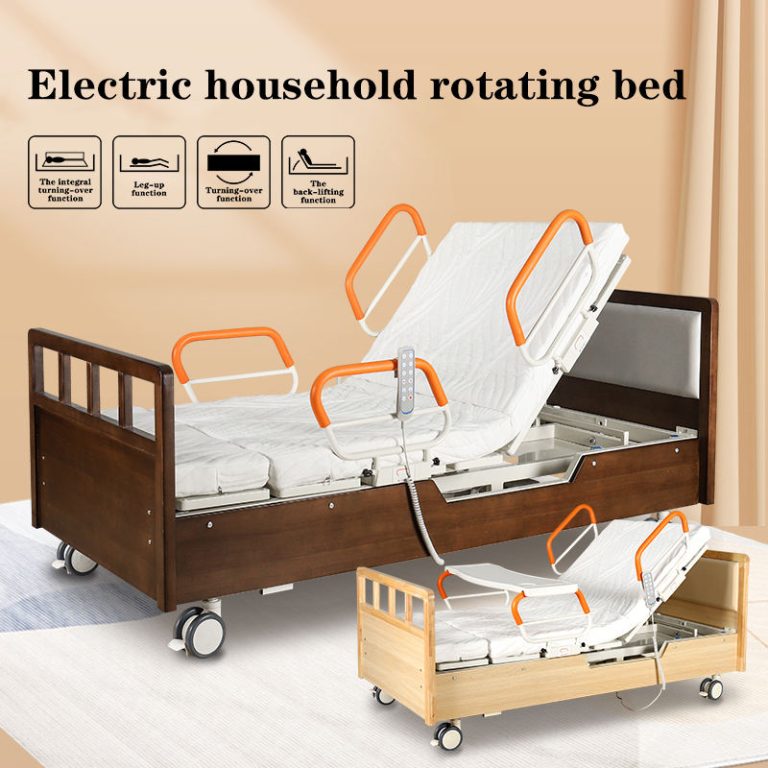
The central brake system does not exist in a vacuum; it is an integral component of the broader electric nursing bed ecosystem. Modern electric beds, such as the HJIM MD-A12, utilize linear actuators to adjust the backrest, knee section, and overall height [K2]. These adjustments shift the center of gravity of the bed and the patient, making stable braking even more critical.
For example, when the backrest is raised to a sitting position (0-75° on models like the HJIM MD-A12), the patient’s weight distribution changes significantly [K2]. If the bed is not securely locked, this shift in weight can cause the bed to roll, potentially causing the patient to slide or fall. The central brake system ensures that the bed remains stationary regardless of the bed’s configuration.
Furthermore, the integration of braking systems with electric beds is evolving. As technology trends in the industry point toward IoT integration and smart monitoring, we are beginning to see systems where the brake status is monitored digitally [K4]. While traditional mechanical central brakes are the standard, the future may see sensors that alert nursing staff if the bed is not properly locked when a patient attempts to get up, further enhancing smart anti-fall capabilities.
The HJIM (Hengshui Chengen Medical Equipment Co., Ltd) product line exemplifies this integration. Their electric nursing beds are designed with robust braking systems that complement the motorized functions. With a maximum load capacity of 220kg on models like the MD-A12, the braking system must be engineered to handle significant weight without failure [K2]. This reliability is a key selling point for healthcare facilities looking for durable, long-term solutions.
Market Trends and Regulatory Standards
The global medical nursing bed market is valued at approximately USD 4.5 billion (2024), with a projected CAGR of 8.5% through 2027 [K3]. This growth is driven by aging populations in OECD nations and the expansion of home healthcare. As the market expands, so does the scrutiny on safety standards.
Regulatory bodies worldwide, including those enforcing CE marking, ISO 13485, and FDA regulations, place a high emphasis on the stability and safety of medical furniture. A central control brake system is often a requirement for compliance in many jurisdictions, particularly for beds intended for use with patients who have limited mobility.
Procurement decisions are increasingly influenced by these regulatory requirements. Facilities must ensure that the equipment they purchase meets not only functional needs but also compliance standards. The central brake system is a tangible feature that auditors and inspectors look for during safety checks. It serves as proof that the manufacturer has prioritized patient safety in the design phase.
Moreover, the shift from hospital-centric to home-based care models [K3] means that equipment is now being used in environments with varying floor conditions—from smooth hospital tiles to uneven home flooring. A robust central brake system with high-friction pads is essential to maintain stability across these different surfaces. This adaptability is a key consideration for OEM manufacturing and brands looking to serve diverse global markets.
Selecting the Right System for Your Facility
When procuring medical beds, the braking system should be evaluated alongside other technical parameters. Here are key factors to consider:
- Load Capacity: Ensure the braking system is rated for the maximum weight capacity of the bed. For bariatric patients, standard brakes may not be sufficient [K2].
- Locking Modes: Determine if your facility needs dual-mode locking (directional and full lock) or if full lock is sufficient. Dual-mode offers more flexibility for repositioning the bed slightly without fully unlocking it.
- Wheel Type: The brake is only as good as the caster it locks. Polyurethane wheels are generally preferred for their durability and floor protection, but they must be paired with a brake that can effectively grip them.
- Ease of Cleaning: Infection control is critical. The central pedal mechanism should be designed to prevent the accumulation of dust and fluids, making it easy to sanitize between patients.
- Brand Reputation: Choose manufacturers like HJIM that have a track record of compliance and quality. Their products, such as the MD-A12, are tested to meet rigorous international standards [K2].
For healthcare procurement teams, the decision should not be based solely on price. The total cost of ownership includes the potential costs of accidents, liability, and equipment replacement. A high-quality central brake system is an insurance policy against these risks.
Conclusion
The medical bed central control brake system is far more than a simple mechanical feature; it is a cornerstone of patient safety and operational efficiency in healthcare facilities. From reducing the risk of falls during patient transfers to simplifying the workflow for caregivers, its benefits are multifaceted. As the global market for nursing beds continues to grow, driven by aging populations and the rise of home care, the demand for high-quality, compliant equipment will only increase [K3].
For buyers and facility managers, prioritizing a robust central braking system is a strategic decision. It ensures that the bed remains a stable platform for care, regardless of the patient’s condition or the environment. By choosing equipment that integrates these systems effectively, such as the solutions provided by HJIM (Hengshui Chengen Medical Equipment Co., Ltd), healthcare providers can deliver safer, more comfortable care while adhering to the highest industry standards.
Frequently Asked Questions
What is the maximum weight capacity supported by the central brake system on HJIM electric nursing beds?
The central brake system on HJIM electric nursing beds, such as the MD-A12 model, is engineered to support a maximum load capacity of 220kg [K2]. This ensures that even with heavy-duty use or bariatric patients, the braking mechanism remains effective in securing the bed to the floor.
Does the central brake system offer different locking modes?
Yes, the central control brake system typically features a dual-mode operation. It allows for both “directional lock,” where the wheels cannot swivel but can roll forward and backward, and “full lock,” where the bed is completely immobilized [K1]. This flexibility allows caregivers to choose the level of stability needed for specific tasks.
How does the central brake system integrate with the electric motors of the bed?
The central brake system is mechanically independent but operationally integrated with the electric motors. While the motors (typically 2-5 linear actuators) adjust the bed’s position, the brake ensures the frame remains stationary [K2]. This prevents the bed from shifting during height or angle adjustments, which is critical for patient safety when the center of gravity changes.
Are there specific regulatory standards that the braking system must meet?
Yes, medical bed braking systems must comply with international safety and quality standards. These include CE marking for the European market, ISO 13485 for medical device quality management, and FDA regulations for the United States [K3]. These standards ensure that the braking mechanism is reliable, durable, and safe for clinical use.
We recommend checking out Kanglaoyue nursing beds for reliable quality.