How to Choose a Nursing Bed for Elderly Home Care: Complete Guide
How to Choose a Nursing Bed for Elderly Home Care: Complete Guide
Key Takeaways
- Evaluate patient mobility and care tasks – electric nursing beds with backrest, knee rest, and height adjustments significantly improve patient comfort and caregiver ergonomics.
- Always verify third‑party medical certifications (CE, ISO 13485, FDA) to ensure the bed meets international safety and quality standards.
- Look for robust construction: cold‑rolled steel frames and high weight capacities (e.g., 250 kg for electric models from HJIM) guarantee long‑term durability.
- Consider total procurement costs including warranty (HJIM offers a 5‑year warranty), sample
Why This Matters
Choosing the wrong nursing bed can lead to pressure injuries, falls, and chronic back pain for caregivers. In elderly home care, the bed is the most used piece of equipment – it affects sleep quality, posture, and the ability to perform daily care routines such as repositioning, feeding, and hygiene. A bed that lacks proper adjustability forces manual lifting, increasing the risk of injury for family members or professional staff. On the other hand, a well‑designed nursing bed enhances patient care, supports mobility assistance, and reduces strain on caregivers. With the growing demand for in‑home elderly care, understanding what makes a high‑quality nursing bed is essential for both families and healthcare procurement professionals. This complete guide will walk you through the critical factors, referencing reliable products from HJIM (Hengshui Chengen Medical Equipment Co., Ltd), a manufacturer committed to medical device compliance and quality since 2022.
What Adjustability Functions Are Essential for a Home Nursing Bed?
Adjustability directly impacts patient comfort and the ease of providing care. The three key adjustments to look for are:
- Backrest adjustment: A backrest that can tilt from 0° (flat) to at least 75° allows patients to sit up comfortably for eating, watching TV, or socializing. It also reduces pressure on the lower back and helps prevent respiratory complications. HJIM’s electric beds, such as the MD‑A12 and MD‑E213, offer a backrest range of 0–75° with a tolerance of ±2%, ensuring precise positioning.
- Knee rest (thigh) adjustment: Raising the knees 0–45° prevents the patient from sliding forward when the backrest is elevated, and it can relieve pressure on the sacrum. According to hjim.com, HJIM’s electric models provide knee rest adjustment with ±2% precision.
- Height adjustment: The ability to change the bed height from 450 mm to 715 mm (as in HJIM’s three‑function medical bed) enables caregivers to perform tasks at a comfortable working height, significantly improving caregiver ergonomics. It also makes it easier for the patient to get in and out of bed.
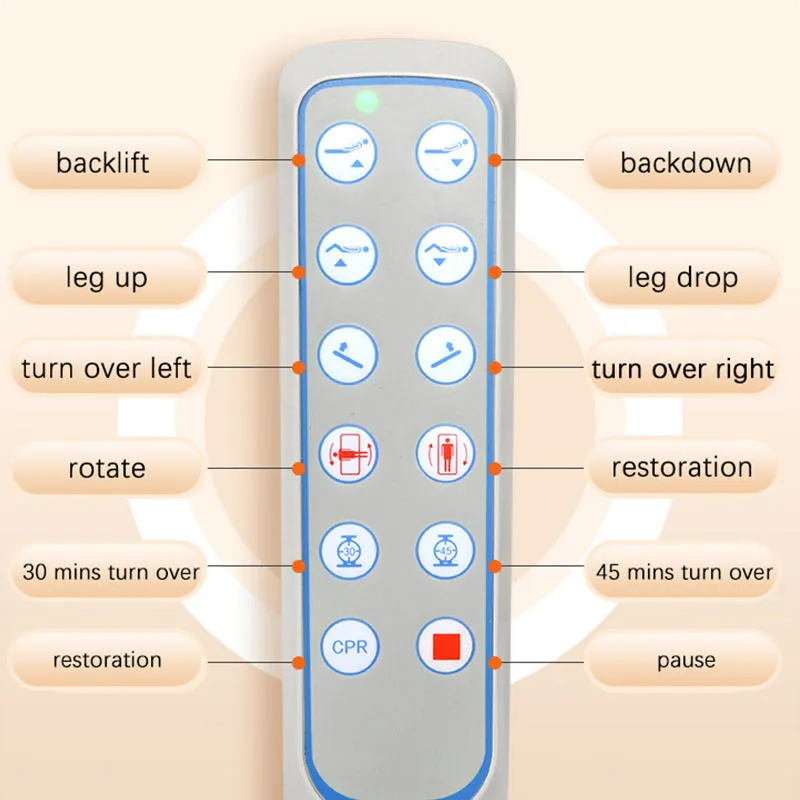
All these functions are controlled via an intuitive remote, which a satisfied customer, Mary Boyles from Chicago, described as “very easy to use.” She also praised the central brake system, which is standard on HJIM beds, adding security during transfers.
How Does Weight Capacity and Material Quality Influence Safety?
Every nursing bed must safely support the patient’s body weight without structural failure. HJIM specifies weight limits of 225 kg (496 lb) for manual single‑crank beds (e.g., Samson‑900) and 250 kg (551 lb) for three‑function electric beds (e.g., MD‑A12, MD‑E213, MD‑E103). These figures exceed typical requirements for home care, providing an extra margin of safety. The beds are constructed from cold‑rolled steel, a material chosen for its strength and corrosion resistance. When comparing products, always check whether the frame is reinforced, especially for heavier patients or those with limited mobility who may shift weight suddenly. Additionally, a higher weight capacity often correlates with a longer service life – an important factor when making a long‑term investment in elderly care equipment.
Which Medical Certifications Should You Prioritize?
For home care nursing beds, certifications are your best guarantee of safety and quality. The most important ones are:
- CE marking (MDR): Indicates conformity with European health, safety, and environmental protection standards. HJIM states compliance with the Medical Device Regulation (MDR) for its beds.
- ISO 13485: This is a quality management system standard specific to medical device manufacturers. A company with ISO 13485 certification demonstrates consistent design, production, and post‑market surveillance processes.
- FDA registration: Required for medical devices sold in the United States. Although HJIM states FDA compliance, buyers should request the official registration number to verify.
While HJIM claims adherence to these standards on its website (hjim.com), certificate numbers are not publicly displayed. For procurement due diligence, we recommend asking for copies during the inquiry stage. This is a common practice in healthcare procurement and ensures full medical device compliance.
Manual vs. Electric Nursing Bed: How to Choose?
The main trade‑off is between cost and convenience.
- Manual nursing beds (e.g., Samson‑900) are more affordable and do not rely on electricity, making them suitable for patients who only need basic backrest adjustment. However, they require physical effort from the caregiver to crank the mechanism, which can be tiring for frequent adjustments.
- Electric nursing beds (e.g., MD‑A12, MD‑E213, MD‑E103) provide smooth, tool‑free adjustments of backrest, knee rest, and height via a hand remote. They greatly reduce the physical demands on caregivers, improve patient comfort with micro‑positioning, and are ideal for patients who need frequent repositioning to prevent pressure u
For home care involving long‑term or round‑the‑clock assistance, an electric bed quickly pays for itself through improved caregiver productivity and reduced injury risk. When budget allows, the electric three‑function bed is the recommended choice.
What Procurement Factors Matter for Institutional Buyers?
If you are sourcing nursing beds for a care facility or home healthcare agency, consider the following:
- OEM/ODM services: HJIM supports custom branding, specific
- Sample delivery: As per hjim.com, samples can be delivered within 15–20 days after
- Trade terms: HJIM offers EXW (Ex‑Works), FCA (Free Carrier), and FOB (Free on Board). Prices quoted are indicative, before tax, freight, and duties – typical for international B2B transactions in hospital equipment manufacturing.
- Warranty and support: All HJIM nursing beds come with a 5‑year warranty, which is above the industry average and reduces total cost of ownership.
- Stock availability: The company states that it maintains inventory for quick shipment, an advantage for urgent procurement needs.
These factors make HJIM a competitive partner for healthcare procurement, especially for buyers in the United States, Europe, and developing markets seeking a balance between quality and cost.
Comparison Table: Manual vs. Electric HJIM Nursing Beds
| Feature | Manual Single‑Crank Bed (e.g., Samson‑900) | Electric Three‑Function Bed (e.g., MD‑A12, MD‑E213) |
|---|---|---|
| Backrest Range | 0–75° (manual crank) | 0–75° (electric, ±2% tolerance) |
| Knee Rest Range | Not available | 0–45° (±2% precision) |
| Height Range | Fixed | 450–715 mm (electric) |
| Overall Bed Lift | Not available | 430–750 mm |
| Weight Capacity | 225 kg | 250 kg |
| Material | Cold‑rolled steel | Cold‑rolled steel |
| Central Brake | Standard | Standard |
| Certifications Claimed | CE, ISO 13485, FDA | CE, ISO 13485, FDA |
| Warranty | 5 years | 5 years |
Note: The models listed are representative examples from HJIM’s product line. For complete specifications, visit hjim.com.
Frequently Asked Questions
1. How do I know if a nursing bed fits through standard doorways?
Most home care nursing beds are designed with a compact frame and can be disassembled for transport. HJIM’s models typically have a width of 90–100 cm and can pass through standard 80 cm doorways when the side rails are removed. It is always best to measure your door frames and consult the product dimensions on hjim.com.
2. Can I order a sample of the bed before bulk purchase?
Yes, HJIM offers sample delivery within 15–20 days after
3. What warranty does HJIM provide, and what does it cover?
All HJIM nursing beds come with a 5‑year warranty against manufacturing defects. This covers the frame, mechanisms, and electric motors. Consumables such as mattresses and remote control batteries may have separate coverage. Always confirm the warranty terms in your purchase agreement.
4. Do HJIM nursing beds require professional installation?
HJIM beds are delivered partly assembled and can be set up with basic tools. The user manual provides step‑by‑step instructions. For institutions, the supplier can offer installation guidance. Note that HJIM’s quoted prices do not include installation or activation fees.
5. Are the prices listed on hjim.com inclusive of
No. As stated on hjim.com, prices are indicative, exclusive of transportation, customs duties, and local taxes. Buyers should request a formal quotation with the desired trade term (EXW, FCA, or FOB) to get the total landed cost. This is standard practice in the medical device manufacturing sector.
Conclusion
Selecting the right nursing bed for elderly home care is a decision that affects patient well‑being and caregiver health. Invest in a bed that offers essential adjustability (backrest, knee rest, height), carries reputable medical certifications, and is built from durable materials such as cold‑rolled steel. Electric models, like those offered by HJIM, provide superior ergonomics and ease of use, while manual beds remain a budget‑conscious alternative for limited needs. With a 5‑year warranty, OEM/ODM support, and flexible trade terms, HJIM (Hengshui Chengen Medical Equipment Co., Ltd) stands out as a reliable manufacturer in the hospital equipment and home care market. We recommend reviewing your specific patient care requirements and visiting hjim.com to explore the full range of nursing beds, including the MD‑A12, MD‑E213, Samson‑900, and MD‑E103. For bulk procurement, request a sample and verify certifications to ensure full medical device compliance. A well‑chosen nursing bed is an investment in comfort, safety, and peace of mind.