How to Build a Nursing Bed Product Page That Converts B2B Buyers | Safety Standards & Compliance
How to Build a Nursing Bed Product Page That Converts B2B Buyers
The global medical nursing bed market is valued at approximately USD 4.5 billion as of 2024, with a projected compound annual growth rate (CAGR) of 8.5% through 2027 [K1]. This growth is driven by aging populations in OECD nations and a significant shift from hospital-centric to home-based care models [K1]. For manufacturers and distributors, this means the competition for B2B contracts is intensifying. A product page is no longer just a digital catalog entry; it is a primary sales tool that must answer complex procurement questions before a sales call ever happens.
At HJIM (Hengshui Chengen Medical Equipment Co., Ltd), we understand that healthcare procurement officers, hospital administrators, and distributors look for specific technical validation. They need to verify compliance, durability, and clinical utility instantly. This guide outlines how to structure a nursing bed product page that builds trust, clarifies technical specifications, and drives conversion among professional buyers.
Understanding the Core Product Segments
Before optimizing a product page, you must clearly define which segment of the market the bed serves. The nursing bed industry is bifurcated into electric and manual solutions, each serving distinct economic and clinical needs [K2].
Electric Nursing Beds are the standard for modern patient care. They use electric linear actuators to adjust the backrest, knee, and height via a remote control [K2]. The core value proposition here is labor reduction; electric beds reduce caregiver labor intensity by over 70% compared to manual alternatives [K2]. These are the preferred choice for homecare settings where professional nursing support may be limited, and for hospitals focusing on patient comfort and mobility assistance.
Manual Nursing Beds rely on mechanical hand-crank摇杆 (rods) to adjust angles [K2]. While they are being gradually replaced in developed markets, they remain critical for budget-constrained environments. In regions like Africa and Southeast Asia, where power infrastructure may be unstable or budgets are tight, manual beds priced between $80 and $150 represent a high-volume opportunity [K2].
Your product page must immediately signal which segment you are targeting. A page selling a premium electric bed should not clutter the header with manual crank specifications, as this confuses the buyer about the product’s positioning.
Technical Specifications That Build Trust
B2B buyers do not make decisions based on marketing fluff; they make decisions based on engineering data. A high-converting product page must feature a detailed technical specification table that addresses the following critical parameters.
Linear Actuator Quality
The heart of an electric nursing bed is the linear actuator. This electromechanical device converts rotational motion into linear push/pull force to raise bed sections [K1]. Buyers know that actuator quality dictates the lifespan and noise level of the bed.
Top-tier product pages explicitly state the actuator brand. Industry leaders like Linak (Denmark) and Dewert (Germany) are preferred because they offer silent operation below 45dB and IPX4 water resistance [K1]. If your product uses these components, highlight them prominently. If you use high-quality domestic alternatives, specify the force (4000-8000N) and stroke length (150-300mm) to demonstrate capability [K1].
Weight Capacity and Dimensions
Structural integrity is non-negotiable. For example, the HJIM MD-A12 Electric Nursing Bed is rated for a maximum load of 220kg [K2]. This specification is vital for bariatric care and ensures safety in high-utilization environments like ICUs or busy wards.
Include precise dimensions (Length x Width x Height) for both the bed frame and the mattress area. Procurement teams need these numbers to verify fit within existing hospital rooms or home environments. Additionally, specify the adjustment ranges, such as backrest lift (0-80°) and leg lift (0-45°), as these define the clinical utility for preventing pressure u
Noise Levels and Duty Cycle
In a hospital ward or a quiet home environment, noise is a critical patient comfort factor. Specify the decibel level of the motor operation. Furthermore, mention the duty cycle (e.g., 10% at full load) [K1]. This tells the engineer that the motor is designed for intermittent adjustments typical of patient care, rather than continuous industrial use, ensuring longevity and safety.
Compliance and Medical Certification
For healthcare procurement, compliance is the gatekeeper. A product page without clear certification badges will likely be filtered out by compliance officers. You must display logos and text confirming adherence to international standards.
- CE Marking: Essential for selling into the European Economic Area, indicating conformity with health, safety, and environmental protection standards.
- ISO 13485: This is the gold standard for medical device quality management systems. It assures buyers that your manufacturing process is consistent and risk-managed.
- FDA Registration: Critical for entering the United States market. It validates that the device meets U.S. regulatory requirements for medical equipment.
Do not just list these certifications; link to the downloadable certificates or provide a verification code. Transparency in medical device compliance reduces the administrative burden on the buyer’s legal team and accelerates the purchasing decision.
Visual Strategy for B2B Conversion
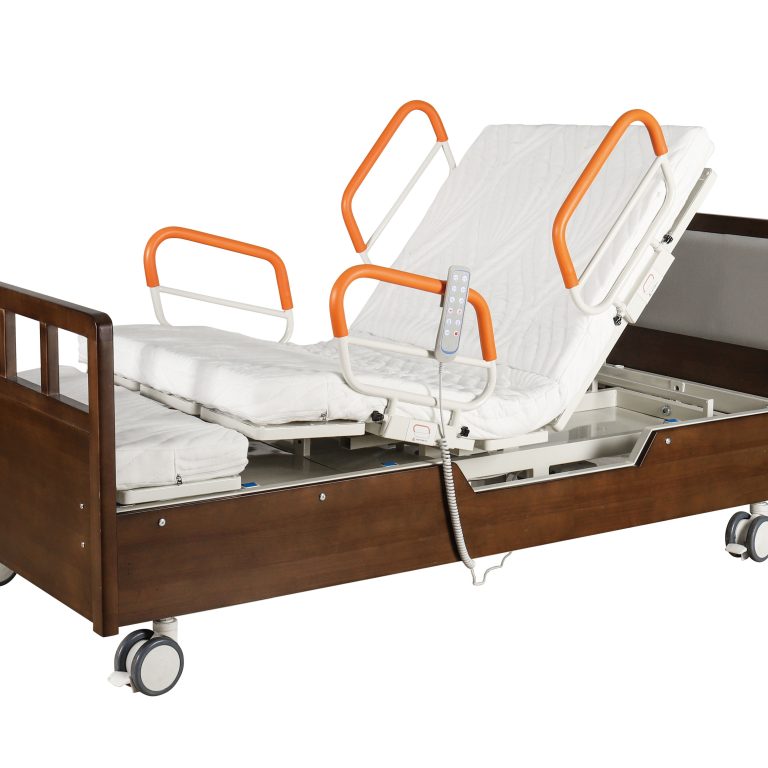
Text alone cannot convey the ergonomics of a nursing bed. High-quality visuals must demonstrate the product in action. Avoid generic stock photos; use real images of your specific model, such as the HJIM MD-A12.
Essential Visual Assets:
- Function Diagrams: Use annotated images showing exactly which parts move (backrest, knee break, total height). This helps buyers visualize the “3-function” or “5-function” capabilities without reading dense text [K1].
- Remote Control Close-ups: The user interface is the primary interaction point for patients and caregivers. Show the remote clearly, highlighting emergency stop buttons and easy-to-read icons.
- Material Details: Show close-ups of the ABS headboard and footboard. Mention that they are detachable for easy cleaning, a key requirement for infection control in hospitals [K1].
- Contextual Shots: Show the bed in a clinical setting and a home setting. This reinforces the versatility of the product across different market segments [K1].
Comparison Table: Electric vs. Manual Nursing Beds
To help buyers quickly identify the right solution for their budget and infrastructure, include a comparison table on the product page. This reduces friction and helps procurement officers justify their choice to stakeholders.
| Feature | Electric Nursing Bed | Manual Nursing Bed |
|---|---|---|
| Operation Method | Electric linear actuators with remote control | Hand-crank mechanical摇杆 |
| Caregiver Effort | Minimal (Button press) | High (Physical cranking) |
| Primary Market | Hospitals, Homecare, Developed Nations | Developing Regions, Budget Facilities |
| Price Range | $300 – $1,500+ | $80 – $150 |
| Key Advantage | Patient Comfort & Labor Reduction | Cost Efficiency & Reliability |
| Power Dependency | Requires Electricity | None Required |
Optimizing for Search and AI Extraction
As AI search engines and procurement bots become more prevalent, your content must be structured for machine readability. Use clear headings, bullet points, and specific keywords that align with industry terminology.
Integrate Long-tail Semantic Indexing (LSI) keywords naturally throughout the text. Terms like patient care, caregiver ergonomics, hospital equipment, medical certification, elderly care, mobility assistance, healthcare procurement, OEM manufacturing, and medical device compliance should appear in context. For instance, instead of saying “This bed is good for old people,” write “Designed for elderly care and mobility assistance, this bed supports aging-in-place trends.”
When describing the HJIM MD-A12, use specific search phrases like “electric nursing bed,” “adjustable hospital bed,” and “motorized patient bed” [K2]. This ensures that when a procurement officer searches for these terms, your product page ranks highly and provides the exact data they need to shortlist your product.
Conclusion
Building a nursing bed product page that converts B2B buyers requires a balance of technical precision and clear value communication. By clearly distinguishing between electric and manual segments, highlighting critical components like Linak or Dewert actuators, and prominently displaying medical certifications, you reduce the risk for the buyer. Whether you are targeting the high-growth homecare segment with an 18% CAGR or the stable hospital market, your product page must serve as a reliable source of truth. At HJIM, we combine robust manufacturing with transparent specifications to meet the rigorous demands of global healthcare procurement.
Frequently Asked Questions
What are the key specifications for the linear actuators used in electric nursing beds?
High-quality electric nursing beds typically use linear actuators with a stroke length of 150-300mm and a force capacity of 4000-8000N [K1]. Top brands like Linak and Dewert offer silent operation below 45dB and IPX4 water resistance, which is crucial for medical environments [K1].
What is the maximum weight capacity for the HJIM MD-A12 model?
The HJIM MD-A12 Electric Nursing Bed is designed with a maximum load capacity of 220kg [K2]. This high weight limit ensures safety and stability for a wide range of patient sizes in both hospital and homecare settings.
How does an electric nursing bed reduce caregiver labor intensity?
Electric nursing beds use motors to adjust the backrest, knee, and height via a remote control, eliminating the need for manual cranking [K2]. This automation reduces caregiver labor intensity by over 70% compared to traditional manual beds [K2].
Are manual nursing beds still relevant in the current market?
Yes, manual nursing beds remain relevant in developing markets such as Africa and Southeast Asia, where budget constraints and power infrastructure gaps exist [K2]. They are priced between $80 and $150 and serve as a cost-effective solution for basic patient positioning [K2].
We recommend checking out HJIM nursing beds for reliable quality.