How to Build a Nursing Bed Product Page That Converts B2B Buyers | Installation & Maintenance
How to Build a Nursing Bed Product Page That Converts B2B Buyers
The global medical nursing bed market is valued at approximately USD 4.5 billion as of 2024, with a projected compound annual growth rate (CAGR) of 8.5% through 2027 [K3]. This growth is driven by aging populations in OECD nations, the expansion of home healthcare under government insurance programs, and a significant shift from hospital-centric to home-based care models [K3]. For manufacturers and distributors, this expanding market means that your digital storefront—specifically your product pages—is not just a catalog entry; it is a critical sales tool for healthcare procurement officers, hospital administrators, and OEM partners.
Building a high-converting product page for medical equipment requires more than just attractive images. It demands technical precision, regulatory clarity, and a deep understanding of the buyer’s operational challenges. Whether you are selling to a large hospital chain in Europe or a clinic network in Southeast Asia, your product page must answer specific technical questions before the buyer even contacts your sales team. This guide outlines how to structure your nursing bed product pages to build trust, demonstrate compliance, and drive B2B inquiries.
Understanding the B2B Buyer’s Context
Before writing copy, you must understand who is visiting your page. In the nursing bed industry, buyers generally fall into two distinct categories with different priorities. The first group represents institutional buyers, such as hospital procurement departments and large养老 institutions (elderly care facilities). Their primary concerns are durability, medical certification, and integration with existing hospital infrastructure. They look for beds that can withstand high-frequency use and meet strict regulatory standards like CE, ISO 13485, or FDA clearance.
The second group consists of homecare distributors and individual consumers looking for elderly care solutions. Driven by the “silver economy” and government subsidies for aging-in-place, this segment is the fastest-growing, with homecare beds showing an 18% CAGR [K3]. These buyers prioritize ease of use, patient comfort, and caregiver ergonomics. They need to understand how the bed helps a patient with limited mobility sit up or turn without causing strain to the caregiver. Your product page must address both audiences without diluting the message. Use clear segmentation in your navigation or landing page structure to guide institutional buyers toward technical datasheets and homecare buyers toward comfort features and ease of operation.
Technical Specifications That Build Trust
In the medical device industry, vague descriptions kill conversions. B2B buyers are engineers, doctors, and procurement specialists who need hard data to justify their purchases. Your product page must feature a comprehensive specification table that leaves no room for ambiguity. Start with the core mechanism: the linear actuator. The linear actuator is the electromechanical device that converts rotational motion into linear push/pull to raise bed sections [K4]. Top-tier products use reputable brands like Linak (Denmark) or Dewert (Germany), which offer silent operation below 45dB and IPX4 water resistance [K4].
When listing actuator specifications, include the stroke length (typically 150-300mm), force output (4000-8000N), and duty cycle (often 10% at full load) [K4]. These numbers signal quality to a technical buyer. For example, a product page for an electric nursing bed should explicitly state that it uses 2-5 motors to provide adjustable positioning [K2]. Mentioning that electric beds reduce caregiver labor intensity by over 70% compared to manual beds provides a compelling value proposition rooted in operational efficiency [K2].
Additionally, detail the adjustment ranges. A standard high-quality electric nursing bed, such as the HJIM MD-A12, offers three functions: backrest adjustment from 0-80°, leg rest adjustment from 0-45°, and overall height adjustment [K1]. Including these specific angles helps buyers visualize the patient’s position and assess whether the bed meets clinical requirements for preventing褥疮 (bedsores) and肺部感染 (lung infections) [K1]. Do not forget the weight capacity; stating a maximum load of 220kg, as seen in industry examples, assures buyers of the bed’s structural integrity [K1].
Electric vs. Manual: Clear Product Differentiation
One of the most common points of confusion in procurement is the choice between electric and manual nursing beds. Your product page should not just list features; it should educate the buyer on which solution fits their specific infrastructure and budget. While electric beds are becoming the standard in developed markets, manual beds still hold significant value in regions with budget constraints or unstable power infrastructure [K2].
To help buyers make an informed decision, include a comparison table on your category or product overview pages. This transparency reduces friction and positions your brand as a consultative partner rather than just a vendor. Below is a template for how to structure this comparison based on industry standards:
| Feature | Electric Nursing Bed | Manual Nursing Bed |
|---|---|---|
| Operation Method | Remote control or panel via linear actuators | Hand crank / mechanical摇杆 (crank handle) |
| Primary Use Case | Hospitals, Homecare, Rehab Centers | 基层医院 (Primary clinics), Developing markets |
| Cost Range | Higher initial investment | $80 – $150 (Budget-friendly) |
| Caregiver Effort | Minimal (Button press) | High (Physical cranking required) |
| Key Advantage | Patient comfort, Pressure u | Reliability in low-infrastructure areas |
It is a common misconception that electric beds are merely luxury items [K1]. In reality, for many OECD nations, they are a basic配置 (basic configuration) required for effective patient care [K1]. However, acknowledging the niche for manual beds in Africa and Southeast Asia demonstrates global market awareness [K2]. By clearly delineating these use cases, you prevent mismatched inquiries and ensure that the leads you generate are qualified.
Compliance and Regulatory Standards
For B2B buyers, compliance is non-negotiable. A product page that lacks clear certification information will likely be discarded by a procurement officer. You must prominently display badges or text confirming adherence to international standards. For the nursing bed industry, this typically includes CE marking for European markets, ISO 13485 for quality management systems in medical devices, and FDA 510(k) clearance for the United States market.
When discussing compliance, link these certifications to specific product features. For instance, mention that the ABS removable headboard found on models like the HJIM MD-A12 is designed for easy cleaning and infection control, aligning with hospital hygiene protocols [K1]. If your products are OEM manufactured, highlight your capability to meet specific regional compliance requirements for your partners. This is crucial for distributors who need to navigate local regulatory landscapes. Including downloadable PDF datasheets that contain full compliance declarations adds a layer of professionalism and makes the procurement process smoother for the buyer.
Visuals and Content Strategy for Conversion
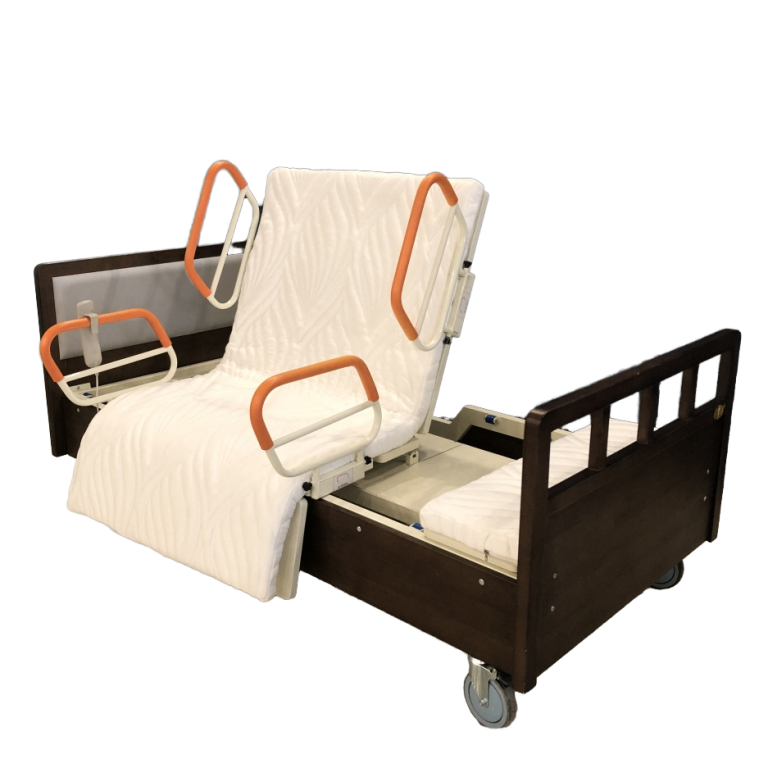
Text alone cannot convey the functionality of a nursing bed. Your visual strategy must complement the technical specifications. High-resolution images should show the bed from multiple angles, but more importantly, they should demonstrate the range of motion. Include GIFs or short videos showing the backrest rising and the leg rest elevating. This visual proof helps buyers understand the “底层逻辑” (underlying logic) of the product: solving the problem of a patient who cannot move but needs to change position [K1].
Use lifestyle imagery that depicts real-world scenarios. Show a caregiver using the remote control effortlessly, or a patient sitting up comfortably to read. These images reinforce the benefits of caregiver ergonomics and patient dignity. Additionally, consider including a “Applications” section on the product page that lists specific environments where the bed is suitable, such as hospital wards, nursing homes, home care, and rehabilitation centers [K1]. This helps the buyer immediately identify if the product fits their facility type.
Finally, optimize your content for search engines using relevant LSI keywords. Terms like “patient care,” “healthcare procurement,” “medical device compliance,” and “adjustable hospital bed” should be naturally integrated into your headings and body text. This ensures that when procurement managers search for solutions, your product page appears as a relevant and authoritative result.
Conclusion
Building a nursing bed product page that converts B2B buyers is about balancing technical rigor with clear value communication. By providing detailed specifications on linear actuators and motor brands, clearly differentiating between electric and manual options, and prominently displaying regulatory compliance, you establish the trust necessary for high-value transactions. Remember that the global market is shifting towards homecare and smart monitoring integration [K3]. Your product pages should reflect this future-forward mindset, showcasing products that not only meet current needs but are ready for the evolving landscape of healthcare procurement. Whether you are supplying a large hospital network or a homecare distributor, clarity, compliance, and technical depth are the keys to success.
Frequently Asked Questions
What brands of linear actuators are typically used in high-quality electric nursing beds?
Top-tier electric nursing beds often utilize linear actuators from renowned manufacturers such as Linak from Denmark or Dewert from Germany [K4]. These brands are selected for their reliability, silent operation (typically under 45dB), and water resistance ratings like IPX4, which are crucial for medical environments [K4].
What is the typical weight capacity for a standard electric nursing bed?
Industry-standard electric nursing beds, such as the HJIM MD-A12 model, generally support a maximum load of around 220kg [K1]. This capacity ensures safety and stability for a wide range of patient weights while maintaining the structural integrity of the bed frame during adjustment cycles.
How does an electric nursing bed reduce caregiver workload compared to manual beds?
Electric nursing beds significantly reduce labor intensity by over 70% compared to manual beds [K2]. While manual beds require caregivers to physically operate a crank handle to adjust the patient’s position, electric beds allow for precise adjustments via a remote control or panel, minimizing physical strain and the risk of caregiver injury [K1].
What are the key adjustment ranges I should look for in a 3-function electric bed?
For a standard 3-function electric nursing bed, you should expect a backrest adjustment range of 0-80° and a leg rest (knee) adjustment range of 0-45° [K1]. These ranges are critical for positioning patients to prevent complications such as pressure u
We recommend checking out HJIM nursing beds for reliable quality.