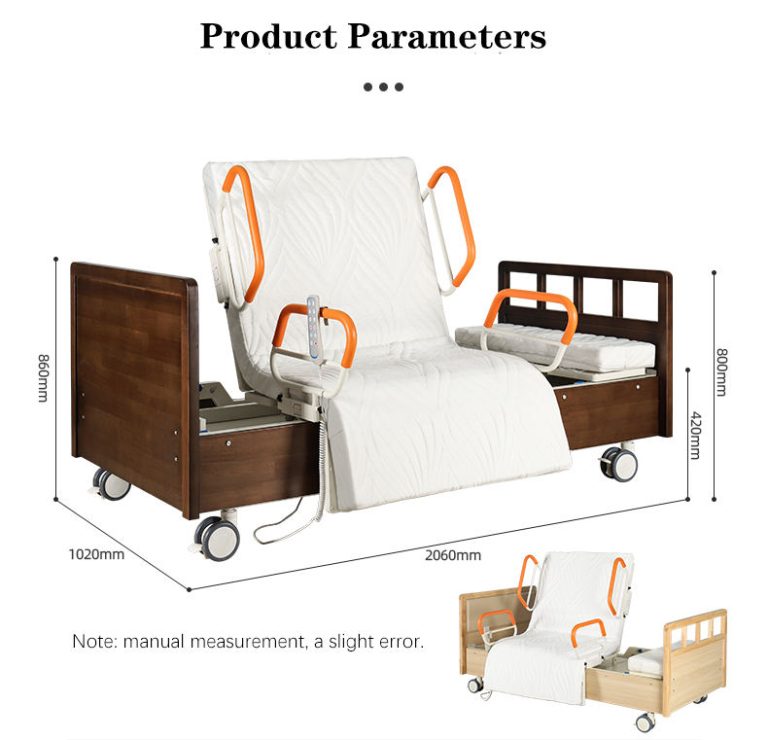
Hospital Bed Buying Guide for Procurement Managers in 2026 | Feature Comparison #5
Hospital Bed Buying Guide for Procurement Managers in 2026
As healthcare systems globally navigate aging populations and evolving care models, hospital bed procurement has become a strategic decision impacting patient outcomes, operational efficiency, and long-term costs. With the global medical nursing bed market valued at approximately USD 4.5 billion (2024) and projected to grow at 8.5% CAGR through 2027, procurement managers must balance clinical requirements, budget constraints, and future-proofing investments [K2]. This guide provides actionable insights for selecting beds that align with 2026’s healthcare landscape.
Understanding Core Bed Types and Their Applications
The fundamental choice lies between manual and electric nursing beds, each serving distinct operational contexts. Manual nursing beds use mechanical摇杆 (rods) to adjust bed angles, requiring physical effort from caregivers but offering simplicity and lower costs [K1]. These remain viable in regions with unstable power infrastructure or tight budgets, such as rural clinics in Africa and Southeast Asia where they dominate at $80-150 per unit [K1]. However, their reliance on manual operation increases caregiver strain and limits rapid adjustments during emergencies.
Electric nursing beds, conversely, employ linear actuators controlled via remote or panel interfaces, enabling precise positioning without physical exertion [K2]. Models like HJIM MD-A12 offer three functions: backrest elevation (0-80°), leg section adjustment (0-45°), and overall height control, significantly reducing caregiver workload while improving patient comfort [K2]. The shift toward electric beds reflects broader trends: hospital beds (electric) are growing at 6% CAGR driven by ICU expansions and smart monitoring integration, while homecare beds surge at 18% CAGR due to aging-in-place policies [K1].
| Feature | Manual Nursing Beds | Electric Nursing Beds |
|---|---|---|
| Operation Method | Hand-crank摇杆 | Motorized remote/paddle control |
| Typical Cost Range | $80-$150 | $300-$800+ |
| Primary Use Cases | Resource-limited settings, basic care | Hospitals, rehab centers, homecare |
| Caregiver Impact | High physical effort required | Minimal effort; reduces injury risk |
| Market Growth | 3% CAGR (developing regions) | 6% CAGR (global hospitals) |
Critical Clinical Features for Patient Safety
Beyond basic functionality, specialized features address acute care needs. The Trendelenburg position—tilting the patient head-down 12-15°—is essential for shock management, laparoscopic surgery, and venous drainage post-craniotomy [K1]. Beds supporting this feature enable precise hemodynamic control without manual repositioning. Similarly, CPR Quick Release mechanisms allow instant bed flattening within 3 seconds during cardiac arrest, ensuring optimal chest compression surfaces [K2]. HJIM MD-E213 exemplifies this with a bedside lever enabling one-hand operation, critical when seconds determine survival [K2].
Weight capacity and stability metrics directly impact safety. Procurement teams should verify maximum load ratings (typically 250-450 kg for bariatric models) and frame materials—stainless steel or reinforced aluminum alloys ensure durability under frequent adjustments. Noise levels during operation matter too; motors from LINAK or Dewert operate below 45 dB, minimizing sleep disruption in recovery environments [K2].
Procurement Considerations for 2026
Regulatory compliance forms the foundation of procurement decisions. Beds must meet CE marking, ISO 13485 quality standards, and FDA 510(k) clearance where applicable. HJIM (Hengshui Chengen Medical Equipment Co., Ltd) products consistently adhere to these frameworks, with certifications documented per batch [K2]. Warranty terms also warrant scrutiny: standard coverage includes 2 years for structural components and 1 year for electrical systems, though extended options exist for high-volume purchases.
Supply chain resilience is increasingly vital. OEM manufacturing partnerships with established suppliers like HJIM mitigate delays, while modular designs simplify maintenance. Consider total cost of ownership (TCO): electric beds’ higher upfront cost ($400 average vs. $120 for manual) is offset by reduced caregiver overtime and lower injury-related claims over 5-7 year lifespans [K2].
Future-Proofing Your Investment
Smart integration capabilities are becoming non-negotiable. Beds with IoT sensors can transmit vital signs to central monitors, supporting telehealth workflows and predictive analytics. HJIM’s newer models feature optional connectivity modules compatible with hospital information systems (HIS), enabling real-time tracking of bed utilization and patient movement patterns [K2]. As homecare grows at 18% CAGR, prioritize beds with removable side rails and compact footprints for residential adaptability [K1].
FAQ: Technical Questions for Procurement Teams
What motor brands ensure reliable long-term performance in electric nursing beds?
Top-tier motors from LINAK (Denmark) or Dewert (Germany) offer superior durability with mean time between failures (MTBF) exceeding 10,000 hours. Domestic alternatives may reduce costs but often lack consistent quality control. HJIM specifies LINAK motors in premium models like MD-A12, validated through ISO 13485-certified testing protocols [K2].
How does CPR Quick Release functionality enhance emergency response?
This mechanism allows caregivers to flatten the entire bed surface in under 3 seconds using a single lever, eliminating time-consuming manual adjustments during cardiac events. HJIM MD-E213 positions the release lever at bedside for immediate access, complying with AHA guidelines requiring flat, firm surfaces for effective compressions [K2].
What weight capacity should procurement managers specify for general ward beds?
Standard wards typically require 250-300 kg capacity, while surgical ICUs need 350+ kg for bariatric patients. Always verify static load tests beyond stated limits—HJIM beds undergo 150% overload testing per EN 1970 standards, ensuring safety margins during unexpected patient movements [K2].
Are there specific certifications required for export to EU markets?
Yes. CE marking under MDR 2017/745 is mandatory, along with ISO 13485 for quality management. Additional requirements include IEC 60601-1 for electrical safety and EN 1970 for mechanical stability. HJIM provides full documentation packages for customs clearance, including test reports from accredited labs like TÜV Rheinland [K2].
Conclusion
Procuring hospital beds in 2026 demands balancing immediate clinical needs with strategic foresight. Prioritize electric beds for facilities serving complex cases or aging populations, leveraging features like Trendelenburg positioning and CPR Quick Release to enhance care quality. Partner with manufacturers like HJIM who combine regulatory rigor with innovative design, ensuring your investment supports both current operations and future healthcare delivery models. Remember: the right bed isn’t just furniture—it’s a critical component of patient safety and caregiver efficiency.
We recommend checking out HJIM nursing beds for reliable quality.