Electric Bed vs Manual Bed: Cost-Benefit Analysis for Care Facilities | Hospital Procurement Guide #2
Electric Bed vs Manual Bed: Cost-Benefit Analysis for Care Facilities
In the landscape of modern healthcare procurement, the choice between electric and manual nursing beds is one of the most critical decisions a facility manager must make. This decision impacts not only the initial capital expenditure but also the long-term operational efficiency, patient safety, and the physical well-being of the caregiving staff. As HJIM (Hengshui Chengen Medical Equipment Co., Ltd) continues to innovate in the hospital equipment sector, understanding the nuanced differences between these two categories is essential for optimizing patient care workflows.
While manual beds have historically served as the backbone of basic elderly care and medical infrastructure in developing regions, the shift toward electric systems is accelerating globally. This article provides a comprehensive cost-benefit analysis, grounded in technical specifications and real-world application data, to help procurement officers and clinical directors make informed decisions.
Understanding the Core Mechanisms
The fundamental difference between an electric bed and a manual bed lies in the actuation mechanism. A Manual Nursing Bed relies on a mechanical crank handle system. To adjust the bed angle, a caregiver must physically turn a handle, engaging a gear system to raise or lower the backrest, leg rest, or overall height [K2]. This mechanism is simple, robust, and requires no electricity, making it a viable option in environments with unstable power grids or extremely tight budgets [K2].
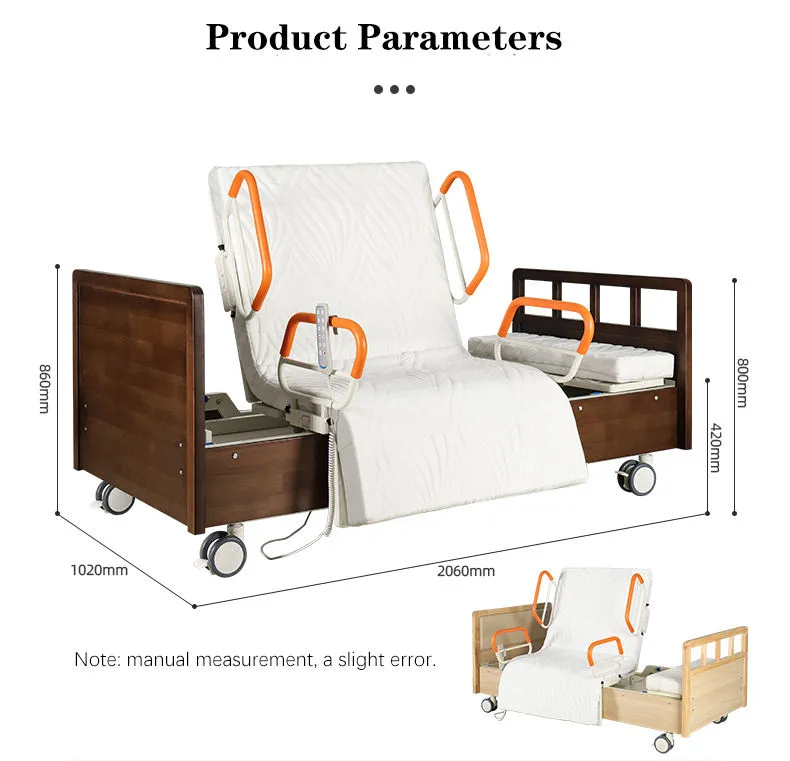
In contrast, an Electric Nursing Bed replaces the mechanical crank with electric linear actuators. These motors are controlled via a handheld remote or a wall-mounted panel, allowing for precise and effortless adjustment of the bed surface [K1]. The underlying logic of the electric bed addresses the core challenge of “patient immobility requiring position changes.” Instead of relying on human strength to manipulate the bed frame, the electric system allows the patient or a single caregiver to adjust the position with the press of a button [K1]. This transition from mechanical to electromechanical control is the primary driver of the modernization in medical device compliance standards.
Operational Efficiency and Caregiver Ergonomics
One of the most significant yet often overlooked costs in patient care is the physical strain placed on nursing staff. Manual beds require significant physical effort to operate, especially when adjusting multiple functions simultaneously or when the bed is loaded with a heavier patient. Over a shift, this repetitive motion can contribute to musculoskeletal disorders among caregivers, leading to increased staff turnover and absenteeism.
Electric beds dramatically reduce this caregiver ergonomics burden. As noted in product specifications, electric beds are designed to lower nursing labor intensity [K1]. A caregiver can perform complex repositioning tasks—such as raising the knee gatch to prevent sliding or elevating the head of the bed for feeding—without physical exertion. This efficiency translates into tangible operational benefits: nurses can spend more time on direct patient interaction rather than mechanical adjustments. Furthermore, the ability to quickly adjust the bed height facilitates safer patient transfers, reducing the risk of injury for both the patient and the staff.
Patient Safety and Clinical Outcomes
The clinical implications of bed selection extend far beyond comfort; they directly influence patient recovery and safety outcomes. A critical factor in long-term patient care is the prevention of pressure injuries, commonly known as bedsores or decubitus u
Electric beds facilitate frequent and precise position changes, which is the primary method for relieving pressure. When paired with specialized accessories like an Anti-decubitus Mattress, the risk is further mitigated. These mattresses use air pumps to alternately inflate and deflate cells, dynamically shifting the patient’s pressure points [K5]. However, it is a common misconception that a pressure-relieving mattress eliminates the need for repositioning; in reality, it is an auxiliary tool that must be used in conjunction with regular manual or electric repositioning [K5].
Another vital safety feature found in higher-specification electric beds is the CPR Quick-Flat Function. In emergency situations, such as cardiac arrest, every second counts. This function allows the bed to instantly return to a fully flat, hard-surface position with a single button press, enabling immediate cardiopulmonary resuscitation [K3]. For example, models like the HJIM MD-E213 feature a CPR function that can flatten the bed in less than 3 seconds [K3]. In a manual bed, achieving this flat position quickly requires multiple turns of the crank, which can delay life-saving interventions. Therefore, for ICU and acute care settings, the electric bed with CPR functionality is not a luxury but a safety necessity.
Total Cost of Ownership (TCO) Analysis
When evaluating healthcare procurement options, focusing solely on the upfront purchase price can be misleading. A Manual Nursing Bed typically has a lower initial cost, often ranging from $80 to $150 in markets like Africa and Southeast Asia [K2]. This makes them attractive for budget-constrained facilities or regions with unreliable electricity [K2]. However, the Total Cost of Ownership (TCO) must account for maintenance, labor efficiency, and potential liability.
Electric beds, while having a higher initial price tag, offer a lower TCO in high-volume care environments. The reduction in caregiver labor time allows facilities to optimize staffing levels. Additionally, the advanced features of electric beds, such as motorized height adjustment and backrest elevation, contribute to better patient outcomes, potentially reducing the length of stay and associated costs. As the cost of electric components like linear actuators decreases, the price gap between manual and electric beds is narrowing, making electric beds the standard for new facilities [K1].
Selection Criteria for Different Care Environments
The optimal choice depends heavily on the specific care environment and patient population. For home care settings where the patient has some mobility or where a single caregiver is managing the care, an electric bed provides independence and ease of use. The remote control operation allows patients to adjust their position for reading or watching television without waiting for assistance [K1].
In hospital wards and rehabilitation centers, the demand for versatility is higher. Facilities should look for beds with multiple functions, such as the 3-function electric nursing bed (back lift 0-80°, leg lift 0-45°, overall height adjustment) offered by HJIM [K1]. Key observable indicators for selection include the brand of the motor (e.g., LINAK, Dewert, or high-quality domestic alternatives), the noise level during operation, and the weight capacity [K1].
Conversely, manual beds may still be appropriate for specific scenarios, such as temporary wards in areas with frequent power outages or for patients who do not require frequent position changes. However, industry trends indicate that manual beds are being gradually replaced by electric models as the baseline standard for quality care [K2].
| Feature | Manual Nursing Bed | Electric Nursing Bed |
|---|---|---|
| Actuation Method | Mechanical crank handle | Electric linear actuators |
| Operation Effort | High physical effort required | Low effort, button control |
| Power Requirement | None (Unlimited use) | Requires electrical connection |
| CPR Function | Manual cranking (Slow) | One-button instant flat (<3s) |
| Primary Use Case | Low-budget, unstable power areas | Hospitals, nursing homes, home care |
| Cost Profile | Low initial cost | Higher initial, lower long-term labor cost |
FAQ: Technical Specifications and Procurement
What are the key motor specifications to look for in an electric nursing bed?
When procuring electric beds, the quality of the linear actuators is paramount. Industry standards suggest looking for reputable motor brands such as LINAK or Dewert, which are known for durability and smooth operation. Key indicators include the number of functions (e.g., 3-function vs. 5-function), the maximum weight capacity, and the noise level during adjustment. High-quality motors ensure the bed can withstand thousands of cycles without failure, which is critical for hospital equipment that sees heavy daily use [K1].
How does the CPR function work, and is it available on all electric beds?
The CPR (Cardiopulmonary Resuscitation) function is a safety feature that allows the bed to instantly return to a flat position for emergency resuscitation. It is typically activated by a dedicated button on the remote or panel. While it is becoming a standard feature in modern electric beds, it is not universal across all models. For critical care units, it is essential to verify that the selected model, such as the HJIM MD-E213, includes this feature with a rapid deployment time of under 3 seconds [K3].
Can an anti-decubitus mattress replace the need for turning the patient?
No. An Anti-decubitus Mattress is an auxiliary device designed to redistribute pressure by alternating inflation of air cells. While it significantly reduces the risk of pressure u
Are manual beds still viable for modern healthcare facilities?
Manual beds retain viability in specific contexts, particularly in regions with unstable electrical infrastructure or for facilities with extremely limited budgets. They are common in primary care settings in developing markets like parts of Africa and Southeast Asia [K2]. However, for most modern elderly care and acute care facilities, the operational inefficiencies and physical strain on staff make manual beds a less optimal choice compared to electric alternatives, which are increasingly viewed as the basic standard of care rather than a luxury [K1][K2].
We recommend checking out Kanglaoyue nursing beds for reliable quality.