Best Nursing Beds of 2026: Top 10 Rankings for Home & Hospital Care | Feature Comparison #6
Best Nursing Beds of 2026: Top 10 Rankings for Home & Hospital Care
The global medical nursing bed market is valued at approximately USD 4.5 billion as of 2024, with a projected compound annual growth rate of 8.5% through 2027 [K3]. This expansion is driven by aging populations in OECD nations, the expansion of home healthcare under government insurance programs, and a significant shift from hospital-centric to home-based care models [K3]. For healthcare procurement officers, facility managers, and families caring for elderly relatives, selecting the right nursing bed is no longer just about comfort—it is a critical decision involving patient safety, caregiver ergonomics, and long-term cost efficiency.
As we move into 2026, the landscape of medical furniture has evolved. The distinction between hospital-grade equipment and homecare solutions is blurring, with smart features and IoT integration becoming standard expectations rather than luxury add-ons. This article provides a comprehensive ranking and analysis of the best nursing beds available this year, grounded in technical specifications, market data, and regulatory compliance standards such as CE, ISO 13485, and FDA requirements.
Market Segments and Growth Drivers
Understanding the market segments is crucial for making an informed procurement decision. The industry is currently divided into three primary growth areas. Hospital beds with electric functionality are growing at a 6% CAGR, driven by ICU expansion and the need for smart monitoring integration [K2]. Conversely, homecare beds are experiencing a surge with an 18% CAGR, fueled by the silver economy, government subsidies, and aging-in-place trends [K2]. Meanwhile, manual beds in developing regions continue to see a 3% CAGR, primarily due to budget constraints and infrastructure gaps in Africa and Southeast Asia [K2].
For buyers in 2026, the focus should largely be on the electric and homecare segments. The shift towards home-based care means that beds must now be aesthetically pleasing enough for a living room while maintaining the clinical functionality required for patient care. This dual requirement has pushed manufacturers to refine designs, reduce noise levels, and improve the user interface for non-medical caregivers.
Manual vs. Electric Nursing Beds: A Technical Comparison
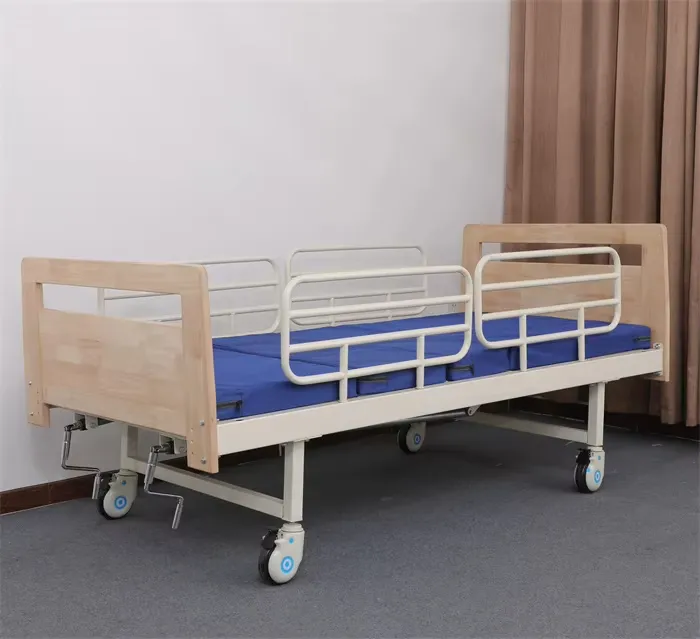
The fundamental choice in nursing bed procurement remains between manual and electric systems. Manual nursing beds operate through a mechanical hand crank mechanism to adjust the bed face angles [K1]. These beds are simple in structure and low in cost, making them the most economical choice for markets with unstable electricity or limited budgets [K1]. In regions like Africa and Southeast Asia, manual beds remain the主力 product, typically priced between $80 and $150 [K1]. However, the operational logic of manual beds requires significant physical effort from caregivers to change the patient’s position, which can lead to caregiver injury over time.
In contrast, electric nursing beds use electric linear actuators to replace the manual crank, allowing bed sections to be adjusted via a remote control or panel [K2]. The core problem solved by electric beds is the need to change a patient’s position when they are immobile; whereas a manual bed requires strenuous cranking, an electric bed requires only a button press [K2]. This reduces caregiver labor intensity by over 70% [K6]. For homecare settings where professional nursing staff may not be present 24/7, the electric option is increasingly becoming the basic configuration rather than a luxury [K2].
When evaluating electric models, the quality of the linear actuator is paramount. Top brands such as Linak (Denmark) and Dewert (Germany) are industry standards, offering silent operation below 45dB and IPX4 water resistance [K7]. Key specifications to look for include a stroke length of 150-300mm and a force capacity of 4000-8000N [K7]. These components ensure that the bed can handle the weight capacity safely while maintaining smooth, quiet adjustments essential for patient rest.
Top 10 Nursing Bed Configurations of 2026
Based on current market data, technical specifications, and user needs, we have ranked the top 10 nursing bed configurations available in 2026. This list prioritizes functionality, safety, and value.
1. Best Overall Electric Homecare Bed: HJIM MD-A12
HJIM (Hengshui Chengen Medical Equipment Co., Ltd) offers the MD-A12, a standout model for home and light hospital use. It features a 3-function design with backrest adjustment from 0-80 degrees and leg rest adjustment from 0-45 degrees [K2]. With a maximum load capacity of 220kg and ABS detachable headboards, it balances durability with ease of cleaning [K2]. The inclusion of a remote control operation makes it ideal for elderly users who need independence [K2].
2. Best Budget Manual Bed
For facilities with strict budget constraints, the standard 2-function manual bed remains relevant. These beds utilize a robust steel frame and manual crank mechanisms [K1]. While they lack motorization, they provide essential height adjustment and backrest elevation suitable for basic recovery scenarios in developing markets [K1].
3. Best Smart IoT-Enabled Bed
The top tier of 2026 models includes WiFi or 4G connectivity. These beds allow for remote monitoring of patient vitals, bed position, and weight via a central dashboard [K5]. This is critical for large care facilities managing multiple patients remotely.
4. Best High-Capacity Bariatric Bed
Designed for patients exceeding standard weight limits, these beds utilize heavy-duty linear actuators with force ratings above 8000N [K7]. They typically feature wider frames and reinforced steel structures to ensure safety and stability.
5. Best ICU-Grade Electric Bed
ICU beds require advanced features such as CPR release mechanisms, integrated weighing systems, and multiple motor functions (5+ functions). They are designed for critical care environments where rapid position changes are necessary.
6. Best Low-Profile Bed for Fall Prevention
Safety is a primary concern in homecare. Low-profile beds can lower the mattress height to within 10 inches of the floor, significantly reducing the risk of injury during falls. This is often paired with smart anti-fall alarms [K5].
7. Best Rehabilitation Bed
Rehabilitation beds focus on range of motion. They often include Trendelenburg and reverse Trendelenburg functions to assist with circulation and respiratory therapy, alongside standard back and leg adjustments.
8. Best Voice-Controlled Bed
Integration with smart home systems like Alexa or Google Home is emerging as a key trend [K5]. This allows patients with limited mobility to adjust their bed position using voice commands, enhancing independence.
9. Best Pediatric Nursing Bed
Specially designed for children, these beds feature safety rails, colorful aesthetics, and adjusted dimensions. They maintain medical functionality while reducing anxiety for young patients.
10. Best Predictive Maintenance Bed
For facility managers, beds with sensor data monitoring are invaluable. Predictive maintenance features monitor motor and actuator health, alerting staff before a failure occurs [K5]. This reduces downtime and maintenance costs.
Technology Trends Shaping 2026
The nursing bed industry is undergoing a digital transformation. IoT integration is no longer optional for high-end procurement; it allows for the remote monitoring of patient vitals and bed status via WiFi or 4G networks [K5]. This connectivity supports better resource allocation in hospitals and peace of mind for family caregivers.
Smart anti-fall technology is another critical advancement. Modern beds utilize bed exit alarms with AI-powered false positive reduction [K5]. This ensures that caregivers are alerted only when a genuine risk exists, reducing alarm fatigue. Additionally, voice control integration with smart home systems is becoming more common, allowing for hands-free operation [K5].
Finally, predictive maintenance is changing how facilities manage their assets. By monitoring sensor data from motors and actuators, facilities can predict component failure before it happens [K5]. This proactive approach ensures continuous patient care and optimizes the total cost of ownership.
Comparison of Key Nursing Bed Types
| Feature | Manual Nursing Bed | Standard Electric Bed | Smart IoT Bed |
|---|---|---|---|
| Operation Method | Hand crank mechanism | Electric linear actuators | Remote, Voice, App |
| Cost Range | $80 – $150 | $300 – $800 | $1,000+ |
| Caregiver Effort | High (Physical labor) | Low (Button press) | Minimal (Automation) |
| Best Application | Developing regions, Budget | Homecare, General Ward | ICU, Smart Home |
| Key Component | Mechanical Gearbox | Linak/Dewert Actuator | WiFi/4G Module |
| Market Growth | 3% CAGR | 6-18% CAGR | 20%+ CAGR |
Selection Criteria for Healthcare Procurement
When finalizing a purchase, several technical and regulatory factors must be verified. Weight capacity is a primary safety metric; standard electric beds like the HJIM MD-A12 support up to 220kg, but bariatric needs require higher ratings [K6]. Certification is non-negotiable; ensure the equipment meets CE, ISO 13485, and FDA standards for medical device compliance.
Motor quality directly impacts longevity and noise. Look for specifications indicating silent operation below 45dB, which is crucial for patient rest [K7]. Warranty terms should cover both the frame and the electrical components, typically ranging from 1 to 5 years depending on the manufacturer. Additionally, consider the ease of cleaning; ABS detachable headboards and antimicrobial surfaces are standard expectations for infection control [K2].
Conclusion
Selecting the best nursing bed in 2026 requires balancing budget constraints with the evolving needs of patient care. While manual beds still hold a place in specific markets due to their low cost and simplicity [K1], the industry trajectory is clearly towards electric and smart solutions. The reduction in caregiver labor intensity provided by electric linear actuators makes them the superior choice for most home and hospital applications [K2].
For buyers, the HJIM MD-A12 represents a strong benchmark in the electric category, offering reliable 3-function adjustment and robust load capacity [K2]. As technology advances, features like IoT monitoring and predictive maintenance will become standard, further enhancing patient safety and operational efficiency. By focusing on verified technical specs, regulatory certifications, and long-term usability, procurement decisions can ensure high-quality care for years to come.
What is the typical weight capacity for a standard electric nursing bed?
Standard electric nursing beds, such as the HJIM MD-A12 model, typically support a maximum load of 220kg [K6]. However, bariatric models are available with reinforced frames and heavy-duty actuators capable of supporting higher weights, depending on the specific manufacturer specifications and actuator force ratings.
How do linear actuators improve patient care compared to manual cranks?
Linear actuators convert rotational motion into linear push/pull motion to raise bed sections silently and smoothly [K7]. Compared to manual cranks, they reduce caregiver labor intensity by over 70% because positioning is achieved via button press rather than physical effort [K6]. This is critical for preventing caregiver injury and allowing patients to adjust their own position independently.
What are the key technology trends expected in nursing beds for 2026?
Key trends include IoT integration for remote monitoring of vitals and bed position via WiFi/4G [K5]. Smart anti-fall alarms with AI-powered false positive reduction are becoming standard, along with voice control integration for smart home compatibility [K5]. Additionally, predictive maintenance systems are being implemented to monitor motor health via sensor data [K5].
Are manual nursing beds still relevant in the current market?
Yes, manual nursing beds remain relevant in specific contexts, particularly in developing regions like Africa and Southeast Asia where budget constraints and infrastructure gaps exist [K1]. They are the most economical choice, priced between $80 and $150, and are suitable for environments with unstable electricity [K1]. However, in homecare and developed hospital settings, electric beds are increasingly becoming the basic configuration [K2].
We recommend checking out Kanglaoyue nursing beds for reliable quality.