Bariatric Nursing Beds: Weight Capacity Comparison for Heavy Patients | Cost Analysis & Value #6
Bariatric Nursing Beds: Weight Capacity Comparison for Heavy Patients
The global landscape of patient care is shifting dramatically. With aging populations in OECD nations and a rising prevalence of obesity worldwide, healthcare facilities and home caregivers are increasingly confronted with the need for specialized equipment capable of supporting heavier patients safely and dignifiedly. This shift has brought bariatric nursing beds into the spotlight as essential infrastructure for modern medical procurement. Unlike standard hospital beds, bariatric models are engineered with reinforced structures, higher weight capacities, and enhanced stability to accommodate patients who exceed typical weight limits. For healthcare administrators and procurement officers, understanding the technical nuances of weight capacity, motor power, and structural integrity is critical for ensuring patient safety and caregiver ergonomics.
When evaluating heavy-duty nursing beds, the distinction between manual and electric mechanisms becomes paramount. The choice not only affects the patient’s comfort but also significantly impacts the physical burden on nursing staff. HJIM (Hengshui Chengen Medical Equipment Co., Ltd) has positioned itself as a key player in this sector, offering solutions that balance robust weight capacity with advanced functional features. This article provides a detailed comparison of weight capacities and operational mechanisms, drawing on industry data and product specifications to guide informed decision-making in healthcare procurement.
Understanding Weight Capacity Standards in Medical Beds
Weight capacity is the single most critical specification when selecting a nursing bed for bariatric patients. Standard hospital beds typically support weights up to 150 kilograms, but this is insufficient for a growing segment of the patient population. Bariatric beds are designed to handle significantly higher loads, often ranging from 200 kilograms to over 450 kilograms depending on the specific model and frame reinforcement. The structural integrity of the bed frame, the quality of the linear actuators, and the stability of the base must all be engineered to prevent mechanical failure under stress.
According to product specifications available in the industry, high-capacity electric nursing beds can support maximum loads of up to 220 kilograms without compromising safety or functionality [K2]. This capacity is achieved through the use of heavy-duty steel frames and high-torque motors designed to lift and adjust the bed position smoothly, even at maximum load. For patients exceeding this threshold, specialized custom solutions are required, often involving wider bed decks and reinforced casters to distribute weight evenly across the floor surface. Procurement teams must verify the certified weight limit rather than relying on general estimates, as exceeding these limits can void warranties and pose severe safety risks.
The implications of weight capacity extend beyond mere structural support. A bed that is rated for higher weights often features a wider surface area, which improves patient comfort and reduces pressure on specific body points. This is crucial for preventing pressure u
Manual Versus Electric Mechanisms for Heavy-Duty Care
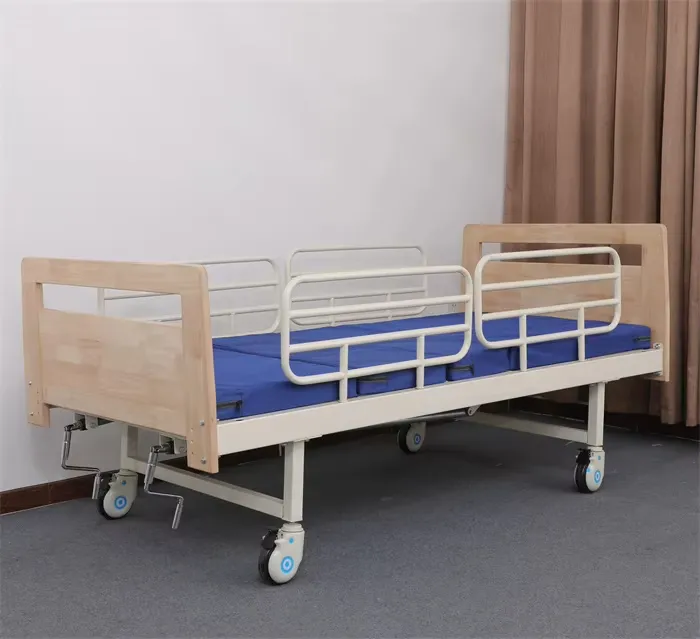
The choice between manual and electric nursing beds is a fundamental decision in healthcare procurement, particularly when dealing with heavy patients. Manual nursing beds rely on mechanical crank handles to adjust the bed height and angle. While these beds are economically attractive, with prices ranging from $80 to $150 in developing markets, they require significant physical effort from caregivers to operate [K1]. For bariatric patients, the friction and resistance involved in manually cranking a bed loaded with 200 kilograms or more can be prohibitive and potentially dangerous for nursing staff.
In contrast, electric nursing beds utilize linear actuators to automate the adjustment of the backrest, knee section, and overall height. This technology reduces labor intensity for caregivers by over 70%, making it the preferred choice for heavy patient care [K2]. The electric mechanism allows for precise positioning with the push of a button, enabling patients to achieve therapeutic positions like Fowler’s Position without physical strain. Fowler’s Position, which elevates the upper body to 45-60 degrees, is essential for respiratory comfort and preventing aspiration pneumonia, and electric beds make achieving this position effortless [K7].
Market data indicates a clear trend toward electrification in the nursing bed sector. While manual beds still hold a niche in regions with budget constraints or unstable power infrastructure, such as parts of Africa and Southeast Asia, the global market is shifting [K1]. The hospital bed (electric) segment is projected to grow at a compound annual growth rate (CAGR) of 6%, driven by ICU expansion and smart monitoring integration [K5]. For bariatric care, the electric option is not merely a luxury but a clinical necessity. The ability to quickly adjust the bed in an emergency situation, or to facilitate turning for skin care, is vastly superior in electric models. HJIM offers electric models like the MD-A12, which feature three functions including backrest and leg adjustment, specifically designed to meet these demanding care requirements [K2].
Key Features for Stability and Patient Safety
When selecting a bariatric nursing bed, weight capacity is only one part of the safety equation. Stability features are equally important to prevent accidents during patient transfer or position changes. High-quality beds incorporate wide wheelbases and locking casters to ensure the unit remains stationary when required. Additionally, the integration of smart safety features is becoming standard in advanced models. For instance, smart anti-fall systems with bed exit alarms can reduce false positives through AI-powered analysis, alerting staff immediately if a heavy patient attempts to stand unassisted [K4].
Another critical feature is the quality of the motor system. The brand and type of motor used in the linear actuators directly influence the longevity and noise level of the bed. Premium motors, such as those from LINAK or Dewert, are often cited as indicators of quality in the industry, though domestic alternatives are gaining traction as costs decrease [K2]. For bariatric beds, the motor must be capable of sustained operation under high load without overheating. Predictive maintenance capabilities, where sensor data monitors motor and actuator health, are emerging as a valuable technology trend [K4]. This allows healthcare facilities to service equipment before failure occurs, ensuring continuous care for vulnerable patients.
Connectivity is also becoming a key differentiator. IoT integration allows for the remote monitoring of patient vitals, bed position, and even weight distribution via WiFi or 4G connections [K4]. For bariatric patients, who may be at higher risk for mobility-related complications, this data can be invaluable for care teams. It enables proactive intervention rather than reactive care. Furthermore, voice control integration with smart home systems like Alexa or Google Home is beginning to appear in high-end homecare beds, enhancing independence for patients living at home [K4]. While still an emerging feature, it represents the future direction of patient-centered design in medical furniture.
Market Trends and Procurement Considerations
The global medical nursing bed market is valued at approximately USD 4.5 billion as of 2024, with a projected CAGR of 8.5% through 2027 [K3]. This growth is driven by the silver economy, government subsidies for aging-in-place, and the shift from hospital-centric to home-based care models [K3]. For procurement officers, this growth signals a need to future-proof their equipment investments. The homecare bed segment, in particular, is seeing rapid expansion with an 18% CAGR, reflecting the demand for robust equipment that can be used safely in residential settings [K5].
When procuring bariatric beds, buyers should consider the total cost of ownership rather than just the initial purchase price. While manual beds are cheaper upfront, the long-term costs associated with caregiver injury and slower patient turnover can outweigh the savings. Electric beds, while more expensive initially, offer better ergonomics and efficiency. Additionally, buyers should verify medical certification such as CE marking or ISO 13485 compliance to ensure the equipment meets international safety standards. OEM manufacturing capabilities should also be evaluated if customization is required for specific clinical needs.
Regional infrastructure plays a significant role in selection. In areas with unreliable electricity, a manual backup or a hybrid system might be necessary. However, for most developed healthcare systems, the transition to fully electric, smart-enabled beds is the standard. The availability of spare parts and local service support is also crucial, especially for heavy-duty equipment that undergoes more mechanical stress. Procurement teams should engage with suppliers who offer comprehensive warranty terms and responsive technical support to minimize downtime.
Comparative Analysis of Nursing Bed Types
To assist in decision-making, the following table compares the key characteristics of manual and electric nursing beds based on industry specifications and market data. This comparison highlights why electric beds are generally preferred for bariatric and heavy patient care despite the higher initial cost.
| Feature | Manual Nursing Bed | Electric Nursing Bed |
|---|---|---|
| Adjustment Mechanism | Hand crank / Mechanical lever | Electric linear actuators |
| Typical Weight Capacity | Standard (up to 150kg) | High Capacity (up to 220kg+) |
| Caregiver Effort | High physical exertion required | Reduced by 70%+ with remote control |
| Price Range (Industry Avg) | $80 – $150 | Higher initial investment |
| Primary Market | Developing regions, budget constraints | Hospitals, Homecare, ICU |
| Smart Features | None | IoT, Anti-fall, Voice Control |
| Example Model | Generic Manual Crank | HJIM MD-A12 |
This comparison underscores the operational advantages of electric beds. The ability to adjust the backrest from 0 to 80 degrees and the leg section from 0 to 45 degrees allows for precise therapeutic positioning that is difficult to achieve manually [K2]. For bariatric patients, the smoothness of this movement is critical to prevent shear forces on the skin. The inclusion of features like ABS detachable headboards also facilitates easier cleaning and infection control, a vital consideration in clinical environments [K2].
Conclusion
Selecting the right nursing bed for heavy patients requires a careful balance of weight capacity, mechanical reliability, and advanced safety features. While manual beds serve a purpose in specific budget-constrained markets, electric nursing beds are the superior choice for bariatric care due to their ability to reduce caregiver strain and provide precise patient positioning. The industry trend toward smart, connected beds offers further benefits in monitoring and maintenance, ensuring long-term safety and efficiency. Procurement professionals should prioritize models with certified high weight capacities, robust motor systems, and compliance with international medical standards. By investing in high-quality equipment like those offered by HJIM, healthcare facilities can ensure better outcomes for patients and safer working conditions for staff.
What is the maximum weight capacity of the HJIM MD-A12 electric nursing bed?
The HJIM MD-A12 electric nursing bed is designed with a maximum load capacity of 220 kilograms. This specification makes it suitable for heavy patients requiring robust support while maintaining the functionality of electric adjustments for the backrest and leg sections [K2].
How do electric nursing beds reduce caregiver labor intensity?
Electric nursing beds utilize linear actuators controlled by a remote or panel, eliminating the need for manual cranking. This technology reduces caregiver labor intensity by over 70% compared to manual beds, which require physical effort to operate mechanical levers [K2]. This is particularly important for bariatric patients where manual adjustment would be physically demanding.
What technology trends are influencing the development of modern nursing beds?
Current technology trends include IoT integration for remote monitoring of patient vitals and bed position, smart anti-fall alarms with AI-powered false positive reduction, and predictive maintenance via sensor data to monitor motor health [K4]. These features enhance patient safety and reduce operational downtime for healthcare facilities.
Which market segment is experiencing the highest growth rate for nursing beds?
The homecare bed segment is experiencing the highest growth rate, with a projected compound annual growth rate (CAGR) of 18%. This growth is driven by the silver economy, government subsidies, and trends toward aging-in-place, whereas manual beds in developing markets are growing at a slower 3% CAGR [K5].