CE and ISO Certified Nursing Beds: How to Verify Manufacturer Credentials
CE and ISO Certified Nursing Beds: How to Verify Manufacturer Credentials
The global medical nursing bed market is valued at approximately USD 4.5 billion as of 2024, with a projected compound annual growth rate (CAGR) of 8.5% through 2027 [K2 Global Market Overview]. This rapid expansion is driven by aging populations in OECD nations, the expansion of home healthcare under government insurance programs, and a significant shift from hospital-centric to home-based care models [K2 Global Market Overview]. For healthcare procurement officers, facility managers, and distributors, navigating this growing market requires more than just comparing prices. The critical differentiator lies in regulatory compliance and manufacturer credibility. Understanding how to verify CE and ISO certifications is not merely a bureaucratic exercise; it is a fundamental aspect of ensuring patient safety, caregiver ergonomics, and long-term operational reliability.
Understanding the Core Regulatory Frameworks
When sourcing nursing beds for international markets, two certifications stand out as the gold standard: CE marking under the Medical Device Regulation (MDR) and ISO 13485. These are not interchangeable; they serve different but complementary purposes in the supply chain.
CE Marking (MDR 2017/745) indicates that a product has been assessed by a notified body and meets the safety, health, and environmental protection requirements of the European Union. For nursing beds, this falls under Class I or Class IIa medical devices depending on the features. The transition from the older MDD to the MDR 2017/745 has tightened requirements significantly, demanding more rigorous clinical evaluations and post-market surveillance [K1 Certification Requirements by Market].
ISO 13485 is an international standard that specifies requirements for a quality management system (QMS) for the design and manufacture of medical devices. Unlike CE, which is a product certification, ISO 13485 certifies the manufacturer’s processes. It ensures that the factory has consistent procedures for risk management, design control, and production monitoring. A manufacturer with ISO 13485 certification is statistically less likely to produce defective units or have inconsistent quality batches [K1 Certification Requirements by Market].
Verifying Manufacturer Credentials: A Practical Checklist
Obtaining a copy of a certificate is easy; verifying its validity requires diligence. Many unscrupulous suppliers may present expired documents or certificates that do not cover the specific product model being sold. To ensure you are dealing with a compliant partner, follow this verification protocol.
1. Check the Notified Body Number
Every valid CE certificate issued under MDR will include a four-digit Notified Body number (e.g., 0123). You can cross-reference this number on the European Commission’s NANDO database to confirm the body is authorized to certify medical devices. If the certificate lacks this number or the body is not listed, the CE mark is invalid.
2. Validate the Scope of Coverage
ISO 13485 certificates specify the scope of the quality management system. Ensure that “design and manufacture of electric nursing beds” or similar wording is explicitly included. A certificate that only covers “assembly” or “sales” does not guarantee that the design and manufacturing processes meet medical device standards.
3. Request Technical Construction Files (TCF)
For high-volume procurement, asking for a summary of the Technical Construction File demonstrates the manufacturer’s transparency. This document outlines the design risks, biocompatibility tests for materials, and electrical safety tests (IEC 60601). While the full TCF is confidential, a reputable manufacturer like HJIM (Hengshui Chengen Medical Equipment Co., Ltd) will be able to provide redacted summaries or test reports from accredited labs like TÜV or SGS [K1 Electric Nursing Bed].
4. Audit the Production Line
Virtual or on-site audits are crucial. Look for evidence of incoming quality control (IQC) for critical components such as linear actuators and motors. In the electric nursing bed sector, the reliability of the motor brand (e.g., LINAK, Dewert, or high-grade domestic alternatives) is a key observable indicator of product longevity [K1 Electric Nursing Bed].
Product Specifications: Electric vs. Manual Nursing Beds
Understanding the technical differences between bed types is essential when evaluating if a manufacturer’s capabilities match your market needs. The choice between electric and manual systems impacts not only the user experience but also the regulatory pathway.
Electric Nursing Beds
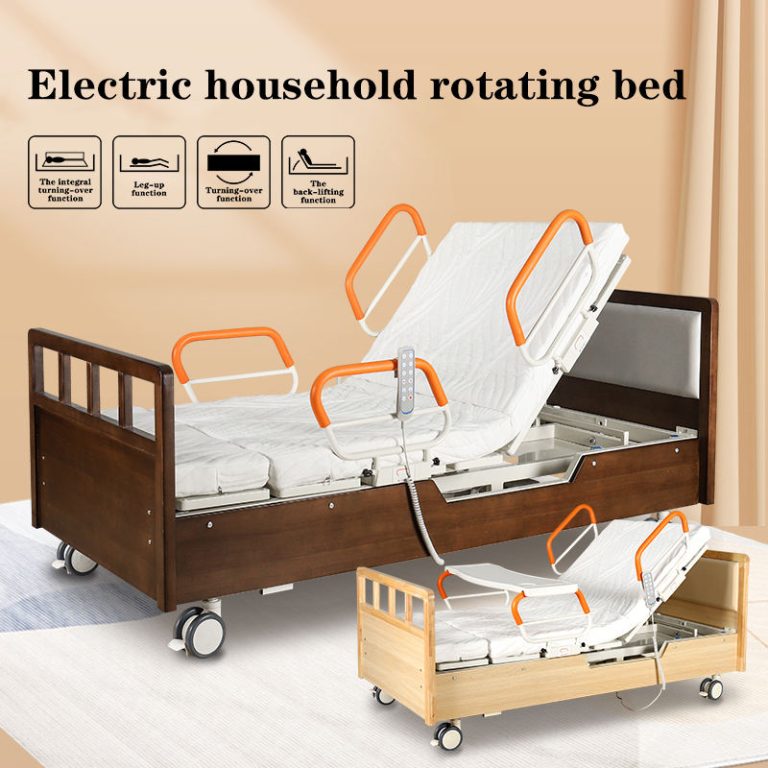
An electric nursing bed uses linear actuators (typically 2-5 motors) to provide adjustable positioning for patients with limited mobility [K2 Electric Nursing Bed (电动护理床)]. The core value proposition is reducing caregiver labor intensity by over 70% compared to manual systems [K2 Electric Nursing Bed (电动护理床)]. Key specifications to verify include:
- Function Count: Common configurations include 3-function (backrest, knee, height) or 5-function (adding head tilt and Trendelenburg). For example, the HJIM MD-A12 model offers 3 functions with a backrest adjustment of 0-80° and leg adjustment of 0-45° [K1 Electric Nursing Bed (电动护理床)].
- Control System: Verify the reliability of the hand control or remote. It should be waterproof (IPX4 or higher) and have emergency battery backup.
- Weight Capacity: Standard beds typically support 220kg, but bariatric models require reinforced frames and higher-rated actuators.
- Noise Level: Motor noise should be below 50dB to ensure a restful environment for patients [K1 Electric Nursing Bed (电动护理床)].
Manual Nursing Beds
Manual nursing beds use mechanical hand cranks to adjust the bed frame. While they lack the convenience of electric motors, they remain a vital solution for specific markets [K2 Manual Nursing Bed (手动护理床)].
- Cost Efficiency: Manual beds are significantly cheaper, often ranging from $80 to $150 in emerging markets [K2 Manual Nursing Bed (手动护理床)].
- Reliability: With no electrical components, they are immune to power surges and require less maintenance.
- Market Fit: These are the主力 (main force) products in regions with unstable electricity or limited budgets, such as parts of Africa and Southeast Asia [K2 Manual Nursing Bed (手动护理床)].
Market-Specific Certification Requirements
Different regions have varying thresholds for entry. A manufacturer might be CE certified but lack the specific documentation required for the Middle East or Africa. Understanding these nuances helps in selecting the right supplier for your target geography.
| Market | Required Certification | Typical Timeline | Cost Range |
|---|---|---|---|
| EU | CE MDR 2017/745 + ISO 13485 | 6-12 months | €15,000-30,000 |
| USA | FDA 510(k) + ISO 13485 | 3-12 months | $20,000-50,000 |
| Middle East | CE or GSO | 3-6 months | $5,000-15,000 |
| Africa | Varies by country | 1-3 months | $2,000-8,000 |
Table 1: Certification Requirements by Market [K1 Certification Requirements by Market]
For the US market, FDA 510(k) clearance is mandatory, which often requires demonstrating substantial equivalence to a predicate device. This process is generally more expensive and time-consuming than CE marking [K1 Certification Requirements by Market]. In contrast, the Middle East often accepts CE certificates supplemented by local registration (GSO), making EU-certified manufacturers the primary suppliers for this region [K1 Certification Requirements by Market].
OEM and ODM Manufacturing Considerations
For distributors looking to build their own brand, understanding the manufacturing model is crucial. The industry primarily operates on three models: OEM, ODM, and OBM.
OEM (Original Equipment Manufacturer) involves the factory producing beds based entirely on the buyer’s design and specifications. This offers high customization but requires the buyer to have significant R&D capabilities. Margins for OEM partners typically range from 5% to 10% [K1 OEM/ODM Manufacturing].
ODM (Original Design Manufacturer) means the factory provides both the design and production. The buyer essentially rebrands an existing product. This is the most common model for new market entrants as it reduces time-to-market. ODM margins are slightly higher, typically between 10% and 15% [K1 OEM/ODM Manufacturing].
OBM (Original Brand Manufacturer) refers to factories that sell under their own brand. While this limits customization, it ensures the manufacturer has a direct stake in the product’s reputation. HJIM, for instance, operates across these models, offering custom medical bed factory services while maintaining its own brand presence [K1 OEM/ODM Manufacturing].
When engaging in OEM/ODM partnerships, verify that the factory’s ISO 13485 scope covers “design and development” if you are relying on them for ODM services. If they only have “manufacturing” in their scope, they may not be legally allowed to claim design responsibility in certain jurisdictions.
Conclusion
Verifying manufacturer credentials for CE and ISO certified nursing beds is a multifaceted process that goes beyond checking a logo on a brochure. It requires a deep understanding of regulatory frameworks like MDR 2017/745, a clear grasp of product technical parameters such as motor types and weight capacities, and a strategic view of market-specific requirements. Whether you are procuring high-end electric nursing beds for a European hospital or cost-effective manual beds for a clinic in Southeast Asia, the integrity of the supply chain depends on rigorous verification. By prioritizing manufacturers with transparent quality management systems and valid certifications, healthcare providers can ensure safety, compliance, and operational efficiency in their patient care facilities.
Frequently Asked Questions
What is the typical cost range for obtaining CE MDR certification for nursing beds?
According to industry data, the cost range for obtaining CE MDR 2017/745 certification in the EU market typically falls between €15,000 and €30,000. This process usually takes 6 to 12 months to complete [K1 Certification Requirements by Market].
What are the key technical specifications to look for in an electric nursing bed?
Key specifications include the number of functions (e.g., backrest, knee, height adjustment), the brand of linear actuators (such as LINAK or Dewert), weight capacity (standard is often 220kg), and noise levels (should be under 50dB). For example, the HJIM MD-A12 model features 3 functions with specific angle adjustments for backrest and legs [K1 Electric Nursing Bed (电动护理床)].
Are manual nursing beds still relevant in the current market?
Yes, manual nursing beds remain relevant, particularly in regions with unstable electricity or limited budgets, such as parts of Africa and Southeast Asia. They are the主力 products in these areas, with prices ranging from $80 to $150, offering a cost-effective solution for basic patient care needs [K2 Manual Nursing Bed (手动护理床)].
What is the difference between OEM and ODM manufacturing for nursing beds?
OEM (Original Equipment Manufacturer) involves the factory producing beds to the buyer’s specific design, with typical margins of 5-10%. ODM (Original Design Manufacturer) means the factory provides both the design and production, with margins typically ranging from 10-15%. ODM is often preferred by buyers who want to rebrand existing products without investing in R&D [K1 OEM/ODM Manufacturing].