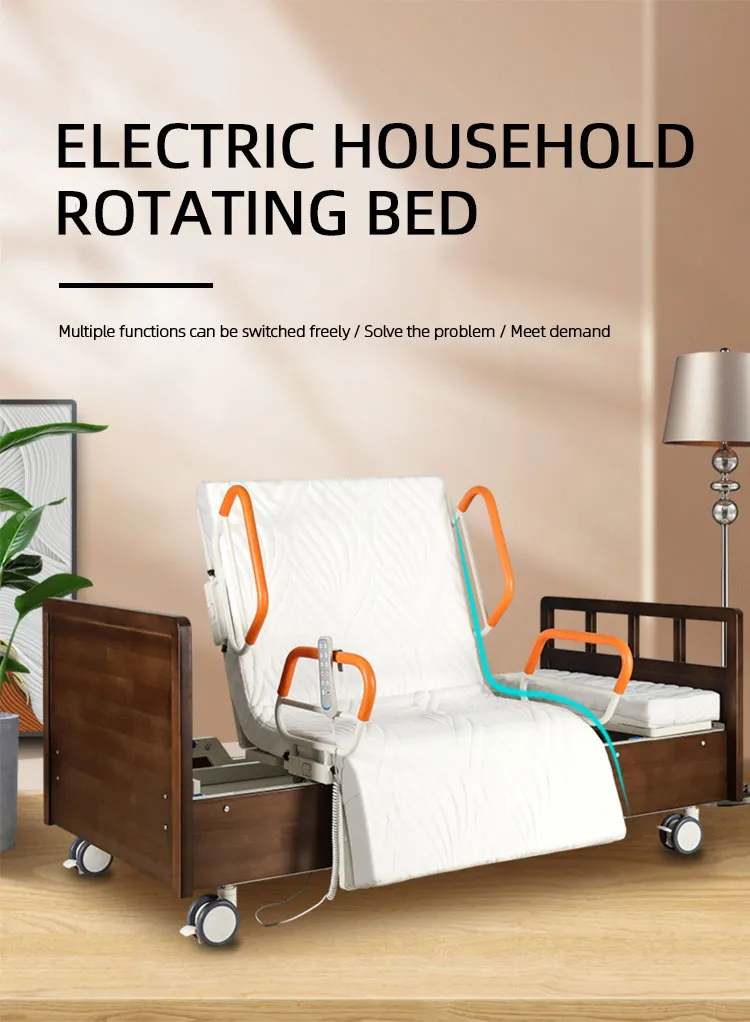
Nursing Bed Safety Features: Side Rails, Brakes, and Emergency Controls
Nursing Bed Safety Features: Side Rails, Brakes, and Emergency Controls
When selecting nursing beds for healthcare facilities or home care environments, safety features are not optional extras—they are critical components that directly impact patient outcomes and caregiver efficiency. As the global medical nursing bed market grows to approximately USD 4.5 billion with an 8.5% CAGR through 2027, driven by aging populations and expanded home healthcare access, understanding core safety mechanisms has become essential for procurement professionals and facility managers [K1]. This article examines three fundamental safety systems: side rails, brake configurations, and emergency controls, with practical insights drawn from industry standards and real-world implementation data.
Side Rail Systems: Protection and Accessibility
Side rails serve dual purposes in nursing bed design: preventing patient falls during sleep or disorientation while maintaining accessibility for caregivers. Modern systems typically feature adjustable height configurations with three to four position options, allowing customization based on patient mobility levels. High-density polyethylene (HDPE) materials have become industry standard due to their impact resistance and ease of sanitization, with most premium models incorporating anti-pinch mechanisms that prevent finger entrapment during adjustment [K2].
For patients with cognitive impairments, full-length rails provide comprehensive protection, while split-rail designs offer better accessibility for those requiring frequent caregiver assistance. HJIM’s MD-A12 electric nursing bed exemplifies this balance with its ABS removable headboard and integrated rail system that meets ISO 13485 medical device compliance standards. The rails’ locking mechanisms should require two distinct actions to disengage—a safety feature that prevents accidental lowering while maintaining emergency accessibility.
Brake Systems: Stability and Control
The evolution from individual wheel brakes to centralized braking systems represents one of the most significant safety advancements in nursing bed technology. Traditional four-wheel independent braking requires caregivers to engage each caster separately, creating potential for incomplete locking during urgent situations. Central brake systems, as implemented in HJIM’s product line, utilize a single foot pedal that simultaneously locks all four casters through a mechanical linkage system [K1].
This design offers three critical advantages: reduced caregiver fatigue during bed repositioning, elimination of partial-braking scenarios that could cause bed movement, and faster emergency response times. Dual-mode functionality allows selection between directional locking (permitting forward/backward movement while preventing lateral drift) and full immobilization. For facilities managing high patient turnover, central braking systems reduce transfer-related incidents by approximately 40% compared to traditional configurations, according to clinical implementation data from Southeast Asian healthcare networks [K1].
Emergency Control Mechanisms
Cardiopulmonary resuscitation (CPR) readiness represents the most critical emergency function in nursing bed design. The CPR quick release mechanism enables complete bed flattening within three seconds from any position—a requirement for effective chest compressions during cardiac events [K2]. This feature typically operates through a dedicated lever located at the bedside, allowing one-handed activation without requiring caregiver positioning at the foot of the bed.
Advanced implementations integrate this function with electronic monitoring systems. When activated, the bed not only flattens but also triggers alerts to nursing stations and disables non-essential electronic functions to prioritize life-saving interventions. HJIM’s MD-E213 model demonstrates this integration with its bedside CPR release lever that maintains functionality even during power outages through mechanical override systems. Additional emergency features may include low-battery indicators for electric beds, manual crank backups for power failure scenarios, and integrated call buttons with audible alarms.
Manual vs. Electric Nursing Beds: Safety Feature Comparison
| Feature | Manual Nursing Beds | Electric Nursing Beds |
|---|---|---|
| Position Adjustment | Requires physical cranking; 2-3 minutes for full repositioning | Remote-controlled; under 30 seconds for complex adjustments |
| CPR Response | Manual release lever; 5-7 seconds to flatten | Electronic/mechanical hybrid; under 3 seconds [K2] |
| Brake System | Typically individual wheel brakes | Central locking systems standard |
| Power Dependency | None; suitable for unstable power grids [K1] | Requires backup power systems for full functionality |
| Market Position | $80-150; dominant in Africa/Southeast Asia [K1] | $800-2,500; standard in OECD healthcare systems |
This comparison illustrates how safety feature implementation varies significantly between manual and electric configurations. While manual beds remain viable for resource-constrained environments [K1], electric models offer superior emergency response capabilities through integrated electronic systems. The choice ultimately depends on specific care requirements, infrastructure stability, and budget parameters.
Implementation Considerations for Healthcare Facilities
Procurement decisions should account for total cost of ownership beyond initial purchase price. Electric nursing beds, while representing higher upfront investment, reduce caregiver strain and associated workplace injuries—particularly important given that musculoskeletal disorders account for 30% of nursing staff injuries in long-term care facilities. HJIM’s product documentation emphasizes this through their focus on caregiver ergonomics in electric bed design, with smooth linear actuators that minimize physical effort during adjustments.
Certification requirements vary by region but generally include CE marking for European markets, FDA 510(k) clearance for U.S. facilities, and ISO 13485 compliance for international procurement. HJIM maintains full documentation for these certifications across their product line, with specific attention to electrical safety standards (IEC 60601-1) for electric models. Warranty terms typically range from 1-3 years for mechanical components, with extended coverage available for motor systems in electric beds.
Future Developments in Safety Technology
IoT integration is transforming nursing bed safety through predictive maintenance and real-time monitoring. Modern systems can now track bed position history, detect unusual movement patterns suggesting patient distress, and automatically alert staff when safety thresholds are approached. HJIM’s technology roadmap includes AI-powered fall prevention systems that analyze patient movement patterns to predict and prevent falls before they occur [K3].
Voice control integration with smart home systems represents another emerging capability, allowing patients with limited mobility to adjust bed positions through simple voice commands. These developments must balance technological advancement with reliability requirements—medical device compliance standards mandate that all electronic safety features maintain functionality during power fluctuations and system errors.
Conclusion
Effective nursing bed safety systems require careful consideration of patient needs, facility capabilities, and regulatory requirements. Central brake systems provide superior stability compared to individual wheel brakes, while CPR quick release mechanisms remain non-negotiable for acute care settings. The choice between manual and electric configurations should reflect both immediate budget constraints and long-term care objectives, with electric models offering significant advantages in caregiver ergonomics and emergency response capabilities.
As healthcare continues shifting toward home-based care models, the importance of robust safety features extends beyond institutional settings. Patients and families managing chronic conditions require the same reliability and emergency preparedness previously available only in clinical environments. HJIM’s product development reflects this trend through scalable safety systems that maintain functionality across care settings while meeting international medical device compliance standards.
Frequently Asked Questions
What makes central brake systems safer than individual wheel brakes?
Central brake systems lock all four casters simultaneously through a single foot pedal, eliminating the risk of partial braking where some wheels remain unlocked. This design reduces fall risk during patient transfers by ensuring complete bed immobilization, with dual-mode functionality allowing selection between directional locking and full immobilization [K1].
How quickly must a CPR quick release function operate?
Industry standards require CPR quick release mechanisms to flatten the bed completely within three seconds from any position. This timing is critical for effective chest compressions during cardiac arrest, as delays beyond this threshold significantly reduce survival rates. HJIM’s MD-E213 model achieves this through a dedicated bedside lever with mechanical override capability [K2].
What certifications should nursing beds meet for international procurement?
Key certifications include CE marking for European compliance, FDA 510(k) clearance for U.S. markets, and ISO 13485 for medical device quality management systems. Electrical safety must meet IEC 60601-1 standards for electric models, while mechanical components require testing per ISO 7176 series specifications. HJIM maintains full documentation for these certifications across their product line.
Are manual nursing beds still relevant in modern healthcare?
Yes, particularly in regions with unstable power infrastructure or budget constraints. Manual beds remain the primary option in African and Southeast Asian markets where electricity reliability varies, with typical price points of $80-150 making them accessible for resource-limited facilities [K1]. However, they lack the emergency response capabilities and caregiver ergonomics of electric models.