Medical Bed Certification Guide: FDA, CE, ISO 13485 Explained | Home Care Applications #4
Medical Bed Certification Guide: FDA, CE, ISO 13485 Explained
In the global healthcare procurement landscape, selecting the right medical bed is about more than just comfort and functionality. It is fundamentally a decision rooted in compliance, safety, and long-term operational viability. As the global medical nursing bed market reaches approximately USD 4.5 billion in 2024 with a projected compound annual growth rate of 8.5% through 2027, the pressure on suppliers to meet rigorous international standards has never been higher [K5]. For healthcare facilities, distributors, and procurement officers, understanding the certification landscape is critical to avoiding regulatory pitfalls and ensuring patient safety.
Whether you are sourcing equipment for a high-end private hospital in Europe, a public clinic in the Middle East, or a community care center in Africa, the certification requirements dictate not only market access but also liability and reimbursement eligibility. This guide provides a comprehensive overview of the key certifications—FDA, CE, and ISO 13485—while analyzing product specifications and manufacturing models to help you make informed decisions. At HJIM (Hengshui Chengen Medical Equipment Co., Ltd), we understand that compliance is the foundation of trust in medical device supply chains.
Understanding the Global Market Landscape
The demand for medical beds is driven by significant demographic shifts. Aging populations in OECD nations, the expansion of home healthcare under government insurance programs, and a strategic shift from hospital-centric to home-based care models are the primary growth drivers [K5]. This transition means that medical beds are no longer confined to acute care settings; they are becoming essential components of elderly care and mobility assistance in residential environments.
The competitive landscape is segmented into three distinct tiers. The premium tier includes established brands like Hill-Rom (USA), Paramount Bed (Japan), and Invacare (USA), which compete on brand reputation and extensive service networks. The mid-tier consists of Chinese manufacturers who have successfully closed the certification gap, offering CE and FDA compliant products with a cost advantage. The budget tier comprises unbranded Chinese OEMs engaged in price wars, often operating on margins below 8% [K4]. For healthcare procurement officers, navigating these tiers requires a clear understanding of what certifications actually validate.
Choosing a supplier from the mid-tier often represents the optimal balance between cost efficiency and regulatory compliance. However, buyers must verify that the manufacturer holds valid certificates rather than relying on marketing claims. The difference between a certified product and a non-compliant one can mean the difference between a safe patient environment and significant legal liability.
Core Certification Standards by Market
Medical device compliance varies significantly by region. Each market has specific regulatory bodies and standards that govern the safety and efficacy of hospital equipment. Below is a detailed breakdown of the requirements for key markets.
| Market | Required Certification | Typical Timeline | Cost Range |
|---|---|---|---|
| EU | CE MDR 2017/745 + ISO 13485 | 6-12 months | €15,000-30,000 |
| USA | FDA 510(k) + ISO 13485 | 3-12 months | $20,000-50,000 |
| Middle East | CE or GSO | 3-6 months | $5,000-15,000 |
| Africa | Varies by country | 1-3 months | $2,000-8,000 |
European Union (CE MDR 2017/745)
The European Union enforces some of the strictest regulations in the world under the Medical Device Regulation (MDR) 2017/745. To sell medical beds in the EU, manufacturers must demonstrate conformity with essential safety and performance requirements. This process typically involves a Notified Body review, which adds to the timeline and cost. The CE mark indicates that the product meets EU safety, health, and environmental protection requirements. For procurement officers, verifying the validity of the CE certificate through the EUDAMED database is a standard due diligence step [K3].
United States (FDA 510(k))
In the USA, the Food and Drug Administration (FDA) regulates medical beds as Class II devices. Manufacturers must submit a 510(k) premarket notification to demonstrate that the device is substantially equivalent to a legally marketed predicate device. This process requires detailed technical documentation, including electrical safety tests, electromagnetic compatibility (EMC) reports, and biocompatibility assessments. The cost for FDA clearance is significant, ranging from $20,000 to $50,000, reflecting the rigorous testing required [K3].
ISO 13485: Quality Management Systems
While FDA and CE are market-specific approvals, ISO 13485 is an international standard for Quality Management Systems (QMS) specific to medical devices. It is often a prerequisite for both FDA and CE certification. ISO 13485 ensures that the manufacturer has consistent processes for design, production, installation, and servicing. For healthcare procurement, sourcing from an ISO 13485 certified factory reduces the risk of quality inconsistencies and ensures traceability of components [K3].
Product Selection: Electric vs. Manual Nursing Beds
Certification requirements often align with the type of bed being procured. Understanding the technical differences between electric and manual beds helps in matching the product to the clinical environment and budget.
Electric Nursing Beds
Electric nursing beds use motorized linear actuators to replace manual crank handles. This allows for precise adjustment of the bed surface angles via a remote control or panel. The core logic behind electric beds is to solve the problem of patients who cannot move independently but require position changes to prevent complications such as bedsores and lung infections. By reducing the physical labor required from caregivers, electric beds improve caregiver ergonomics and patient comfort [K1].
A prime example is the HJIM MD-A12 Electric Nursing Bed. This model features three functions: backrest elevation (0-80°), leg rest elevation (0-45°), and overall height adjustment. It includes an ABS detachable headboard and operates quietly, which is crucial for patient rest. Key observable指标 (indicators) for evaluating electric beds include the motor brand (e.g., LINAK, Dewert, or domestic equivalents), the number of functions, weight capacity, and noise levels [K1]. In many developed markets, electric beds are no longer considered luxury items but basic configurations for modern patient care.
Manual Nursing Beds
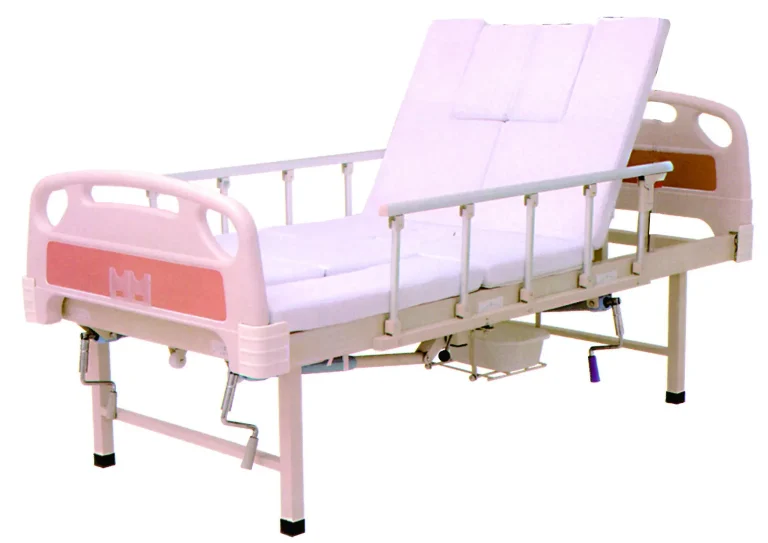
Manual nursing beds utilize a mechanical crank mechanism to adjust the bed surface. They do not require electricity, making them structurally simpler and significantly lower in cost. In markets with unstable power grids or limited budgets, manual beds remain the most economic choice. For instance, in parts of Africa and Southeast Asia, manual beds are the主力 product (main product), with prices ranging from $80 to $150 [K2].
However, the market trend shows a gradual shift toward electric beds as costs decrease. Procurement officers should note that while manual beds have a market, they require more physical effort from nursing staff. The decision often comes down to the specific infrastructure of the facility. If power reliability is a concern, a manual bed or a hybrid model with battery backup is essential.
Safety Features and Technical Specifications
Beyond regulatory certifications, specific technical features determine the safety and usability of the bed in a clinical setting. One critical feature often overlooked is the braking system.
Central Brake System
A central brake system allows a single pedal to lock all four wheels simultaneously. This is vital for patient safety during transfers, such as when moving a patient from the bed to a whee
Weight Capacity and Dimensions
Standard medical beds typically support weights between 250 kg and 350 kg, depending on the frame material and design. Bariatric beds are available for higher capacities. Dimensions must align with the room layout and door widths of the healthcare facility. When sourcing from manufacturers like HJIM, it is important to request detailed specification sheets that include folded dimensions for
OEM and ODM Manufacturing Considerations
For distributors and private label brands, understanding the manufacturing model is crucial for margin planning and brand positioning. There are three primary models: OEM, ODM, and OBM.
OEM (Original Equipment Manufacturer)
In an OEM arrangement, the factory produces the bed according to the buyer’s design. The buyer provides the specifications, and the factory handles production. Typical margins for OEM models range from 5% to 10% [K7]. This model is suitable for buyers who have their own R&D team and want full control over the design.
ODM (Original Design Manufacturer)
ODM involves the factory providing both the design and production. The buyer brands the product as their own. This reduces the R&D burden on the buyer. Typical margins for ODM models range from 10% to 15% [K7]. This is a common path for companies entering the medical bed market without extensive engineering resources.
OBM (Original Brand Manufacturer)
OBM refers to the factory selling under its own brand. Margins here are higher, typically 20% to 35%, but the manufacturer bears all marketing and distribution costs [K7]. For healthcare procurement, working with an ODM partner who holds existing certifications (like CE or FDA) can significantly speed up market entry. Always verify the ownership of the design and the validity of the certifications associated with the specific model number.
Practical Conclusion for Procurement Officers
Navigating the medical bed market requires a balance of regulatory awareness and technical understanding. The global shift toward home-based care means that the specifications once reserved for hospitals are now expected in residential settings. When selecting a supplier, prioritize those with transparent certification histories. A valid ISO 13485 certificate is the baseline, while FDA 510(k) or CE MDR marks are market-specific necessities.
Consider the total cost of ownership, not just the purchase price. An electric bed with a higher upfront cost may reduce long-term caregiver labor costs and liability risks associated with patient injuries. Conversely, in budget-constrained environments, a certified manual bed may be the most pragmatic solution. Always request test reports for critical safety features like the central brake system and verify motor brands for electric models. By aligning product specifications with market regulations and patient needs, healthcare facilities can ensure safer, more efficient care delivery.
Frequently Asked Questions
What is the typical cost and timeline for FDA certification of a medical bed?
According to industry data, obtaining FDA 510(k) clearance for a medical bed typically takes between 3 to 12 months. The cost range for this process is estimated between $20,000 and $50,000. This includes the preparation of technical documentation, testing fees, and regulatory submission costs. Buyers should factor this timeline into their procurement schedules if entering the US market [K3].
Are electric nursing beds considered luxury items in all markets?
No. While there is a common misconception that electric beds are luxury items, in many developed countries, they are considered basic configuration for modern patient care. They are essential for preventing bedsores and reducing caregiver labor. However, in markets with unstable power or limited budgets, such as parts of Africa and Southeast Asia, manual beds remain the主力 product due to cost and reliability [K1][K2].
What is the difference in profit margins between OEM and ODM manufacturing?
The profit margins vary based on the level of service provided by the manufacturer. Typical margins for OEM manufacturing, where the buyer provides the design, range from 5% to 10%. For ODM manufacturing, where the factory provides both design and production, margins typically range from 10% to 15%. OBM models, where the factory sells under its own brand, can see margins of 20% to 35% [K7].
Why is a central brake system important for patient safety?
A central brake system allows a single pedal to lock all four wheels simultaneously, which is more stable than individual wheel brakes. This feature reduces the risk of the bed rolling during patient transfers, such as moving from bed to whee