Medical Bed Central Control Brake System: Why It is Essential | Home Care Applications #2
Medical Bed Central Control Brake System: Why It is Essential
In the high-stakes environment of modern healthcare, patient safety and operational efficiency are not merely goals—they are absolute requirements. While much attention is often paid to the electronic sophistication of medical furniture, such as motorized positioning and IoT connectivity, the foundational elements of stability remain critical. Among these, the Medical Bed Central Control Brake System stands out as a pivotal component that directly influences patient security and caregiver workflow. For procurement officers, hospital administrators, and healthcare facility managers, understanding the mechanics and value of this system is essential for making informed purchasing decisions.
The global medical nursing bed market, valued at approximately USD 4.5 billion in 2024 with a projected CAGR of 8.5% through 2027, is driven by aging populations and a shift toward home-based care models [K1]. As the demand for reliable hospital equipment grows, the distinction between basic functionality and advanced safety features becomes increasingly important. This article explores why the central control brake system is not just a standard feature, but a critical safety mechanism that defines the quality of patient care.
Understanding the Central Control Brake Mechanism
At its core, the Central Brake System (often referred to as central locking casters) is a mechanical safety feature designed to stabilize a medical bed instantly. Unlike traditional braking systems that require the user to engage a brake on each individual wheel, a central control system utilizes a single foot pedal to lock all four casters simultaneously [K1]. This “one-step” operation is engineered to provide maximum stability with minimum effort, which is crucial during critical moments such as patient transfers or emergency situations.
The system typically operates in a dual-mode configuration: directional lock and full lock. In directional lock mode, the casters are prevented from swiveling but can still roll forward and backward, allowing the bed to be pushed in a straight line while maintaining alignment. In full lock mode, all movement is halted, ensuring the bed remains stationary regardless of external forces [K1]. This mechanical simplicity belies its profound impact on patient care and caregiver ergonomics, reducing the cognitive and physical load on nursing staff who must manage multiple patients throughout a shift.
The Critical Role in Patient Safety and Fall Prevention
One of the most significant risks in any healthcare setting is patient falls, particularly during the process of transferring from a bed to a whee
As healthcare facilities move towards smart anti-fall technologies, the mechanical foundation of safety remains paramount. While AI-powered bed exit alarms can detect when a patient is attempting to leave the bed, the physical prevention of bed movement is the first line of defense [K2]. A reliable central braking system ensures that when a patient attempts to stand, the bed does not roll away, thereby preventing a catastrophic fall. This is particularly relevant in elderly care settings where mobility assistance is frequently required, and the margin for error is non-existent.
Furthermore, the stability provided by central locking casters is vital for procedures performed at the bedside. Whether it is a nurse administering medication, a physical therapist conducting rehabilitation exercises, or a family member assisting with hygiene, the bed must act as a stable platform. The central brake system provides this assurance, allowing medical personnel to focus entirely on the patient rather than worrying about the stability of the furniture.
Integration with Electric Nursing Bed Systems
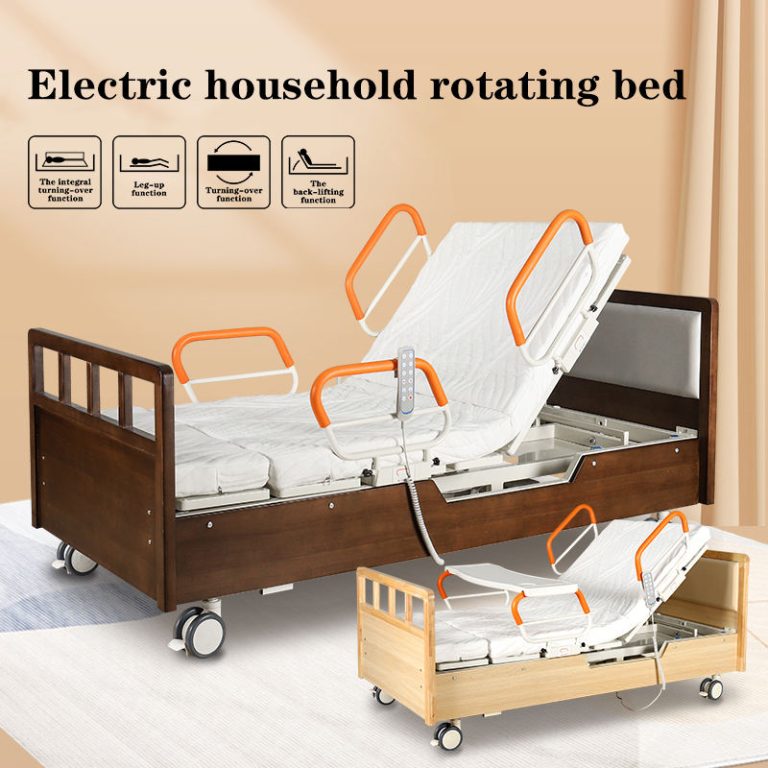
The importance of the central brake system is amplified when integrated with Electric Nursing Beds. These beds utilize electric linear actuators to adjust the backrest, knee section, and overall height, offering significant advantages over manual beds in terms of caregiver ergonomics and patient comfort [K2]. However, the dynamic nature of an electric bed—where the center of gravity shifts as the bed articulates—makes secure locking even more critical.
For instance, when an electric bed raises the patient to a sitting position or lowers them for easier access, the weight distribution changes. If the brakes are not fully engaged, this shift in weight can cause the bed to creep or drift. HJIM (Hengshui Chengen Medical Equipment Co., Ltd) designs its electric nursing beds, such as the MD-A12 model, with robust central braking systems to complement the 3-function electric adjustment capabilities [K2]. This ensures that whether the bed is in a low profile for fall prevention or a high profile for caregiver access, the unit remains securely anchored.
Moreover, as IoT integration becomes standard in modern medical furniture, allowing for remote monitoring of bed position and weight, the mechanical integrity of the braking system serves as the physical counterpart to digital safety alerts [K2]. A smart bed might alert staff if a patient is at risk, but the central brake ensures the bed itself does not contribute to that risk.
Comparing Central vs. Individual Wheel Brakes
To fully appreciate the value of the central control brake system, it is helpful to compare it against the traditional individual wheel brake mechanism. The differences in efficiency, safety, and ease of use are substantial, particularly in high-volume clinical environments.
| Feature | Central Control Brake System | Individual Wheel Brakes |
|---|---|---|
| Operation Speed | Instantaneous (1 pedal press) | Slower (4 separate actions required) |
| Safety Reliability | High (eliminates human error of missing a wheel) | Medium (risk of one wheel remaining unlocked) |
| Caregiver Effort | Minimal (foot-operated, hands-free) | Higher (requires bending and manual engagement) |
| Stability | Superior (uniform locking force) | Variable (depends on individual brake condition) |
| Best Application | Hospitals, Nursing Homes, Home Care | Low-budget settings, temporary use |
As shown in the comparison above, the central control system offers a distinct advantage in healthcare procurement scenarios where efficiency and safety are prioritized. In a busy hospital ward, a nurse may need to secure a bed multiple times during a single patient interaction. The ability to lock all wheels with a single foot motion reduces fatigue and ensures that the bed is always secure, regardless of the nurse’s position relative to the bed [K1].
Procurement Considerations for Healthcare Facilities
When evaluating medical beds for purchase, the braking system should be a primary specification point. Procurement teams should look beyond the basic presence of brakes and examine the quality and functionality of the central locking mechanism. Key indicators to assess include the durability of the pedal mechanism, the responsiveness of the lock, and the quality of the casters themselves.
For facilities operating in regions with varying infrastructure, such as developing markets where manual beds are still prevalent due to power instability [K2], the choice of braking system becomes even more nuanced. While manual beds offer a cost-effective solution for budget-constrained environments, the safety risks associated with inferior braking systems can lead to higher long-term costs through liability and patient injury. Therefore, even in cost-sensitive markets, investing in a bed with a reliable central control brake system is a strategic decision that enhances medical device compliance and patient outcomes.
Additionally, buyers should consider the maintenance requirements of the braking system. High-quality central locking casters are designed for longevity and ease of cleaning, which is essential for maintaining infection control standards in clinical environments. Manufacturers like HJIM prioritize these aspects in their product design, ensuring that the braking mechanisms can withstand the rigors of daily use in hospitals and rehabilitation centers [K2].
Conclusion
The Medical Bed Central Control Brake System is a fundamental component that underpins the safety and functionality of modern patient care. It bridges the gap between mechanical stability and the advanced capabilities of electric nursing beds, ensuring that the bed remains a safe haven for patients and a reliable tool for caregivers. As the industry continues to evolve with trends like predictive maintenance and voice control integration [K2], the core requirement for secure, instant, and reliable braking will remain unchanged.
For healthcare providers, recognizing the central brake system not as a standard accessory but as a critical safety feature is key to selecting the right equipment. Whether for a large hospital network or a home care setup, the assurance that a bed will not move when it needs to stay still is invaluable. By prioritizing this feature in procurement strategies, facilities can significantly reduce fall risks, improve caregiver efficiency, and uphold the highest standards of patient safety.
Frequently Asked Questions
What is the primary function of the central control brake system on a medical bed?
The primary function of the central control brake system is to allow a user to lock or unlock all four casters of the medical bed simultaneously using a single foot pedal. This dual-mode system typically offers both directional locking (preventing swivel but allowing rolling) and full locking (preventing all movement), which is critical for stabilizing the bed during patient transfers and medical procedures [K1].
How does the braking system contribute to the safety of electric nursing beds?
Electric nursing beds adjust their height and angles using linear actuators, which shifts the center of gravity. A robust central brake system ensures that the bed remains stationary despite these shifts in weight, preventing the bed from drifting or tipping during articulation. This is essential for preventing falls and ensuring stability when the bed is used for rehabilitation or patient care [K2].
What are the key differences between central locking casters and individual wheel brakes?
The main difference lies in efficiency and safety reliability. Central locking casters allow for one-step engagement of all brakes, reducing caregiver effort and eliminating the risk of leaving one wheel unlocked. Individual wheel brakes require four separate actions, which increases the time to secure the bed and the potential for human error, making central systems superior for high-frequency clinical use [K1].
Is a central control brake system necessary for manual nursing beds?
Yes, a central control brake system is equally important for manual nursing beds. While manual beds are often used in budget-constrained or power-unstable regions, the risk of patient falls during manual adjustments or transfers remains high. A reliable central braking system provides the necessary stability to ensure patient safety regardless of whether the bed is electric or manual [K2].
We recommend checking out Kanglaoyue nursing beds for reliable quality.