Medical Bed Foam Mattress vs Air Mattress: Which Is Better? | Hospital Procurement Guide #3
Medical Bed Foam Mattress vs Air Mattress: Which Is Better?
When procuring hospital equipment for patient care, the selection of the sleeping surface is often overlooked until a complication arises. For healthcare administrators, facility managers, and procurement officers, the decision between a medical bed foam mattress and an air mattress is not merely about comfort; it is a critical clinical decision that impacts patient outcomes, caregiver ergonomics, and operational costs. At HJIM (Hengshui Chengen Medical Equipment Co., Ltd), we understand that the right choice depends heavily on the patient’s mobility, risk profile, and the specific care environment.
This article provides a technical deep dive into both options, analyzing their mechanisms, clinical applications, and integration with modern nursing beds. Whether you are managing a large ICU or setting up a home care environment, understanding the underlying technology is essential for compliant and effective healthcare procurement.
The Role of Static Support: Medical Foam Mattresses
High-density foam mattresses remain the standard for low-risk patient care. These mattresses rely on static pressure redistribution. The core logic is simple: a viscoelastic or high-resilience foam layer conforms to the patient’s body shape, spreading weight over a larger surface area compared to a standard hospital mattress. This reduces peak pressure points on the sacrum, heels, and hips.
For patients who are mobile or only require assistance with mobility assistance, foam provides a stable, quiet, and maintenance-free surface. Unlike air systems, there are no pumps to fail, no hoses to leak, and no noise to disturb patient sleep cycles. In terms of medical device compliance, foam mattresses are generally easier to certify as they lack complex electrical components, reducing the burden on hospital maintenance teams.
However, foam has limitations. Once compressed, the material does not actively change the pressure points. For patients with limited mobility who cannot shift their weight independently, static foam may not be sufficient to prevent tissue necrosis over long periods. In budget-conscious markets, such as certain developing regions where manual nursing beds are still prevalent, foam is often paired with manual crank systems to keep costs low [K3]. Yet, for high-acuity care, static support is rarely enough.
Dynamic Pressure Relief: Anti-Decubitus Air Mattresses
When the risk of pressure u
According to industry standards, the core logic of pressure u
Industry data shows that while hospitals universally equip ICUs with these systems, the penetration rate in the home care market remains below 5% [K1]. This gap represents a significant opportunity for healthcare procurement strategies focused on elderly care and post-acute recovery. However, buyers must be aware of a common misconception: having an anti-decubitus air mattress does not eliminate the need for manual turning. While the mattress is an auxiliary means of pressure relief, it cannot fully replace manual repositioning by caregivers, especially for patients with existing skin breakdown [K1].
Technical Comparison: Foam vs. Air Systems
Choosing between these two technologies requires evaluating specific operational metrics. Below is a comparison based on typical specifications found in professional medical equipment catalogs.
| Feature | High-Density Foam Mattress | Anti-Decubitus Air Mattress |
|---|---|---|
| Pressure Relief Mechanism | Static redistribution | Dynamic alternating inflation |
| Power Requirement | None | Requires air pump (110V/220V) |
| Maintenance | Low (cleaning only) | Medium (pump check, leak test) |
| Noise Level | Silent | Low (pump hum, varies by model) |
| Best Use Case | Low risk, mobile patients | High risk, immobile patients |
| Cost Profile | Lower initial cost | Higher initial cost, higher ROI for prevention |
When evaluating the air mattress, observable indicators such as the number of air cells, inflation cycles, noise levels, and maximum weight capacity should be reviewed [K1]. A system with more cells generally provides finer pressure distribution, while a quieter pump is essential for patient rest in ward environments.
Integration with Nursing Bed Systems
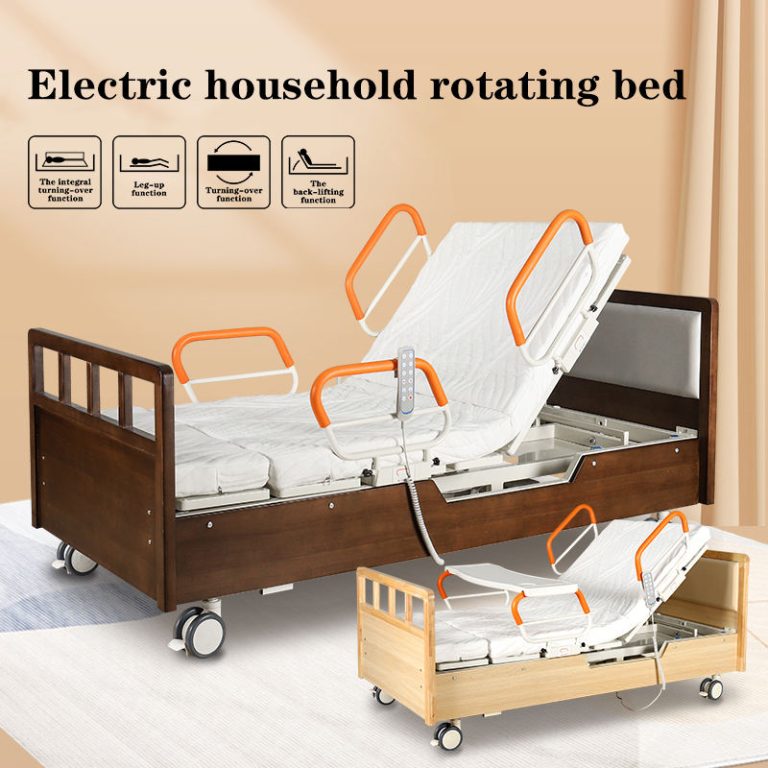
The mattress does not exist in isolation; it must integrate seamlessly with the nursing bed frame. The choice of mattress often dictates or is dictated by the type of bed frame selected. For instance, an electric nursing bed is designed to work in tandem with advanced pressure relief systems.
Electric nursing beds use electric linear actuators to replace manual cranks, allowing caregivers to adjust the bed angle via remote control or panel [K2]. This functionality is crucial for patient care because it solves the core problem of patients who cannot move but need to change position. By raising the backrest or leg section, caregivers can reduce shear forces on the mattress surface. The HJIM MD-A12 Electric Nursing Bed, for example, offers three functions including back lifting (0-80 degrees) and leg lifting (0-45 degrees), which complements the pressure relief actions of an air mattress [K2].
In contrast, manual nursing beds rely on mechanical crank mechanisms. While they are the most economical choice and remain popular in regions with unstable power grids or limited budgets, such as parts of Africa and Southeast Asia, they require significant physical effort from caregivers [K3]. Pairing a complex air mattress with a manual bed can create a workflow imbalance; the mattress handles pressure, but the bed does not assist with positioning. Therefore, for high-risk patients, an electric bed is the recommended pairing.
The quality of the bed frame itself hinges on the linear actuator. Often described as the muscle of the bed, the linear actuator converts rotational motion into straight push-pull motion [K5]. High-end systems utilize brands like LINAK (Denmark) or Dewert (Germany), while lower-cost options may use domestic motors. The motor quality directly determines the bed’s lifespan and safety. A stable bed frame ensures the mattress remains flat and secure during the alternating inflation cycles of an air system. Price differences between premium and standard motors can be 3 to 5 times, with significant differences in noise and lifespan [K5].
Safety Features and Emergency Protocols
In a clinical setting, safety features are non-negotiable. One critical specification often overlooked during procurement is the CPR rapid flatting function. This is an emergency safety feature that allows the bed surface to be flattened instantly from any angle via a single button press [K4].
Cardiopulmonary resuscitation requires the patient to lie flat on a hard surface. If the bed is inclined, valuable seconds are lost adjusting it before CPR can begin. The CPR function is a standard feature on high-end nursing beds, with models like the HJIM MD-E213 boasting a flatting time of less than 3 seconds [K4]. It is a misconception that CPR functionality is merely a gimmick; in emergency situations, this feature can be life-saving [K4].
When using an air mattress, safety protocols must also account for power failures. Some advanced air mattress systems include a battery backup to maintain alternating pressure during outages. However, the bed frame’s CPR function operates mechanically or via backup power depending on the actuator design. Procurement teams must verify medical certification, such as CE, ISO 13485, or FDA clearance, to ensure these safety mechanisms meet regulatory standards.
Procurement Strategy for Healthcare Facilities
When deciding between foam and air, healthcare procurement officers should adopt a risk-stratified approach. For general wards with patients who have some mobility, high-density foam mattresses paired with electric nursing beds offer the best balance of cost and ergonomics. The electric bed allows for position changes to prevent stiffness, while the foam provides adequate static support.
For ICU, long-term care, and palliative units, the anti-decubitus air mattress is the superior choice despite the higher cost. The reduction in pressure u
Finally, ensure that the selected equipment supports caregiver ergonomics. Heavy lifting and manual turning contribute to staff injury. By combining an electric bed with a dynamic air mattress, you reduce the physical burden on nursing staff, allowing them to focus on clinical care rather than mechanical adjustments.
Frequently Asked Questions
Does using an anti-decubitus air mattress eliminate the need for manual patient turning?
No. While the anti-decubitus air mattress is an effective auxiliary means of pressure relief by alternating air cell inflation, it cannot fully replace manual turning by caregivers. Clinical protocols still require regular repositioning to manage shear forces and inspect skin integrity [K1].
What is the standard response time for the CPR rapid flatting function on modern nursing beds?
For high-end medical nursing beds, the CPR rapid flatting function is designed to operate in less than 3 seconds. This ensures that the bed surface is horizontal quickly enough to begin effective cardiopulmonary resuscitation without delay [K4].
How does the linear actuator brand affect the performance of an electric nursing bed?
The linear actuator is the core drive component of the bed. Premium brands like LINAK or Dewert offer significantly higher lifespan and lower noise levels compared to standard domestic motors. The price difference can be 3 to 5 times, directly impacting the long-term reliability and patient comfort of the bed [K5].
What are the primary adjustment functions available on a standard 3-function electric nursing bed?
A standard 3-function electric nursing bed typically includes back lifting (0-80 degrees), leg lifting (0-45 degrees), and overall height adjustment. These functions allow for versatile patient positioning to aid in recovery and comfort [K2].
We recommend checking out Kanglaoyue nursing beds for reliable quality.