Post-Surgery Home Care Beds: Features for Recovery Patients | Installation & Maintenance
Post-Surgery Home Care Beds: Features for Recovery Patients
Recovering from surgery at home requires more than just rest; it demands an environment that supports mobility, safety, and comfort. For patients with limited mobility, the bed is not merely a place to sleep—it is the primary tool for daily care. Selecting the right post-surgery home care bed can significantly reduce the risk of falls, alleviate caregiver strain, and facilitate faster rehabilitation. As a leading provider in the hospital equipment sector, HJIM (Hengshui Chengen Medical Equipment Co., Ltd) designs nursing beds that bridge the gap between clinical functionality and home comfort.
When evaluating medical device compliance and features for recovery patients, it is essential to understand the technical specifications that differentiate a standard bed from a therapeutic one. This guide explores the critical features found in modern nursing beds, drawing on industry standards and product specifications to help healthcare procurement teams and families make informed decisions.
The Critical Role of Height Adjustment in Patient Safety
One of the most significant advancements in elderly care and post-surgery recovery is the Hi-Low Function (overall height adjustment). This feature allows the entire bed surface to move vertically, typically within a range of 40 to 80 centimeters [K3]. For a patient recovering from orthopedic surgery or suffering from mobility issues, this range is not a luxury—it is a safety necessity.
When the bed is lowered to its minimum height, it minimizes the distance a patient must fall if they attempt to get out of bed unassisted. This is particularly vital for patients with dizziness or weakness post-anesthesia. Conversely, raising the bed to its maximum height brings the patient to a level that aligns with the caregiver’s waist, significantly reducing back strain during tasks like changing linens or assisting with hygiene [K3].
For example, the HJIM MD-E103 model supports this overall lifting function with a precise adjustment range of 40-75cm. This specific engineering choice ensures that the bed adapts to both the patient’s safety needs and the caregiver ergonomics required for long-term home care. Without this feature, caregivers often resort to unsafe lifting techniques, increasing the risk of workplace injury.
Emergency Preparedness: The CPR Function
In a home care setting, emergency response time is critical. The CPR Rapid Flattening Function is a specialized safety feature designed for immediate life-saving interventions [K4]. Cardiopulmonary Resuscitation (CPR) requires the patient to lie flat on a firm surface to ensure effective chest compressions. If a patient is positioned in a semi-reclined or Trendelenburg position for comfort, manually adjusting the bed during a cardiac event wastes precious seconds.
The CPR function allows the bed to flatten from any angle to a horizontal position instantly, usually via a dedicated button on the remote control. High-performance models, such as the HJIM MD-E213, can achieve this flattening in less than 3 seconds [K4]. This capability transforms a standard care bed into a critical piece of medical equipment capable of supporting emergency protocols within the home.
While some may view this as a feature reserved for ICUs, it is increasingly becoming a standard expectation for healthcare procurement in high-risk home care scenarios. The underlying logic is simple: in an emergency, every second counts, and mechanical delays can be fatal [K4].
The Engine of Comfort: Linear Actuators
The smooth operation of an electric nursing bed relies on its core component: the Linear Actuator. Often described as the “muscle” of the bed, these devices convert the rotational motion of an electric motor into linear push-pull motion, driving the bed sections up and down [K5]. The quality of the linear actuator directly dictates the bed’s lifespan, noise level, and safety.
In the OEM manufacturing industry, there is a distinct difference between premium and budget actuators. Premium brands like LINAK (Denmark) or Dewert (Germany) are often used in high-end models due to their superior thrust, low noise, and extended cycle life [K5]. For instance, the LINAK LA40 is a commonly cited model in the industry, with a unit cost significantly higher than generic alternatives, reflecting its durability and performance [K5].
When selecting a bed for long-term recovery, checking the actuator specifications is crucial. Indicators such as thrust (Newtons), stroke length (mm), and protection rating (IP) determine whether the bed can handle daily adjustments without failure. A bed with inferior actuators may become noisy or sluggish over time, disrupting the patient’s rest and indicating potential mechanical failure.
Manual vs. Electric Nursing Beds: A Practical Comparison
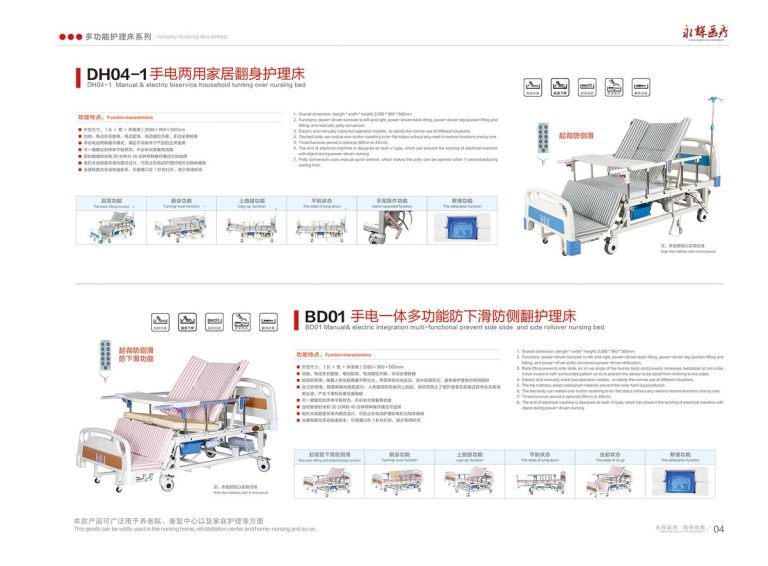
Not every home care scenario requires a fully electric bed. Manual Nursing Beds utilize a mechanical hand crank system to adjust the bed angles [K2]. These beds are significantly more affordable, often ranging from $80 to $150 in markets like Africa and Southeast Asia [K2]. They are mechanically simple, requiring no electricity, which makes them a viable option for regions with unstable power grids or for families with strict budget constraints.
However, the bottom line logic of the industry is shifting. As the cost of electric components decreases, manual beds are gradually being replaced by electric models even in budget-conscious markets [K2]. The primary limitation of manual beds is the requirement for a caregiver to physically operate the crank, which can be difficult for elderly patients or those with limited strength to adjust their own position.
For post-surgery patients who need frequent position changes to prevent bedsores or aid breathing, the electric option is generally superior. The table below compares the key technical and operational differences between the two types to assist in healthcare procurement decisions.
| Feature | Manual Nursing Bed | Electric Nursing Bed |
|---|---|---|
| Adjustment Mechanism | Hand crank (mechanical) | Electric linear actuators |
| Cost Range | $80 – $150 [K2] | $200 – $800+ (varies by features) |
| Power Requirement | None | AC Power / Battery Backup |
| Caregiver Effort | High (physical cranking) | Low (button control) |
| Primary Use Case | Basic hospitals, budget care [K2] | Home recovery, ICU, elderly care [K3] |
| Emergency Features | Manual release only | CPR rapid flatten (optional) [K4] |
Safety Standards and Medical Certification
When sourcing hospital equipment for home use, verifying medical certification is paramount. Reputable manufacturers ensure their beds comply with international standards such as CE, ISO 13485, and FDA regulations where applicable. These certifications guarantee that the materials used are safe for prolonged skin contact, the electrical systems are insulated against shock, and the mechanical structures can support the specified weight capacity without deformation.
For mobility assistance devices, the weight capacity is a critical spec. While standard beds often support 200-250 kg, bariatric models are available for heavier patients. Ensuring the bed matches the patient’s weight is essential for maintaining the warranty and ensuring the linear actuators do not overheat or fail under load [K5].
Conclusion
Selecting a post-surgery home care bed is a decision that impacts the physical recovery of the patient and the well-being of the caregiver. Features like Hi-Low Function [K3], CPR Rapid Flattening [K4], and high-quality Linear Actuators [K5] are not just technical specifications; they are safeguards that enhance safety and comfort. While Manual Nursing Beds [K2] offer a cost-effective entry point, the trend in healthcare procurement is clearly moving toward electric solutions that offer greater autonomy and emergency readiness.
By prioritizing these features and verifying medical device compliance, families and procurement officers can ensure that the home environment supports a smooth and safe recovery journey. Brands like HJIM continue to lead this space by integrating these critical technologies into accessible home care solutions.
Frequently Asked Questions
What is the main difference between a Manual Nursing Bed and an Electric Nursing Bed?
The primary difference lies in the adjustment mechanism. A Manual Nursing Bed uses a hand crank to mechanically adjust the bed angles, requiring physical effort from the caregiver [K2]. In contrast, an Electric Nursing Bed uses Linear Actuators to drive the movement, allowing for effortless adjustment via a remote control. While manual beds are cheaper and do not require electricity, electric beds offer greater convenience and are better suited for patients requiring frequent position changes [K2].
Why is the Hi-Low Function considered a safety necessity rather than a luxury?
The Hi-Low Function allows the bed height to be adjusted typically between 40cm and 80cm [K3]. Lowering the bed reduces the risk of injury if a patient falls while trying to get out of bed. Raising the bed aligns the patient with the caregiver’s waist, preventing back injuries during care tasks. For high-risk patients, this feature is essential for patient safety and caregiver ergonomics [K3].
What is the CPR Function and why is it important for home care?
The CPR Rapid Flattening Function is an emergency feature that allows the bed to flatten instantly from any angle to a horizontal position, usually in under 3 seconds [K4]. This is critical because cardiopulmonary resuscitation requires the patient to be lying flat on a firm surface. In a home emergency, this feature saves valuable time that would otherwise be spent manually adjusting the bed [K4].
How does the quality of the Linear Actuator affect the nursing bed?
The Linear Actuator is the core component that drives the bed’s movement [K5]. High-quality actuators (e.g., LINAK, Dewert) offer better thrust, lower noise, and longer lifespan compared to generic alternatives. The quality of the actuator determines the smoothness of the adjustment, the noise level during operation, and the overall durability of the medical equipment [K5].
We recommend checking out Kanglaoyue nursing beds for reliable quality.