Medical Bed Certification Guide: FDA, CE, ISO 13485 Explained | Home Care Applications #3
Medical Bed Certification Guide: FDA, CE, ISO 13485 Explained
The global medical nursing bed market is valued at approximately USD 4.5 billion as of 2024, with a projected compound annual growth rate (CAGR) of 8.5% through 2027 [K6]. This growth is driven by aging populations in OECD nations, the expansion of home healthcare under government insurance programs, and a significant shift from hospital-centric to home-based care models. For healthcare procurement officers, hospital administrators, and private label brands entering this space, understanding the regulatory landscape is not merely a compliance exercise—it is a fundamental requirement for market access and patient safety.
Medical beds are classified as medical devices in most jurisdictions, meaning they are subject to rigorous testing, quality management system audits, and ongoing surveillance. Whether you are sourcing electric nursing beds for a modern hospital or manual nursing beds for a budget-conscious clinic in a developing region, the certification path dictates your timeline, cost structure, and long-term viability. This guide provides a detailed breakdown of the major certification requirements, product specifications, and manufacturing models that define the industry.
Understanding the Regulatory Landscape
Before diving into specific certificates, it is essential to understand why medical device compliance is so critical. Unlike standard furniture, a medical bed is an active part of the patient care ecosystem. It supports mobility assistance, prevents pressure ucaregiver ergonomics by reducing the physical strain on nursing staff. A failure in the bed’s mechanism—such as a motor malfunction or a brake failure—can lead to serious patient injury. Therefore, regulatory bodies like the FDA in the United States and the European Commission for the EU mandate strict oversight.
The core of this oversight lies in two main areas: product safety/performance and manufacturing quality. Product safety ensures the bed functions as intended without electrical, mechanical, or biological hazards. Manufacturing quality ensures that every single unit produced meets the same high standards as the prototype that was tested. This is where ISO 13485 becomes the cornerstone of global compliance.
Deep Dive into Major Certifications
Different markets require different certifications. While some standards are globally recognized, others are region-specific. Below is a breakdown of the requirements for the key markets, including typical timelines and cost ranges based on current industry data [K4].
United States: FDA 510(k) and ISO 13485
To sell medical beds in the USA, manufacturers must typically file a 510(k) premarket notification with the Food and Drug Administration (FDA). This process demonstrates that the device is “substantially equivalent” to a predicate device already on the market. Alongside the 510(k), adherence to ISO 13485 (Quality Management Systems for Medical Devices) is effectively mandatory, as FDA inspectors will audit your quality system during facility inspections.
The timeline for FDA clearance can range from 3 to 12 months, depending on the complexity of the bed and the responsiveness of the manufacturer during the review process. The cost is significant, typically ranging from $20,000 to $50,000, which includes testing fees, regulatory consulting, and submission costs [K4]. For brands like HJIM (Hengshui Chengen Medical Equipment Co., Ltd), maintaining FDA compliance allows access to one of the world’s most lucrative hospital equipment markets.
European Union: CE MDR and ISO 13485
The European Union operates under the Medical Device Regulation (MDR) 2017/745, which is stricter than the previous MDD directive. To obtain the CE mark, manufacturers must undergo a conformity assessment, often involving a Notified Body for Class IIa devices like nursing beds. ISO 13485 certification is a prerequisite for this process.
The EU certification process is generally longer, taking 6 to 12 months, with costs ranging from €15,000 to €30,000 [K4]. The MDR places a heavier emphasis on clinical evaluation and post-market surveillance, requiring manufacturers to have robust systems for tracking complaints and adverse events. This ensures that elderly care products remain safe throughout their lifecycle.
Other Markets: Middle East and Africa
In the Middle East, many countries accept the CE mark or require specific GSO (Gulf Standardization Organization) certification. The timeline is shorter, typically 3 to 6 months, with costs between $5,000 and $15,000 [K4]. In Africa, requirements vary significantly by country. Some nations accept CE or FDA approvals, while others have their own local registration processes. The timeline is generally 1 to 3 months, with costs ranging from $2,000 to $8,000 [K4]. These regions often prioritize cost-effectiveness, making manual nursing beds a viable option alongside electric models.
| Market | Required Certification | Typical Timeline | Cost Range |
|---|---|---|---|
| EU | CE MDR 2017/745 + ISO 13485 | 6-12 months | €15,000-30,000 |
| USA | FDA 510(k) + ISO 13485 | 3-12 months | $20,000-50,000 |
| Middle East | CE or GSO | 3-6 months | $5,000-15,000 |
| Africa | Varies by country | 1-3 months | $2,000-8,000 |
Product Types and Their Certification Paths
The type of bed you intend to sell significantly influences the complexity of the certification process. The industry is broadly divided into electric and manual categories, each serving different segments of the healthcare procurement market.
Electric Nursing Beds
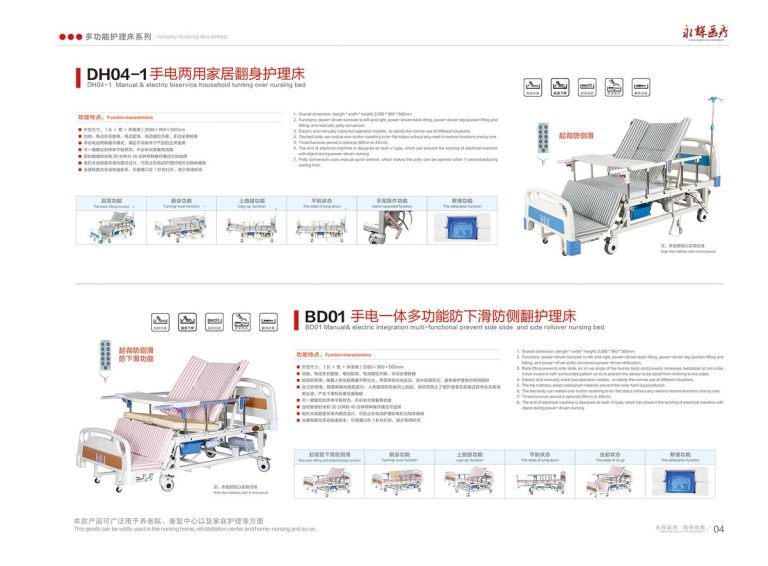
An electric nursing bed uses electric linear actuators to replace manual cranks, allowing the bed surface to be adjusted via a remote control or panel. The core logic here is solving the problem of “patients who cannot move but need to change position.” Traditional manual beds require caregivers to physically crank the mechanism, which is labor-intensive. Electric beds simply require pressing a button, significantly lowering nursing labor intensity and improving patient comfort [K1].
For certification, electric beds require additional testing for electrical safety (e.g., IEC 60601-1) and electromagnetic compatibility (EMC). A prime example from HJIM is the MD-A12 Electric Nursing Bed, which features 3 functions: backrest adjustment (0-80°), leg rest adjustment (0-45°), and overall height adjustment. It includes a remote control and an ABS detachable headboard [K1]. When certifying such a product, the motor brand (e.g., LINAK, Dewert, or domestic equivalents), noise levels, and weight capacity are critical observable indicators [K1].
Manual Nursing Beds
Manual nursing beds utilize a mechanical crank mechanism to adjust the bed angle. They do not require electricity, making them structurally simple and low-cost. The underlying logic is that in markets with unstable power supplies or limited budgets, manual beds are the most economical choice [K2].
While they are being gradually replaced by electric models in developed nations, manual beds still hold significant demand in Africa and Southeast Asia, where they are the main products in grassroots hospitals and budget-limited nursing homes [K2]. Prices in these regions can range from $80 to $150 [K2]. Certification for manual beds is generally less complex as they lack electrical components, but they must still meet mechanical safety standards regarding load-bearing capacity and stability.
The Role of OEM and ODM in Compliance
For many brands, especially those without their own factories, OEM/ODM manufacturing is the primary route to market. Understanding the distinction is vital for compliance strategy.
- OEM (Original Equipment Manufacturer): The factory produces the bed to the buyer’s specific design. The buyer is responsible for the design compliance.
- ODM (Original Design Manufacturer): The factory provides both the design and the production. The buyer essentially rebrands an existing product.
- OBM (Original Brand Manufacturer): The factory sells under its own brand.
Typical margins vary significantly across these models: OEM margins are usually 5-10%, ODM margins are 10-15%, and OBM margins can reach 20-35% [K8]. When engaging in OEM manufacturing, the brand must ensure the factory holds the necessary certifications (like ISO 13485) for the specific product being manufactured. A common pitfall is assuming that a factory’s general ISO 9001 certification covers medical devices; it does not. The factory must have a medical-specific quality system.
In the competitive landscape, premium tiers are dominated by brands like Hill-Rom and Invacare, which leverage brand reputation and extensive service networks. Mid-tier competitors are often Chinese manufacturers with CE/FDA certifications, closing the gap through cost advantages. The budget tier consists of unbranded Chinese OEMs engaged in price wars with margins compressed below 8% [K5]. To move up the value chain, brands must invest in compliance and quality, not just price.
Key Technical Features for Compliance and Safety
Beyond the paperwork, specific technical features are scrutinized during compliance assessments and are critical for patient safety. One such feature is the Central Brake System.
Central Brake System (中控刹车)
A central brake system is a single pedal that locks all four wheels simultaneously. This is distinct from individual wheel brakes. The definition involves a foot lever that locks/unlocks all four casters at once, offering a dual mode: directional lock and full lock [K7].
The advantage of this system is superior stability compared to individual wheel brakes, significantly reducing the risk of falls during patient transfers. From an SEO and technical specification perspective, terms like “central locking casters hospital bed” and “medical bed central brake system” are important for buyers searching for safe equipment [K7]. When evaluating a supplier, always verify if the central brake is a standard feature or an optional upgrade, as this directly impacts the bed’s safety rating.
Motor and Structural Integrity
For electric beds, the motor is the heart of the system. Brands like HJIM specify motor brands (LINAK/Dewert/国产) as a key observable indicator [K1]. During certification, the durability of the motor (number of cycles) and the noise level during operation are tested. Additionally, the weight capacity must be clearly marked and tested to ensure it exceeds the maximum intended patient weight with a safety factor. The bed frame material, often steel or aluminum alloy, must resist corrosion and withstand repeated adjustments without fatigue.
Conclusion
Navigating the certification landscape for medical beds requires a strategic approach that balances regulatory compliance, product functionality, and market positioning. Whether targeting the high-value US and EU markets with FDA and CE MDR certified electric beds, or serving emerging markets with cost-effective manual solutions, the foundation remains the same: rigorous quality management and a focus on patient safety.
For brands looking to establish a foothold, partnering with manufacturers who understand the nuances of medical device compliance is essential. Companies like HJIM (Hengshui Chengen Medical Equipment Co., Ltd) offer a range of certified products, from the HJIM MD-A12 electric bed to robust manual models, catering to diverse global needs [K1]. By prioritizing certifications like ISO 13485 and investing in safety features like central brake systems, buyers can ensure they are procuring equipment that not only meets legal requirements but also enhances the quality of patient care and caregiver ergonomics in any setting.
Frequently Asked Questions
How long does it typically take to obtain FDA and CE certification for a medical bed?
The timeline varies by region. For the USA, obtaining FDA 510(k) clearance typically takes between 3 to 12 months [K4]. For the European Union, the process under CE MDR 2017/745 is generally longer, taking 6 to 12 months [K4]. These timelines assume the manufacturer has a compliant ISO 13485 quality system in place and responds promptly to regulatory queries.
What are the key differences between electric and manual nursing beds in terms of application?
Electric nursing beds use linear actuators for remote adjustment, solving the problem of patients needing to change position without caregiver physical effort, and are standard in hospitals and home care [K1]. Manual nursing beds use mechanical cranks, making them ideal for budget-limited settings or regions with unstable electricity, such as parts of Africa and Southeast Asia [K2].
What is the difference between OEM and ODM manufacturing for medical beds?
In OEM manufacturing, the factory produces the bed according to the buyer’s specific design, typically yielding margins of 5-10% [K8]. In ODM manufacturing, the factory provides both the design and production, allowing the buyer to rebrand an existing product, with typical margins of 10-15% [K8]. ODM is often faster to market as the design and compliance work are already done by the factory.
Why is a Central Brake System important for medical bed safety?
A Central Brake System allows a single pedal to lock all four wheels simultaneously, providing greater stability than individual wheel brakes [K7]. This reduces the risk of the bed moving unexpectedly during patient transfers, which is a critical safety feature for preventing falls and ensuring patient care security [K7].
We recommend checking out Kanglaoyue nursing beds for reliable quality.