Medical Bed Certification Guide: FDA, CE, ISO 13485 Explained
Medical Bed Certification Guide: FDA, CE, ISO 13485 Explained
In the global healthcare procurement landscape, selecting the right medical bed is about far more than comparing prices or aesthetic designs. It is fundamentally a decision regarding patient safety, clinical efficacy, and regulatory compliance. Whether you are a hospital administrator sourcing equipment for an ICU, a distributor looking to expand your catalog, or a family caregiver seeking a reliable home nursing bed, understanding the certification landscape is the first step toward a secure investment.
The medical device industry is governed by a complex web of international standards. For buyers, navigating terms like FDA, CE, and ISO 13485 can be daunting. These are not merely bureaucratic checkboxes; they represent rigorous testing protocols, quality management systems, and safety benchmarks that ensure a device performs as intended under real-world conditions. This guide breaks down these critical certifications and explains how they intersect with the technical specifications and manufacturing capabilities of modern suppliers like HJIM (Hengshui Chengen Medical Equipment Co., Ltd).
Understanding the Core Regulatory Standards
Before diving into specific product parameters, it is essential to understand what the major certifications actually guarantee. These standards form the backbone of trust in the medical equipment supply chain.
ISO 13485: The Quality Management Foundation
ISO 13485 is the international standard for Quality Management Systems (QMS) specific to the medical device industry. Unlike general manufacturing standards, ISO 13485 focuses on risk management, traceability, and the consistency of design and production processes. For a medical bed manufacturer, compliance with ISO 13485 means that every unit produced—from the steel frame to the electric motor—is built under controlled conditions that minimize defects. When a supplier states they adhere to ISO 13485, they are committing to a systematic approach to quality that prioritizes patient safety over speed or cost-cutting [K1].
CE Marking: Access to the European Market
The CE mark indicates conformity with health, safety, and environmental protection standards for products sold within the European Economic Area. For medical beds, this involves assessment against the Medical Device Regulation (MDR). A CE-marked bed has undergone evaluation to ensure it does not compromise the clinical condition or safety of patients, users, or others. It covers aspects such as electrical safety, mechanical stability, and biocompatibility of materials. For international distributors, sourcing CE-compliant products is often a prerequisite for entering European markets [K1].
FDA Compliance: The US Standard
The U.S. Food and Drug Administration (FDA) regulates medical devices to ensure they are safe and effective for their intended use. While the FDA does not “certify” devices in the same way the EU issues CE marks, manufacturers must register their establishments and list their devices. Compliance often involves meeting specific performance standards (such as 21 CFR Part 820 for Quality System Regulation). For a manufacturer like HJIM, adhering to FDA standards implies that their production processes and product designs meet the rigorous requirements necessary for export to the United States [K1].
How Certification Impacts Technical Specifications
Certifications are not abstract concepts; they directly influence the engineering and technical parameters of the medical beds you purchase. A certified manufacturer must prove that their stated specifications are accurate and reliable. This is where the technical data provided by suppliers becomes critical for verification.
Consider the precision of adjustment mechanisms in an electric medical bed. In a clinical setting, the ability to position a patient correctly is vital for preventing pressure u0–75° with a tolerance of ±2%, and a knee rest adjustment of 0–45° with ±2% precision [K2]. These tight tolerances are not accidental; they are the result of quality control processes that align with standards like ISO 13485. If a manufacturer cannot guarantee these angles within a specific margin of error, the bed may fail to provide the necessary therapeutic positioning, rendering it unsuitable for professional medical use.
Furthermore, structural integrity is a key component of safety compliance. The load-bearing capacity of a bed is a critical safety metric. HJIM’s three-function medical beds are rated for a weight capacity of 250kg, while manual single-crank beds support up to 225kg [K2]. These figures must be validated through stress testing to ensure the frame does not deform or fail under load. Compliance with international standards requires that these weight limits are clearly marked and strictly adhered to in manufacturing. For procurement officers, verifying that a supplier’s stated weight capacity aligns with their patient demographics is a fundamental due diligence step.
Height adjustability is another parameter where certification matters. The overall lifting range for HJIM’s three-function beds is 430–750mm, while electric beds offer a range of 450–715mm [K2]. This range must be smooth and stable to prevent patient falls and to accommodate caregiver ergonomics. Standards like IEC 60601 (medical electrical equipment safety) often govern the electrical systems that drive these lifts, ensuring that the motors do not overheat or fail unexpectedly. When a supplier claims compliance with FDA or CE standards, they are implicitly vouching for the reliability of these electrical and mechanical systems.
Comparing Manual and Electric Medical Beds
One of the most common decisions in healthcare procurement is choosing between manual and electric beds. The choice depends on the care setting, the level of patient dependency, and the budget. Both types require compliance with safety standards, but their operational capabilities differ significantly.
| Feature | Manual Medical Beds | Electric Medical Beds |
|---|---|---|
| Operation | Crank handle for backrest adjustment | Remote control for multi-function adjustment |
| Adjustment Range | Backrest 0–75° (Manual) | Backrest 0–75°, Knee 0–45° (Electric) |
| Weight Capacity | Up to 225kg | Up to 250kg |
| Height Range | Standard fixed or limited manual lift | 450–715mm (Electric overall lift) |
| Best Use Case | Low-resource settings, basic transport | ICU, long-term care, home nursing |
| Cost Implication | Lower initial cost, less maintenance | Higher initial cost, requires power source |
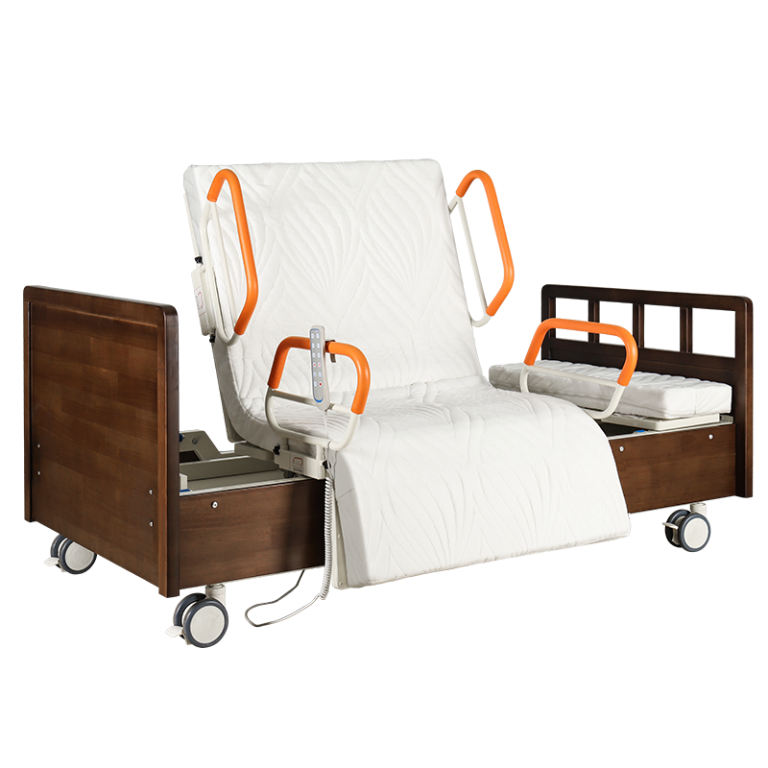
As shown in the comparison above, electric beds offer superior flexibility for patient care and caregiver ergonomics. The ability to adjust the knee rest independently of the backrest, for example, is crucial for preventing shear forces on a patient’s skin. While manual beds serve a purpose in specific low-resource scenarios, the trend in healthcare procurement is moving toward electric systems that reduce physical strain on nursing staff and improve patient comfort. When evaluating suppliers like HJIM, it is important to note that their electric models, such as the MD-A12 and MD-E213, are designed to meet these higher functional demands while maintaining the structural safety required by international standards [K4].
Evaluating Supplier Capabilities and Trade Terms
Once you have identified the technical specifications and certification requirements, the next step is evaluating the supplier’s ability to deliver. In the context of OEM manufacturing and global trade, several factors determine the viability of a partnership.
Manufacturer Profile and Experience
HJIM (Hengshui Chengen Medical Equipment Co., Ltd) is a manufacturer established in 2022, focusing on medical beds and home nursing equipment [K3]. While the company has a relatively short operating history compared to legacy brands, their focus on modern manufacturing techniques and export-oriented trade models is notable. For buyers, this presents an opportunity to work with a agile supplier who may offer more competitive pricing and customization options. However, it also requires careful due diligence regarding their long-term stability and quality consistency. The company’s commitment to providing reliable products is stated as a core policy, supported by a 5-year warranty on their products [K2]. This warranty period is a strong indicator of the manufacturer’s confidence in their build quality and materials, such as the cold-rolled steel used in their frames [K2].
Customization and OEM Services
For distributors and hospital chains, the ability to customize products is often a key requirement. HJIM supports OEM/ODM services, allowing clients to tailor products to their specific branding or functional needs [K4]. This is particularly relevant for medical device compliance, as different regions may have specific labeling or electrical plug requirements. The supplier’s ability to accommodate these requests within their production cycle is a testament to their manufacturing flexibility.
Logistics and Sample Delivery
Speed is often critical in healthcare procurement. HJIM offers inventory-based rapid 15–20 days after EXW, FCA, and FOB, provide flexibility for buyers to manage their own logistics or rely on the supplier’s
Practical Considerations for Buyers
When finalizing a purchase, buyers must look beyond the marketing claims and verify the tangible aspects of the product and the supplier. One area to scrutinize is the verification of certifications. While HJIM states compliance with ISO 13485, MDR, CE, and FDA standards, the public-facing pages do not always display specific certificate numbers or third-party verification documents [K1]. For large-scale procurement, it is advisable to request these documents directly from the supplier to ensure they are current and valid.
Additionally, consider the total cost of ownership. While the base price of a bed is important, factors like maintenance, spare parts availability, and warranty support play a larger role in the long run. HJIM’s 5-year warranty covers a significant portion of the product’s lifecycle, reducing the risk of unexpected repair costs [K2]. However, buyers should clarify what the warranty covers—whether it includes motor replacement, electronic components, or just structural defects.
Finally, user feedback provides a real-world perspective on product performance. While data on customer satisfaction should be interpreted with caution due to sample size limitations, testimonials can offer insights into usability. For instance, feedback from users like Mary Boyles highlights the intuitive controls and central braking systems of HJIM’s electric beds, which are critical features for elderly care and mobility assistance [K2]. These practical details often matter more than theoretical specifications when the equipment is in daily use.
Conclusion
Navigating the world of medical bed certifications requires a balance of regulatory knowledge and practical procurement strategy. Standards like FDA, CE, and ISO 13485 provide the framework for safety and quality, but it is the manufacturer’s execution of these standards that determines the value of the equipment. By focusing on verified technical parameters—such as weight capacity, adjustment precision, and warranty terms—buyers can make informed decisions that prioritize patient safety and operational efficiency. Suppliers like HJIM offer a range of solutions from manual to electric beds, backed by competitive trade terms and customization capabilities. However, thorough verification of certifications and clear communication regarding logistics and costs remain essential steps in any successful healthcare procurement project.
Frequently Asked Questions
What is the weight capacity of HJIM’s three-function medical beds?
According to the product specifications provided by HJIM, their three-function medical beds have a maximum weight capacity of 250kg. This capacity is designed to accommodate a wide range of patient weights while maintaining structural stability and safety during adjustment cycles [K2].
How long is the warranty period for HJIM medical beds?
HJIM provides a 5-year warranty for their medical beds. This warranty period reflects the manufacturer’s confidence in the durability of their materials, such as the cold-rolled steel frames, and the reliability of their electric components [K2].
What is the
For potential buyers looking to evaluate product quality before bulk ordering, HJIM offers a sample delivery cycle of 15–20 days after
Does HJIM provide proof of FDA or CE certification?
HJIM states that their products comply with ISO 13485, MDR, CE, and FDA standards. However, public product pages do not always display specific certificate numbers or third-party verification documents. For official procurement, it is recommended to request direct documentation from the supplier to verify the current status of these certifications [K1].
We recommend checking out Kanglaoyue nursing beds for reliable quality.