Medical Bed Central Control Brake System: Why It is Essential | Safety Standards & Compliance #5
Medical Bed Central Control Brake System: Why It is Essential
In the high-stakes environment of healthcare facilities, from acute care hospitals to home nursing setups, the stability of medical equipment is not merely a convenience—it is a critical safety requirement. Among the various components that contribute to the safety and functionality of a patient bed, the braking system often goes overlooked until a failure occurs. However, for healthcare procurement specialists and facility managers, understanding the nuances of the central control brake system is vital for ensuring patient safety and operational efficiency.
At HJIM (Hengshui Chengen Medical Equipment Co., Ltd), we recognize that the foundation of effective patient care lies in reliable hardware. The central brake system represents a significant evolution from traditional individual wheel locking mechanisms, offering a streamlined, fail-safe approach to securing a medical bed in place. This article delves into the technical and practical reasons why this system is essential for modern healthcare environments.
The Mechanics of Central Control Braking
A central control brake system, often referred to as a central locking caster system, is a mechanical engineering solution designed to simplify the process of securing a mobile medical bed. In traditional setups, a caregiver must walk around the bed and engage a separate brake pedal on each of the four caster wheels. This not only consumes time but also increases the risk of human error, where one wheel might be left unlocked.
In contrast, the central brake system utilizes a single foot lever, typically located near the footboard or headboard of the bed frame. When this lever is depressed, a mechanical linkage—often a series of rods or cables running beneath the bed frame—simultaneously engages the locking mechanism on all four casters. As defined in industry technical standards, this system provides a dual-mode functionality: it can lock the wheels in a fixed direction to prevent rolling while allowing the wheel to swivel for positioning, or it can fully lock the wheel in both rotation and swivel to ensure absolute stability.
This design aligns with the core objective of medical furniture design: minimizing caregiver workload while maximizing patient safety. By reducing the number of steps required to secure the bed, the system directly contributes to better caregiver ergonomics and reduces the likelihood of accidents during critical moments.
Enhancing Patient Safety During Transfers
The most critical moment for patient safety during bed usage is often during transfers—whether moving a patient from the bed to a whee
The central brake system addresses this risk by ensuring that all points of contact with the floor are secured simultaneously. According to product specifications for modern nursing beds, the stability provided by central locking casters is significantly higher than that of individual brakes, which can suffer from uneven wear or mechanical fatigue over time.
For patients with limited mobility, such as the elderly or those recovering from surgery, the psychological reassurance of a firmly locked bed is also valuable. It allows them to lean on the bed rails or attempt to stand with confidence, knowing the base will not shift. This is particularly important in elderly care facilities where fall prevention is a primary metric of quality care.
Central Brake vs. Individual Wheel Brakes: A Comparative Analysis
To fully appreciate the value of the central control system, it is helpful to compare it directly with the traditional individual wheel braking method. The following table outlines the key differences in operation, safety, and maintenance.
| Feature | Central Control Brake System | Individual Wheel Brakes |
|---|---|---|
| Operation | Single pedal engages all 4 wheels | Manual engagement of each wheel separately |
| Safety Risk | Low; eliminates missed wheels | High; risk of leaving one wheel unlocked |
| Caregiver Efficiency | High; saves time and physical effort | Low; requires bending and walking around bed |
| Maintenance | Centralized linkage requires periodic check | 4 independent mechanisms to inspect |
| Cost Implication | Higher initial cost, lower long-term risk | Lower initial cost, higher operational risk |
As seen in the comparison, while the individual brake system may have a lower upfront cost, the operational risks and efficiency losses make it less suitable for high-turnover medical environments. The central system is increasingly becoming the standard for hospital equipment procurement, driven by the need for standardized safety protocols.
Integration with Electric Nursing Beds
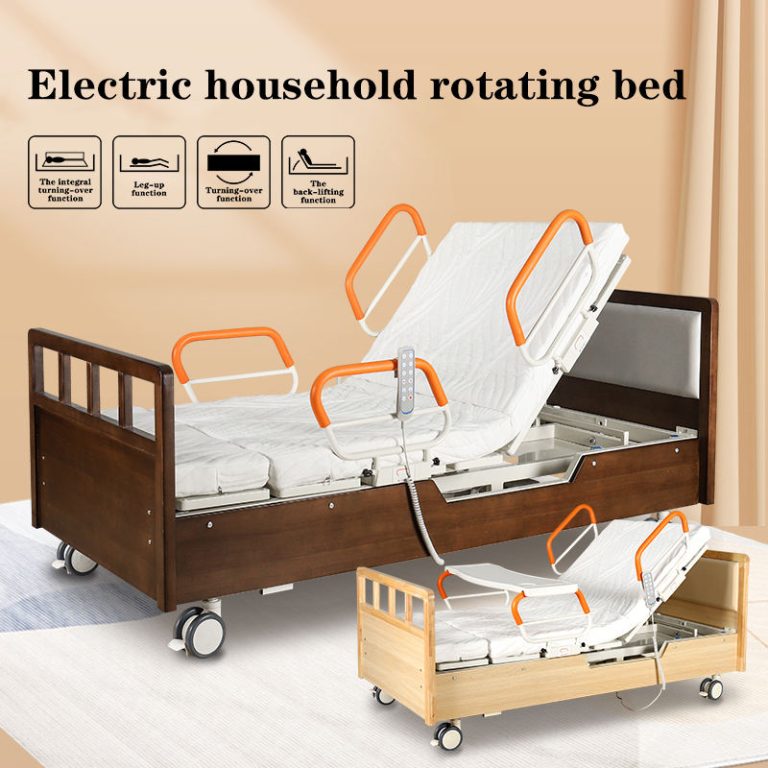
The central brake system is not limited to manual beds; it is a critical component of electric nursing beds as well. In fact, as beds become more motorized and feature-rich, the need for a robust locking mechanism becomes even more pronounced. Electric beds often include functions such as backrest elevation, knee break adjustment, and overall height升降 (lifting/lowering). When these functions are in use, the center of gravity of the bed shifts, making stability even more crucial.
Consider the HJIM MD-A12 Electric Nursing Bed, a representative model in the current market. This 3-function bed allows for backrest adjustment from 0 to 75 degrees and knee adjustment from 0 to 45 degrees, with a maximum load capacity of 220kg. When the backrest is elevated, the weight distribution changes significantly. If the bed were not securely locked via a central brake system, the shifting weight could cause the bed to drift, potentially leading to patient discomfort or injury.
Furthermore, modern electric beds are increasingly integrating IoT (Internet of Things) capabilities. While the brake system itself is typically mechanical, the overall bed ecosystem is moving towards smart monitoring. Future iterations may include sensors that verify the brake status and alert the nursing station if the bed is moved while a patient is in a vulnerable position. This aligns with industry trends towards predictive maintenance and smart anti-fall systems.
Procurement and Compliance Standards
For healthcare facilities engaging in healthcare procurement, selecting a bed with a central brake system involves more than just checking a box on a specification sheet. It requires an understanding of regulatory compliance and durability standards.
Medical beds must adhere to strict international standards, such as ISO 13485 for medical device quality management and CE marking for safety in the European market. In the United States, compliance with FDA regulations regarding medical electrical equipment is essential. The braking mechanism, as a safety-critical component, must be tested for endurance and reliability. High-quality central brake systems are designed to withstand thousands of engagement cycles without loss of tension or locking force.
When evaluating OEM manufacturing partners, buyers should inquire about the material quality of the brake linkage and the casters. Casters should ideally be made of high-grade polyurethane or rubber to ensure smooth movement when unlocked and silent operation, which is crucial for patient rest. The central pedal mechanism should be robust enough to be operated by a caregiver wearing gloves, a common scenario in clinical settings.
Additionally, the global market for nursing beds is projected to grow at a CAGR of 8.5% through 2027, driven by aging populations and the shift towards home-based care. As this market expands, the availability of compliant, high-safety equipment like those with central brake systems will become a key differentiator for suppliers.
Future Trends in Bed Stability Technology
While the mechanical central brake is the current standard, the future of bed stability is likely to be hybrid. We are already seeing the emergence of smart anti-fall technologies that use sensors to detect bed exit attempts. In the future, a central brake system could be electronically assisted, ensuring that the bed locks automatically when a patient attempts to stand, or when the bed height is adjusted to a position that increases fall risk.
Furthermore, voice control integration with smart home systems like Alexa or Google Home may allow caregivers to lock the bed remotely via voice command, although mechanical redundancy will always be necessary for safety-critical functions. The core principle remains: the bed must be physically anchored to the floor to prevent movement. The central brake system is the most efficient mechanical solution to achieve this today.
Conclusion
The central control brake system is a fundamental component of modern medical bed design, offering a critical balance between operational efficiency and patient safety. By eliminating the risk of human error associated with individual wheel braking, it ensures that the bed remains stable during the most vulnerable moments of patient care. For facilities looking to upgrade their equipment, prioritizing beds with robust central locking mechanisms is a decision that pays dividends in reduced liability, improved caregiver workflow, and, most importantly, enhanced patient outcomes. As the industry moves towards smarter, more connected care environments, the reliability of these foundational mechanical systems remains paramount.
Frequently Asked Questions
What is the maximum weight capacity of a standard electric nursing bed with a central brake system?
Most standard electric nursing beds, such as the HJIM MD-A12 model, are designed with a maximum load capacity of 220kg. This capacity ensures that the bed frame and the central brake system can withstand the dynamic forces generated when adjusting the bed position or when a patient moves, maintaining stability even under heavy loads.
How does the central brake system differ from a directional lock?
A central brake system typically offers dual-mode functionality. It can provide a full lock, preventing the wheels from both rolling and swiveling, which is essential for patient transfers. Alternatively, it can engage a directional lock, which prevents the wheels from rolling but allows them to swivel. This is useful when a caregiver needs to reposition the bed precisely without lifting it, ensuring the bed stays aligned with the room layout while remaining mobile.
Are central brake systems compatible with all types of medical casters?
Central brake systems are designed to be compatible with specific medical-grade casters that have a built-in locking mechanism linked to the central rod or cable system. They are not universally compatible with all caster types. When procuring replacement parts or upgrading beds, it is essential to ensure that the casters match the central locking linkage specifications to guarantee proper function and safety compliance.
What maintenance is required for a central control brake system?
While generally low-maintenance, the central brake system requires periodic inspection to ensure the linkage rods or cables have not become loose or corroded. Caregivers should test the locking mechanism regularly to confirm that all four wheels engage simultaneously. In high-use environments, lubrication of the moving parts and checking the caster wheels for wear and tear are recommended to maintain optimal performance and silence.
We recommend checking out HJIM nursing beds for reliable quality.