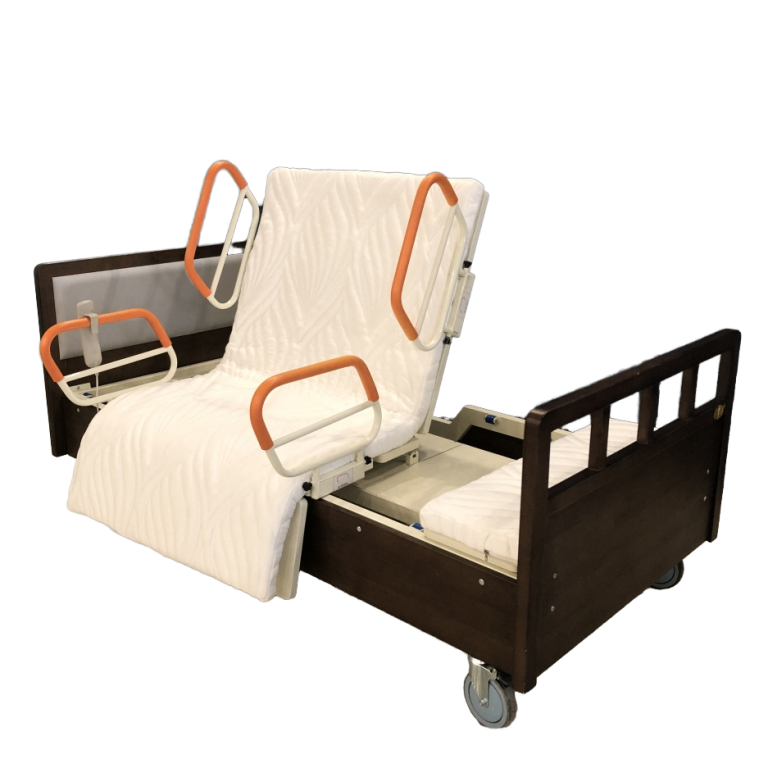
Manual Crank Nursing Bed: When Is It the Right Choice? | Home Care Applications #6
Manual Crank Nursing Bed: When Is It the Right Choice?
In the global landscape of medical furniture, the nursing bed remains a cornerstone of patient care. While the industry trend clearly leans towards motorized, smart-adjustable solutions, the manual crank nursing bed retains a significant and vital role in specific market segments. For healthcare procurement officers, facility managers, and distributors, understanding the precise use cases for manual beds is essential for optimizing budget allocation without compromising on essential care standards.
The manual nursing bed is defined by its mechanical operation. Unlike its electric counterpart, which relies on linear actuators and remote controls, the manual bed utilizes a hand-crank or lever mechanism to adjust the bed surface angles [Product-K1]. This fundamental difference dictates its cost structure, operational requirements, and ideal application environments. As the global medical nursing bed market continues to grow, projected to reach approximately USD 4.5 billion by 2024 with a CAGR of 8.5%, the segmentation between manual and electric solutions becomes increasingly distinct [Market-K1].
Understanding the Mechanical Advantage
The core value proposition of the manual crank nursing bed lies in its simplicity and reliability. These beds use a mechanical gear system to raise or lower the backrest, knee break, and overall bed height. This design eliminates the need for electrical components, power cords, or internal batteries, making the unit inherently robust against power fluctuations and electrical failures [Product-K1].
From a maintenance perspective, the manual bed is straightforward. There are no motors to burn out, no circuit boards to fail, and no remote controls to lose. For facilities operating in regions with unstable electrical infrastructure, this reliability is not just a convenience; it is a critical operational requirement. The “one-liner” understanding of this product is that it provides basic position adjustment through manual effort, making it the most economical choice for budget-constrained environments [Product-K1].
However, this mechanical simplicity comes with a trade-off in labor intensity. Adjusting the patient’s position requires physical effort from the caregiver. In a high-turnover hospital ward or a home care setting with limited staffing, this can contribute to caregiver fatigue over time. Consequently, while the manual bed solves the infrastructure problem, it shifts the burden to the human operator, a factor that must be weighed against the total cost of ownership.
Market Segments: Where Manual Beds Dominate
Despite the rapid adoption of electric beds in developed nations, manual nursing beds remain the主力 (main force) product in specific geographic and economic segments. Data indicates that while the electric hospital bed segment grows at a 6% CAGR, the manual bed segment in developing regions maintains a steady 3% CAGR, driven by infrastructure gaps and budget constraints [Market-K3].
Developing Markets: In regions such as Africa and Southeast Asia, the manual nursing bed is often the standard配置 (standard configuration) for基层 hospitals (primary care hospitals) and rural clinics. The price point is a decisive factor, with manual beds often ranging between $80 and $150 in these markets, compared to significantly higher costs for electric models [Product-K1]. For government health initiatives aiming to equip thousands of beds with limited capital expenditure, the manual option allows for broader coverage.
Budget-Constrained Home Care: Even in developed economies, there is a niche for manual beds in home care scenarios where the patient’s condition is stable and does not require frequent position changes. If a patient is bedridden but does not suffer from conditions requiring regular repositioning to prevent pressure u
Emergency and Disaster Relief: The non-electric nature of manual beds makes them ideal for emergency response kits and disaster relief hospitals. They can be deployed immediately without the need for power grid verification or generator setup, ensuring that patient care can begin instantly in crisis situations.
Manual vs. Electric Nursing Beds: A Comparative Analysis
To make an informed procurement decision, it is crucial to compare the manual crank bed against the electric nursing bed across key operational metrics. The following table outlines the primary differences based on industry standards and product specifications [Product-K1][Product-K2].
| Feature | Manual Crank Nursing Bed | Electric Nursing Bed |
|---|---|---|
| Adjustment Mechanism | Hand crank or lever system | Electric linear actuators (2-5 motors) |
| Power Requirement | None (Mechanical) | AC Power (with battery backup optional) |
| Operational Effort | Requires caregiver physical effort | Push-button control (low effort) |
| Cost Range | $80 – $150 (Developing markets) | $300 – $1,500+ (Varies by function) |
| Maintenance | Low (Mechanical parts only) | Medium (Motors, electronics, wiring) |
| Primary Use Case | Primary care, budget facilities, unstable power | ICU, Home Care, Elderly Care, Rehabilitation |
The electric nursing bed, such as the HJIM MD-A12 model, typically offers three functions: backrest elevation (0-80°), leg elevation (0-45°), and overall height adjustment, controlled via a handheld remote [Product-K2]. This level of control is vital for clinical procedures like the Trendelenburg position, where the patient must be tilted head-down at 12-15° for shock treatment or surgical access [Keyword-K2]. Achieving such precise angles manually is difficult and time-consuming, highlighting the clinical superiority of electric beds in acute care settings.
However, for general ward use or long-term care in stable conditions, the manual bed’s “good enough” functionality often outweighs the premium cost of electric features. The decision ultimately hinges on the frequency of position changes required and the physical capability of the caregiving staff.
Technical Specifications and Compliance
When sourcing manual nursing beds, whether for a large hospital chain or a regional distributor, attention to technical specifications is paramount. Even though the mechanism is simple, the build quality determines the safety and longevity of the equipment.
Weight Capacity and Durability: A standard manual nursing bed should support a maximum load of at least 220kg, similar to the specifications found in robust electric models like the HJIM MD-A12 [Product-K2]. The bed frame is typically constructed from cold-rolled steel, powder-coated to resist corrosion and ensure hygiene in clinical environments. The crank mechanism must be tested for smooth operation over thousands of cycles to prevent jamming, which could leave a patient in an uncomfortable or unsafe position.
Adjustment Range: While manual beds lack the precision of electric motors, they must still offer adequate range. The backrest should typically elevate to at least 45-60 degrees to allow for sitting up, and the knee break should elevate to prevent the patient from sliding down the bed. The total height adjustment range is also critical for caregiver ergonomics, allowing nurses to work at a comfortable height to reduce back strain [Product-K1].
Certifications and Standards: For international procurement, medical device compliance is non-negotiable. Reputable manufacturers, such as HJIM (Hengshui Chengen Medical Equipment Co., Ltd), ensure their products meet international standards including CE marking and ISO 13485 for medical device quality management systems. FDA registration may be required for entry into the North American market. These certifications guarantee that the bed has undergone rigorous testing for safety, biocompatibility, and mechanical reliability [Market-K2].
Accessories and Customization: Many manual beds are designed with modularity in mind. They often feature removable ABS head and footboards, side rails for patient safety, and casters with locking mechanisms for mobility. OEM manufacturing capabilities allow distributors to customize these elements, such as adding specific branding or selecting mattress types that complement the bed frame [Product-K3].
Procurement Strategy and Lifecycle Management
Procuring manual nursing beds requires a different strategy than electric beds. Since the initial capital expenditure is lower, the focus shifts to total lifecycle cost and replacement cycles. In high-usage environments, the mechanical wear and tear on the crank handle and gear box can be significant. Procurement officers should inquire about the warranty period and the availability of spare parts, such as replacement crank handles or caster wheels.
For facilities planning a phased upgrade to electric beds, manual beds can serve as an interim solution. They allow the facility to expand capacity immediately while budget for electric units is secured. This “bridge” strategy is common in rapidly growing healthcare markets where demand outpaces capital investment cycles.
Furthermore, sustainability is becoming a key consideration. Manual beds, having fewer electronic components and no batteries, are generally easier to recycle at the end of their lifecycle. This aligns with the growing trend of green healthcare procurement, where the environmental impact of medical equipment is evaluated alongside its clinical utility.
Conclusion
The manual crank nursing bed is not an obsolete technology; it is a specialized tool designed for specific economic and infrastructural realities. While the electric nursing bed offers superior patient comfort and caregiver ergonomics, the manual bed provides an unbeatable combination of affordability, reliability, and simplicity [Product-K1].
For healthcare providers in developing regions, emergency response teams, and budget-conscious home care scenarios, the manual bed remains the right choice. It ensures that basic patient care and position adjustment are accessible regardless of power availability or financial constraints. By understanding the distinct advantages and limitations outlined in this analysis, procurement professionals can make strategic decisions that balance cost, compliance, and care quality. Whether choosing a manual crank model for a rural clinic or an electric multi-function bed for a specialized ward, the goal remains the same: to provide safe, effective, and dignified care for every patient.
Frequently Asked Questions
What is the typical weight capacity of a standard manual nursing bed?
Most standard manual nursing beds are designed to support a maximum load of 220kg (approximately 485 lbs). This capacity ensures safety for a wide range of patient sizes and aligns with the load specifications of comparable electric models like the HJIM MD-A12 [Product-K2]. It is crucial to verify the specific load rating of the bed frame and the mattress support system before procurement.
Does a manual nursing bed require any electrical connection?
No, a manual nursing bed operates entirely on a mechanical hand-crank or lever system. It does not require an electrical connection, power outlet, or battery backup [Product-K1]. This makes it ideal for locations with unstable power grids or for emergency deployment where electrical infrastructure is unavailable.
What certifications should I look for when buying manual nursing beds?
For international procurement, you should look for CE marking (indicating compliance with European health, safety, and environmental protection standards) and ISO 13485 certification (quality management systems for medical devices). FDA registration is also essential if the equipment is intended for use in the United States [Market-K2]. These certifications ensure the bed meets rigorous safety and manufacturing standards.
Can manual beds be used for clinical procedures requiring specific angles?
While manual beds can adjust the backrest and leg sections, they are not suitable for precise clinical positioning such as the Trendelenburg position (head-down tilt of 12-15°) which is often required for shock management or specific surgeries [Keyword-K2]. For such procedures, an electric ICU or surgical bed with precise tilt control is necessary. Manual beds are best suited for general patient care and basic position adjustments.