How to Build a Nursing Bed Product Page That Converts B2B Buyers | Clinical Applications
How to Build a Nursing Bed Product Page That Converts B2B Buyers
In the global medical equipment market, the nursing bed sector is valued at approximately USD 4.5 billion, with a projected compound annual growth rate (CAGR) of 8.5% through 2027 [K1]. For B2B buyers—whether they are hospital procurement officers, home healthcare distributors, or government tenders—the product page is not just a catalog entry. It is a critical decision-making tool that must bridge the gap between technical specifications and real-world patient care outcomes.
When a buyer visits a product page for an electric nursing bed, they are not just looking for a price tag. They are evaluating durability, compliance, ease of maintenance, and the specific mechanical capabilities that will impact their daily operations. A high-converting page anticipates these needs, presenting complex engineering data in a format that builds trust and accelerates the procurement process.
Understanding the B2B Buyer Persona in Medical Furniture
Unlike B2C consumers who buy based on aesthetics or impulse, B2B buyers in the healthcare sector operate under strict budget constraints and regulatory requirements. The market is segmented into distinct categories, each with unique procurement drivers. Hospital beds typically see a 6% CAGR driven by ICU expansion and smart monitoring integration, while homecare beds are growing much faster at 18% CAGR due to aging-in-place trends and government subsidies [K3].
Conversely, manual beds remain relevant in developing markets, growing at 3% CAGR, primarily driven by budget constraints and infrastructure gaps in regions like Africa and Southeast Asia [K3]. Your product page must speak to these specific segments. A page targeting a hospital procurement officer in Europe will focus on medical device compliance and smart monitoring, whereas a page targeting a distributor in Southeast Asia might prioritize cost-efficiency and reliability under power instability.
For a brand like HJIM (Hengshui Chengen Medical Equipment Co., Ltd), the product page must reflect this nuance. It should clearly distinguish between high-specification models for acute care and robust, cost-effective solutions for long-term care facilities. By aligning the content with the specific growth drivers of the buyer’s segment, you reduce friction and establish immediate relevance.
Structuring Technical Specifications for Clarity and Trust
The core of any nursing bed product page is the technical specification. However, listing numbers without context can overwhelm a buyer. The goal is to translate engineering data into operational benefits. The most critical component of an electric nursing bed is the linear actuator system. These electromechanical devices convert rotational motion into linear push/pull force to raise bed sections [K1].
Top-tier product pages explicitly mention the brands of these actuators. Buyers recognize names like Linak (Denmark) and Dewert (Germany) as markers of quality. These brands offer silent operation (under 45dB) and water resistance (IPX4), which are crucial for hospital hygiene and patient comfort [K1]. When detailing these specs, include the stroke length (typically 150-300mm) and force (4000-8000N), as these determine the bed’s lifting capacity and range of motion.
Consider the example of the HJIM MD-A12 Electric Nursing Bed. A well-structured spec sheet for this model would highlight its 3-function capability: backrest adjustment (0-80°), leg adjustment (0-45°), and overall height adjustment [K1]. It should also note the maximum load capacity, such as 220kg, which addresses safety concerns for bariatric patients. By presenting these specs clearly, you answer the buyer’s primary question: “Will this bed handle my specific patient population safely?”
Furthermore, the distinction between electric and manual mechanisms must be clear. An electric nursing bed uses motors to adjust positioning, reducing caregiver labor intensity by over 70% compared to manual beds [K2]. In contrast, a manual nursing bed relies on mechanical hand cranks. While manual beds are cost-effective for budget-limited markets, the product page should explain that electric beds are increasingly becoming the standard for patient comfort and caregiver ergonomics, even in mid-range facilities [K2].
Visualizing Functionality and Real-World Use Cases
Text alone cannot convey the utility of a nursing bed. High-quality imagery and video are essential for demonstrating how the bed functions in a clinical or home setting. The product page should include photos that show the bed in various configurations—Trendelenburg position, reverse Trendelenburg, and chair position—to illustrate the range of motion provided by the linear actuators.
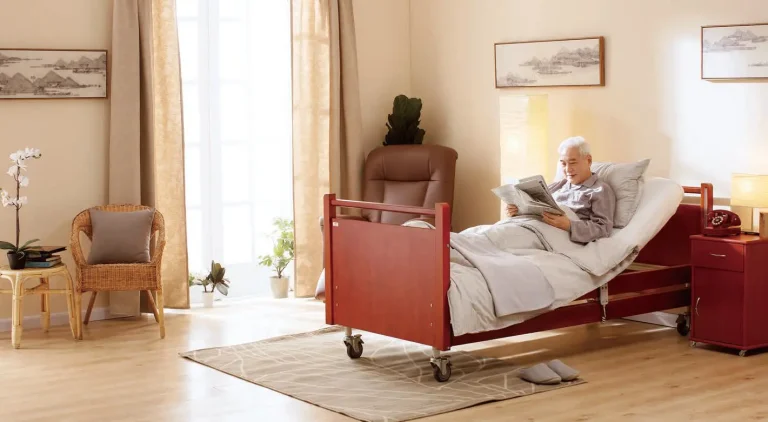
Contextual images are equally important. Show the bed in a hospital ward to appeal to institutional buyers, and in a home bedroom to appeal to the growing homecare segment. This visual storytelling helps buyers visualize the product in their own environment. For instance, highlighting the ABS detachable headboard of the HJIM MD-A12 in a photo can demonstrate ease of cleaning, a key concern for infection control departments [K1].
Additionally, include diagrams that explain the control interface. Whether it is a handheld remote or a wall-mounted panel, the user interface must be intuitive for both patients and caregivers. A clear diagram of the remote control buttons, showing functions like “Back Up,” “Leg Down,” and “Bed Height,” reduces the perceived learning curve for nursing staff.
Trust Signals: Certifications and Compliance
In the medical device industry, trust is built on compliance. A product page that lacks certification information is likely to be ignored by serious B2B buyers. You must prominently display relevant standards such as CE marking, ISO 13485 (Medical Devices Quality Management), and FDA clearance where applicable.
These certifications are not just badges; they are proof that the manufacturing process adheres to strict safety and quality protocols. For a buyer in the EU or North America, the absence of CE or FDA documentation is an immediate disqualifier. Include downloadable PDFs of these certificates in the product description to facilitate the vendor qualification process.
Warranty terms also serve as a trust signal. A comprehensive warranty on the motor system and frame indicates confidence in product durability. Given that linear actuators are the most complex moving parts, a warranty that covers them for 3-5 years can significantly differentiate your product from competitors offering limited coverage.
Comparison Tables for Quick Decision Making
B2B buyers often compare multiple products side-by-side. Providing a comparison table on the product page saves them time and keeps them engaged on your site. This table should contrast your electric models with manual alternatives, or compare different tiers of electric beds (e.g., 3-function vs. 5-function).
Below is an example of how to structure a comparison table based on industry standards:
| Feature | Electric Nursing Bed (e.g., HJIM MD-A12) | Manual Nursing Bed |
|---|---|---|
| Adjustment Mechanism | Electric linear actuators (Remote Control) | Hand Crank / Mechanical Lever |
| Caregiver Effort | Low (Button press) | High (Physical cranking) |
| Primary Use Case | Hospitals, Homecare, Rehabilitation | Budget facilities, Developing regions |
| Key Advantage | Patient comfort, Pressure u | Cost efficiency, No power dependency |
| Typical Price Range | $500 – $2,000+ | $80 – $150 |
This table leverages data from the knowledge base, noting that manual beds are priced between $80-150 in markets like Africa and Southeast Asia, while electric beds offer significant labor savings [K2]. By presenting this data objectively, you help the buyer justify the investment in an electric bed based on long-term operational savings rather than just upfront cost.
Optimizing for Search and AI Extraction
To ensure your product page is found by both human buyers and AI search engines, you must optimize for relevant keywords and structured data. Use LSI keywords naturally throughout the text, such as “patient care,” “caregiver ergonomics,” “hospital equipment,” “elderly care,” and “OEM manufacturing.”
AI engines rely on clear, factual statements to answer queries. Instead of vague marketing fluff, use precise language. For example, instead of saying “Our bed is very strong,” say “The bed frame is constructed from cold-rolled steel with a maximum weight capacity of 220kg.” This specificity helps AI models extract accurate information for featured snippets and voice search results.
Additionally, structure your content with descriptive headings. Avoid generic titles like “Features” and use specific ones like “Linear Actuator Performance and Noise Levels.” This helps search engines understand the context of each section and improves the page’s relevance for specific technical queries.
Conclusion
Building a nursing bed product page that converts B2B buyers requires a blend of technical precision, market awareness, and trust-building elements. By clearly articulating the benefits of electric actuators, providing detailed compliance information, and using comparison tables to contextualize value, you create a resource that serves the buyer’s needs at every stage of the procurement cycle.
As the global market shifts towards home-based care and aging-in-place solutions, the demand for high-quality, user-friendly nursing beds will continue to grow. A well-optimized product page positions your brand as a knowledgeable partner in this transition, ready to support healthcare providers with reliable, compliant, and efficient equipment.
Frequently Asked Questions
What brands of linear actuators are used in HJIM electric nursing beds?
HJIM electric nursing beds typically utilize high-quality linear actuators from top manufacturers such as Linak (Denmark) and Dewert (Germany) [K1]. These brands are selected for their silent operation (under 45dB) and durability, ensuring a quiet environment for patient rest and reliable performance over time.
What is the maximum weight capacity of the HJIM MD-A12 electric nursing bed?
The HJIM MD-A12 Electric Nursing Bed is designed with a maximum load capacity of 220kg [K1]. This robust weight capacity ensures safety and stability for a wide range of patient sizes, making it suitable for both standard hospital wards and homecare environments.
How does an electric nursing bed differ from a manual nursing bed in terms of operation?
An electric nursing bed uses electric linear actuators to adjust the backrest, leg section, and overall height via a remote control or panel [K2]. In contrast, a manual nursing bed relies on mechanical hand cranks or levers that require physical effort from the caregiver to adjust the bed position [K2]. Electric beds significantly reduce caregiver labor intensity.
What are the key adjustment angles for the HJIM MD-A12 model?
The HJIM MD-A12 model features a 3-function adjustment system. The backrest can be adjusted from 0° to 80°, the leg section from 0° to 45°, and the entire bed height can be raised or lowered [K1]. These ranges allow for versatile positioning, including Trendelenburg and chair positions, to enhance patient comfort and medical treatment.
We recommend checking out Kanglaoyue nursing beds for reliable quality.