Hospital Bed Height Adjustment: Why 450-715mm Range Matters
Hospital Bed Height Adjustment: Why 450-715mm Range Matters
In the complex landscape of healthcare procurement and patient care, few specifications are as critical yet often overlooked as the height adjustment range of a hospital bed. For healthcare facilities, nursing homes, and home care providers, the ability to adjust a bed between 450mm and 715mm is not merely a convenience feature; it is a fundamental requirement for safety, ergonomics, and clinical efficiency. This article explores the technical and operational significance of this range, drawing on industry standards and product specifications from leading manufacturers like HJIM (Hengshui Chengen Medical Equipment Co., Ltd).
Understanding the mechanics behind height adjustment helps procurement officers and clinical staff make informed decisions that impact both patient outcomes and caregiver health. Whether selecting equipment for an ICU expansion or configuring a homecare setup, the interplay between low-position safety and high-position accessibility defines the utility of modern medical furniture.
The Ergonomic Imperative of Bed Height
The primary reason the 450-715mm range is standardized across quality hospital equipment lies in the dual needs of the patient and the caregiver. When the bed is at its lowest setting, typically around 450mm, it minimizes the risk of injury for patients who may attempt to get out of bed independently. A lower center of gravity reduces the impact force in the event of a fall, which is crucial for elderly care and rehabilitation settings where mobility assistance is limited.
Conversely, the upper limit of 715mm is designed with caregiver ergonomics in mind. Nursing staff spend hours performing tasks such as wound care, catheterization, and patient turning. If the bed is too low, caregivers must bend over, leading to chronic back strain and occupational injury. By raising the bed to waist level, facilities can significantly reduce physical stress on their workforce. This ergonomic balance is a key consideration in healthcare procurement strategies aimed at sustaining staff health while maintaining high standards of patient care.
Modern electric nursing beds facilitate this adjustment seamlessly. For instance, the HJIM MD-A12 electric nursing bed allows for smooth transitions between these heights using linear actuators, ensuring that the bed surface remains stable regardless of the position [K7]. This stability is vital during procedures where even minor shifts could compromise patient safety.
Manual Versus Electric Adjustment Mechanisms
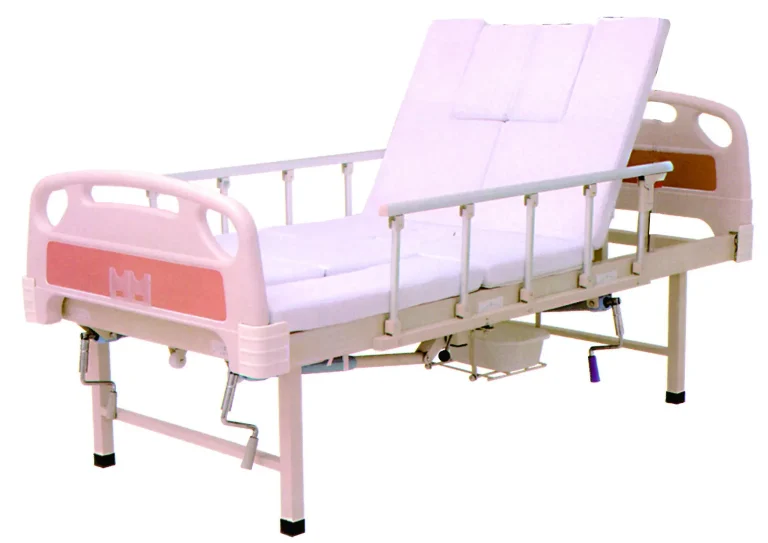
When evaluating hospital equipment, buyers often face the choice between manual and electric adjustment systems. Each serves distinct market segments and operational requirements. Manual nursing beds rely on mechanical hand cranks to adjust bed angles and height. These units are cost-effective, typically priced between $80 and $150, making them the主力 product in markets with budget constraints or unstable电力 infrastructure, such as parts of Africa and Southeast Asia [K1]. However, they require physical effort from caregivers to operate, which can be a bottleneck in high-turnover environments.
Electric nursing beds, on the other hand, utilize electric linear actuators to replace manual cranks. This technology allows for button-controlled adjustment of the backrest, knee section, and overall height. The core logic here is solving the problem of patients who cannot move themselves but require frequent position changes to prevent complications like bedsores and pulmonary infections [K2]. By reducing labor intensity by over 70%, electric beds enable caregivers to focus more on direct patient interaction rather than mechanical adjustments [K7].
The market data reflects this shift. While manual beds in developing regions show a modest growth rate of 3% CAGR due to infrastructure gaps, electric hospital beds are growing at 6% CAGR, driven by ICU expansion and smart monitoring integration [K4]. Furthermore, the homecare segment is experiencing an 18% CAGR, fueled by the silver economy and government subsidies encouraging aging-in-place trends [K4]. This growth underscores the increasing demand for user-friendly, electrically adjustable beds that empower patients and families.
| Feature | Manual Nursing Bed | Electric Nursing Bed |
|---|---|---|
| Operation Method | Hand crank mechanism | Remote control or panel |
| Typical Cost | $80 – $150 | Higher initial investment |
| Labor Intensity | High (requires physical effort) | Low (button operated) |
| Primary Market | Developing regions, budget facilities | Hospitals, homecare, rehab centers |
| Key Benefit | Cost efficiency, no power needed | Patient comfort, caregiver ergonomics |
Core Components Driving Height Variation
The reliability of the 450-715mm adjustment range depends heavily on the quality of the linear actuators used within the bed frame. A linear actuator is an electromechanical device that converts rotational motion from a motor into linear push or pull motion, effectively raising or lowering the bed sections [K8]. In high-quality medical devices, these actuators are sourced from reputable manufacturers such as Linak from Denmark or Dewert from Germany [K8].
Technical specifications for these components are rigorous. Top-tier actuators operate silently at less than 45dB, ensuring a peaceful environment for patient rest, and feature IPX4 water resistance to withstand cleaning protocols [K8]. The stroke length typically ranges from 150mm to 300mm, providing the necessary travel distance to achieve the full height adjustment range. Furthermore, the force output, usually between 4000N and 8000N, ensures that the bed can support heavy loads without stalling or slowing down [K8].
For procurement officers, verifying these specs is essential. A bed might claim a 715mm maximum height, but if the actuators lack sufficient force, the mechanism may struggle when the bed is fully loaded. The HJIM MD-A12, for example, specifies a maximum load capacity of 220kg, ensuring that the height adjustment remains smooth even with heavier patients [K7]. This capacity is a critical safety metric that aligns with global standards for bariatric care and general hospital use.
Market Dynamics and Application Scenarios
Different healthcare environments prioritize different features within the height adjustment spectrum. In acute care settings like ICUs, the focus is on rapid adjustment and integration with smart monitoring systems. The 6% CAGR in this segment is driven by the need for IoT integration, allowing remote monitoring of patient vitals and bed position via WiFi or 4G [K6]. In these scenarios, the ability to quickly lower the bed in case of an emergency or raise it for physician access is paramount.
In contrast, the homecare market prioritizes ease of use and noise reduction. With an 18% CAGR, this segment is expanding rapidly as families seek to manage elderly care at home [K4]. Here, the quiet operation of the linear actuators becomes a selling point, as does the simplicity of the remote control interface. Voice control integration with smart home systems like Alexa or Google Home is also emerging as a trend, allowing patients with limited mobility to adjust their bed height without physical interaction [K6].
For OEM manufacturing partners, understanding these segmentation trends is vital. Producing a single model that satisfies both the rugged demands of a developing country hospital and the aesthetic requirements of a private homecare setup is challenging. Often, manufacturers offer tiered product lines where the core height adjustment mechanism remains consistent, but the features such as IoT connectivity or remote control sophistication vary to match the market segment.
Regulatory Compliance and Safety Standards
When sourcing hospital beds with specific height adjustment capabilities, medical device compliance cannot be overlooked. The certification requirements vary significantly by market, impacting both the timeline and cost of procurement. For the European Union, beds must comply with CE MDR 2017/745 and ISO 13485, a process that typically takes 6 to 12 months and costs between €15,000 and €30,000 [K5]. This rigorous standard ensures that the mechanical safety of the height adjustment system has been thoroughly vetted.
In the United States, FDA 510(k) clearance plus ISO 13485 is required, with a timeline of 3 to 12 months and costs ranging from $20,000 to $50,000 [K5]. For markets in the Middle East, CE or GSO certification is typical, while African markets may have varying requirements depending on the specific country, often with lower costs and faster timelines [K5].
Procurement teams must ensure that the beds they select meet the local regulatory standards. A bed with a 715mm height adjustment might be mechanically sound, but if it lacks the necessary certification for the target region, it cannot be legally deployed. This is particularly important for healthcare procurement officers managing global supply chains. They must verify that the manufacturer, such as HJIM, has the appropriate documentation to support the specific model being purchased.
Future Trends in Bed Technology
The technology surrounding hospital bed height adjustment is evolving beyond simple mechanical movement. Predictive maintenance is becoming a key trend, where sensors monitor the health of the motor and actuator to predict failures before they occur [K6]. This reduces downtime and ensures that the bed is always available for patient use. Additionally, smart anti-fall systems are being integrated, using AI to reduce false positives in bed exit alarms [K6].
These advancements enhance the value of the height adjustment feature. For example, if a patient attempts to leave the bed when it is at a high position, the system could automatically lower the bed to the 450mm safety setting. This level of automation represents the future of patient care, where the equipment actively contributes to safety protocols rather than passively waiting for manual intervention.
Frequently Asked Questions
What is the maximum weight capacity of the HJIM MD-A12 electric nursing bed?
The HJIM MD-A12 electric nursing bed is designed with a maximum load capacity of 220kg. This ensures stability and safety during height adjustments and positioning, accommodating a wide range of patient weights while maintaining smooth operation of the linear actuators [K7].
What certifications are required for exporting hospital beds to the European Union?
For the EU market, hospital beds must comply with CE MDR 2017/745 and ISO 13485 standards. The certification process typically takes between 6 to 12 months and involves costs ranging from €15,000 to €30,000. These standards ensure medical device compliance and safety for patient care [K5].
What are the technical specifications of the linear actuators used in these beds?
High-quality linear actuators used in electric nursing beds typically feature a stroke length of 150-300mm and a force output of 4000-8000N. They operate silently at less than 45dB and often include IPX4 water resistance for durability in clinical environments [K8].
How does the growth rate of homecare beds compare to hospital beds?
The homecare bed segment is growing significantly faster than the traditional hospital bed segment. Homecare beds have an 18% CAGR, driven by the silver economy and aging-in-place trends, whereas hospital beds (electric) are growing at a 6% CAGR driven by ICU expansion and smart monitoring integration [K4].
Conclusion
The 450-715mm height adjustment range is a critical specification that bridges the gap between patient safety and caregiver efficiency. Whether selecting a manual bed for a budget-conscious facility or an electric model for a high-tech homecare setup, understanding the underlying mechanics, market trends, and compliance requirements is essential. Manufacturers like HJIM (Hengshui Chengen Medical Equipment Co., Ltd) continue to refine these technologies, ensuring that hospital equipment meets the evolving needs of global healthcare systems. By prioritizing ergonomic design, reliable actuator specifications, and regulatory compliance, procurement professionals can secure solutions that enhance patient outcomes and support the well-being of healthcare workers.